


Key Points and Summary – Born from embargo and urgency, Israel’s IAI Kfir (Lion Cub) married the Mirage airframe idea to an American J79 engine and local avionics, creating a tough multi-role fighter for strike, interception, and later precision attack.
-Entering Israeli service mid-1970s, Kfirs flew hard over Lebanon and along tense borders as fighter-bombers, then bowed out as F-15s and F-16s took center stage.
-Abroad, Kfirs served Colombia, Ecuador, and Sri Lanka—seeing combat and later receiving deep upgrades—while the U.S. Navy and Marines leased Kfirs as F-21A aggressors.
-Retired from Israeli front-line duty by the 1990s, the Kfir’s real legacy is resilience: a capable jet built under constraint that still shaped tactics, exports, and future designs.
-BONUS: National Security Journal visited a real IAI Kfir on the deck of USS Intrepid in New York Harbor. The pictures included in this article are from that visit on September 18, 2025.
IAI Kfir: The Fighter Israel Built When No One Would Sell One
The 1960s left Israel with two clear lessons. First, air superiority and quick-reaction strike were existential needs in a region where crises arrived with little warning. Second, access to foreign fighters could vanish overnight with politics. When a major order of French Mirages was caught in a post-1967 arms embargo, Jerusalem needed a fast, hard-hitting aircraft it could support without depending on France—and ideally with an engine and systems that wouldn’t be embargoed next.
That urgency birthed a tight brief: take a proven delta-wing concept that Israel already understood, integrate a non-French powerplant that delivered more thrust and logistics depth, fold in homegrown avionics and weapons, and produce an airframe suited to low-level strike, border interception, and hot-day, short-runway realities. The answer became Kfir—“lion cub”—a small name for a big bet on self-reliance.

IAI Kfir National Security Journal Photo.
From Mirage To Nesher To Kfir: The Origin Story
Kfir was not a tabula rasa. Israel’s starting point was the Mirage 5/Nesher lineage—simple, robust, and well-liked by Israeli pilots for its climb and point-and-shoot feel. The evolution moved in two brisk steps:
Nesher (first step): a Mirage-style jet built to Israeli specifications with local avionics and weapons integration.
Kfir (second step): the pivotal change—swap the French engine for the American J79 turbojet (used in the F-4 Phantom II), then re-engineer the airframe around that hotter, more powerful core. The result demanded new inlet geometry, cooling arrangements, and structural reinforcement—but delivered a serious jump in thrust-to-weight.
Kfir’s early C1 variant entered service in the mid-1970s. The C2 added dogtooth leading edges, pronounced strakes and canards—all to tame high-alpha handling, reduce approach speeds, and sharpen turn performance. The C7 pushed the concept further with more power, extra hardpoints, and better nav-attack systems, cementing the jet’s real job: fighter-bomber first, interceptor when needed.
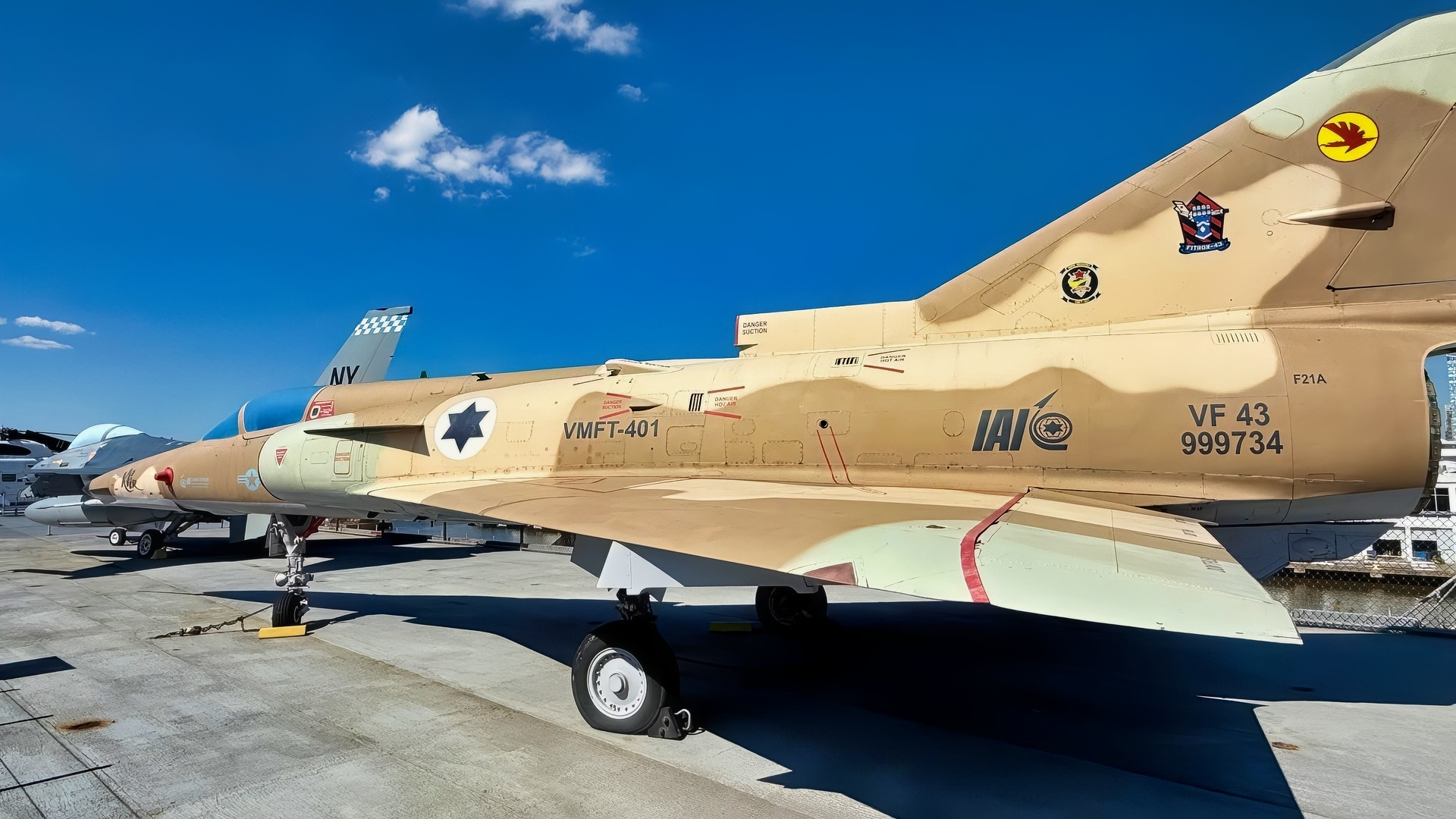
IAI Kfir Fighter Photo National Security Journal. Taken on September 18, 2025.
Design And Systems: Simple To Maintain, Tough To Fight
The Kfir’s delta planform kept the low-drag, high-altitude sprint strength of its Mirage ancestors, while the J79 and airframe tweaks improved hot-and-high performance and low-level punch. Israeli engineers emphasized:
Powerplant: the J79 provided reliable thrust, fast acceleration, and a friendly logistics tail thanks to U.S. production depth.
Aerodynamics: canards/strakes and a leading-edge dogtooth improved lift at slow speeds and high angles of attack—vital for short, hot runways and heavy strike loads.
Avionics: Israeli radios, navigation, and (later) radar solutions favored clarity and reliability. Over time, export upgrades added modern glass cockpits, helmet sights, and multi-mode radars.
Survivability: twin 30 mm DEFA cannon gave a last-ditch bite and a reliable strafing option, while later fits folded in RWR gear, chaff/flare, and podded ECM.
The emphasis wasn’t elegance; it was availability. Panels opened quickly, line-replaceable units were reachable, and squadron crews could turn jets fast between sorties.
Weapons Loadouts And The Growth Curve
Even early Kfirs carried what mattered: Shafrir-2 and later Python-3 short-range AAMs, iron bombs, and rockets. As experience piled up, the menu grew:
Air-To-Air: Python-3 and later Python-4/5 on export upgrades; some users added Derby for beyond-visual-range shots.

IAI Kfir Sideview. Image Taken By National Security Journal on September 18, 2025 on USS Intrepid flight deck.
Air-To-Ground: classic iron bombs; CBU munitions; later, laser-guided bombs with buddy-lasing or podded designation; AGM-65 Maverick on certain fits.
Pods & Avionics: nav-attack computers, targeting/recce pods, helmet-mounted sights on upgraded airframes, and modern multi-mode radars (e.g., EL/M-2032 family) on “Block 60/CE/COA Mk.2–style” refits.
Fuel & Endurance: supersonic tanks and conformal pylons let the jet carry useful fuel while filling the other stations with ordnance.
By the late 1980s, top-end Kfirs could fly at night and low weather, sling precision bombs, and still defend themselves with all-aspect heaters—respectable capability for a jet conceived under embargo.
Combat History In Israeli Hands: A Workhorse Over Lebanon
When the Kfir arrived, Israel was already pivoting to F-15s for air superiority and F-16s for flexible strike. That left Kfirs a clear niche: fighter-bomber. They flew:
Border interception and alert sorties where quick dash and cannon mattered.
Close air support and interdiction in the late 1970s.
High-tempo strike packages during Operation Litani (1978) and throughout the 1982 Lebanon War, hitting infrastructure, artillery, and SAM-related sites.
In these roles, Kfirs earned a reputation for ruggedness and turn-and-burn availability. Notably, Israeli Kfirs are not credited with air-to-air kills; by 1982, air-to-air dominance was largely the realm of F-15s and F-16s. That absence says less about the Kfir’s ability and more about Israeli tasking: give the mud-moving and interdiction to a fast, sturdy delta; send the fighters to the fighters.
Service Beyond Israel: From Aggressor Squadrons To Shooting Wars
If Israel’s combat use was mostly strike, foreign operators showed the Kfir’s range.
United States: The F-21A Aggressor
In the mid-1980s, the U.S. Navy and Marine Corps leased Kfirs as the F-21A for adversary training. The jet’s acceleration, small planform, and delta handling let instructors simulate Soviet-style threats, forcing blue-air pilots to respect energy management and off-boresight shots. That stint cemented the Kfir’s training value; decades later, private contractors would again fly upgraded Kfirs as red air over U.S. ranges.
Colombia: From Counterinsurgency To Precision Strike
Colombia adopted and later deeply upgraded Kfirs—new radar, helmet sights, precision munitions—to prosecute long-range strikes against insurgent camps and high-value targets. The combination of range, payload, and modern sensors made the jet a cost-effective strategic tool in a tough theater. The fleet remained active into the 2020s before being stood down as air force plans pivoted to a newer type.
Ecuador: A Hot Border And An Air-To-Air Kill
Ecuador’s Kfirs flew combat during the 1995 Cenepa conflict against Peru, mixing air defense with ground attack in the Andes. Ecuador credits its Kfirs with at least one air-to-air victory during the brief but intense campaign, underscoring that a well-flown, heater-armed delta could still be deadly in a turning fight.
Sri Lanka: Long, Grinding Wars At Low Altitude
Sri Lanka turned to Kfirs in the 1990s for strike and interdiction during the civil war against the LTTE. The jets delivered dumb and precision ordnance from rough coastal weather to jungle interiors, a reminder that aircraft born in Cold War state-on-state planning often end up doing COIN and counter-terror work.
Others And The Second Career
Several nations evaluated but did not buy; others flew small numbers. In the jet’s later life, adversary support companies acquired Kfirs for contract red air in the United States—proof that the airframe still offers the right blend of speed, climb, and maintenance simplicity for high-sortie training.
Israeli Retirement: Mission Accomplished, Hand Off The Baton
As the 1980s closed, the Kfir had done the job Israel asked of it: bridge the embargo gap, fly daily strike, and leave air-to-air heroics to Eagles and Vipers. Precision weapons, advanced EW, and multirole flexibility kept drifting toward the F-16. By the mid-1990s, the Israeli Air Force retired its Kfirs from front-line service, with a few continued in test and training roles before final phase-out.
The calculus was simple: the airframes had miles on them; the fleet had standardized on types with deeper U.S. logistics and larger growth curves.
What The Kfir Taught—And The Legacy It Left
1) Make Constraints Your Design Brief. Kfir proved that embargo does not have to equal inferiority. By picking a widely supported engine (J79) and focusing on maintainable systems, Israel fielded a jet that was good enough where it mattered, fast.
2) Airframe + Engine ≠ Copy; It’s Integration. The J79 swap wasn’t a drop-in; it forced re-thinking inlets, cooling, and structure—the kind of systems integration that builds industrial competence. That competence later showed up in more ambitious Israeli programs.
3) Fighter-Bombers Win By Availability. In Israeli service the Kfir’s combat worth was sorties per day, turn time, and ruggedness. In tough wars, the jet on the line at 0600 often matters more than the jet that can do one more trick at 1% of scenarios.
4) Upgrades Beat Obsolescence—For A While. Export Kfirs demonstrated how far avionics refresh can stretch an old airframe: modern radar, HMD, precision weapons, and better self-protection kept the aircraft tactically useful into the 2010s.
5) Adversary Training Is A Second Life. As an aggressor, the Kfir helped teach generations of pilots how to fight small, fast, low-drag opponents—arguably as influential as its combat sorties.
6) A Quiet Influence On Other Designs. South Africa’s Cheetah modernization lineage drew on Israeli know-how from the Kfir program; Israeli Python/Derby missile families matured in part on jets like Kfir before spreading to other platforms. In that sense, Kfir was both a fighter and a flying lab.
Capabilities In Context: Strengths And Limits
The Kfir’s strengths were clear: fast acceleration, sturdy delta for low-level ingress, good payload for its size, and simple maintenance. With canards and strakes, later variants felt far less “Mirage-slippery” at slow speed, and with an internal gun plus high-off-boresight heaters, upgraded Kfirs could surprise complacent opponents.
The limits were just as real: deltas bleed energy in sustained turn; the J79’s fuel thirst could make long-endurance CAPs a tanker tax; and the airframe’s growth margin could only absorb so much radar, wiring, and EW before newer designs simply did more for less effort. Israel recognized those facts and moved on—exactly when it should have.
A Measured Verdict: The Right Jet At The Right Time
Kfir will never be confused with the air-dominance icons of its era, and that’s fine: it wasn’t built to win air shows; it was built to win schedules and survive budgets. It gave Israel breathing space at a moment when no one would sell a frontline fighter, kept the strike mission humming while F-15s and F-16s matured, and left behind a web of export users who proved the jet’s utility and adaptability. It also trained U.S. and allied pilots to respect small profiles and quick deltas—lessons that still echo on today’s ranges.
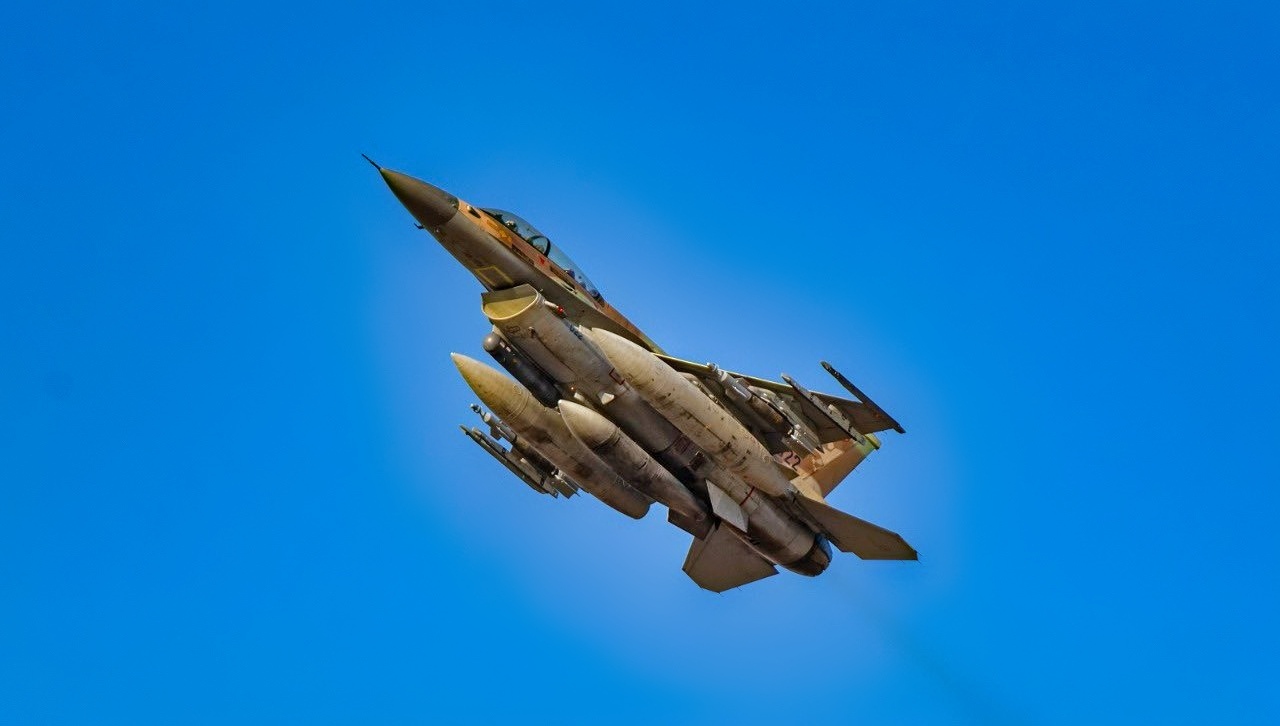
F-16I from Israeli Air Force. Image Credit: Creative Commons.
For a fighter designed under duress, that’s an enviable résumé. The Kfir’s legacy is pragmatic and proud: do the job, keep flying, and make tomorrow’s jets—and pilots—better than yesterday’s.
About the Author: Harry J. Kazianis
Harry J. Kazianis (@Grecianformula) is Editor-In-Chief and President of National Security Journal. He was the former Senior Director of National Security Affairs at the Center for the National Interest (CFTNI), a foreign policy think tank founded by Richard Nixon based in Washington, DC. Harry has over a decade of experience in think tanks and national security publishing. His ideas have been published in the NY Times, The Washington Post, The Wall Street Journal, CNN, and many other outlets worldwide. He has held positions at CSIS, the Heritage Foundation, the University of Nottingham, and several other institutions related to national security research and studies. He is the former Executive Editor of the National Interest and the Diplomat. He holds a Master’s degree focusing on international affairs from Harvard University.
More Military
F-16XL Was the Plane the Air Force Wouldn’t Fly
NATO-Russia War of 2025: It Won’t Be Pretty
K3: The ‘Stealth’ Tank That Looks Like a B-21 Raider and Runs on Hydrogen
The U.S. Navy’s Ohio-Class SSGN Submarines Summed Up in 1 Word


