


Key Points and Summary – General Atomics’ LongShot, funded by DARPA, is an air-launched unmanned vehicle designed to carry and fire existing air-to-air missiles from standoff range.
-Deployed from fighters or internally from bombers—and potentially palletized for cargo aircraft via the Air Force’s Rapid Dragon concept—LongShot aims to “multiply” a single manned jet into several shooters, complicating enemy air defenses.
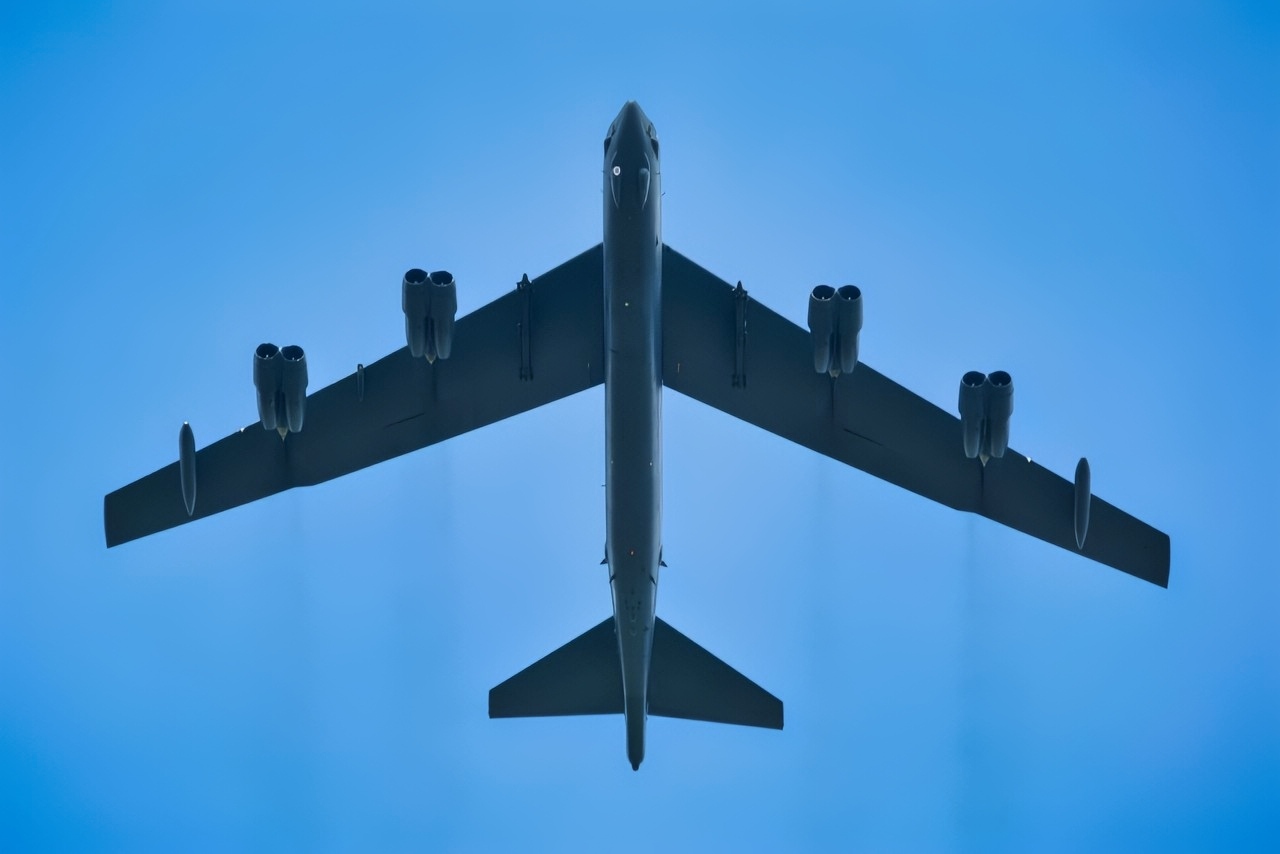
Military service members, veterans, and citizens of Guam gathered for the Memorial Day Commemoration at the Guam Veterans Cemetery. The Ceremony consisted of a fly over from a B-52H Stratofortress, a musical performance from the Guam Territorial Band & Cantate, guest speaking from the honorable Eddie Baza Calvo, a Fallen Soldier Gravesite Tribute, and the playing of Taps. (U.S. Marine Corps photo by Lance Cpl. Jacob Snouffer/Released)
-DARPA highlights a fuel-efficient ingress profile, then high-energy missile endgames, and is tackling challenges like launching AAMs from a small UAV in operational conditions.
-If fielded, LongShot could transform transports into arsenal aircraft and give fourth- and fifth-gen fleets massed, survivable, and affordable reach.
The LongShot Munition Looks Like a Big Deal
The small Loyal Wingman-type drone has the potential to transform cargo planes into flying arsenals, bringing a substantial amount of mass to a fight.
Images from General Atomics provide a preview of their LongShot stand-in, standoff munition, which is currently in development thanks to an award from the Defense Research Projects Agency, better known by its acronym, DARPA. That always-mysterious organization, DARPA’s LongShot information page, offers scant information about what LongShot is and what it hopes to achieve.
“The objective of the LongShot program is to disrupt the paradigm of air combat operations by demonstrating an unmanned air-launched vehicle capable of employing current air-to-air weapons, significantly increasing engagement range and mission effectiveness,” DARPA writes. “The program will design, fabricate, and flight test a demonstration system to prove the feasibility of the LongShot concept.”
The idea is simple: LongShot-toting aircraft, whether bombers carrying dozens of the UAVs or fighters carrying several LongShots each, act as force multipliers thanks to the mass they bring to an aerial fight. Previous artwork from General Atomics shows a couple of pairs of LongShots seemingly launched from F-15 aircraft. Two of the LongShot aircraft have their own bomb bays open, seemingly launching munitions that appear to be air-to-air missiles at far-distant targets.
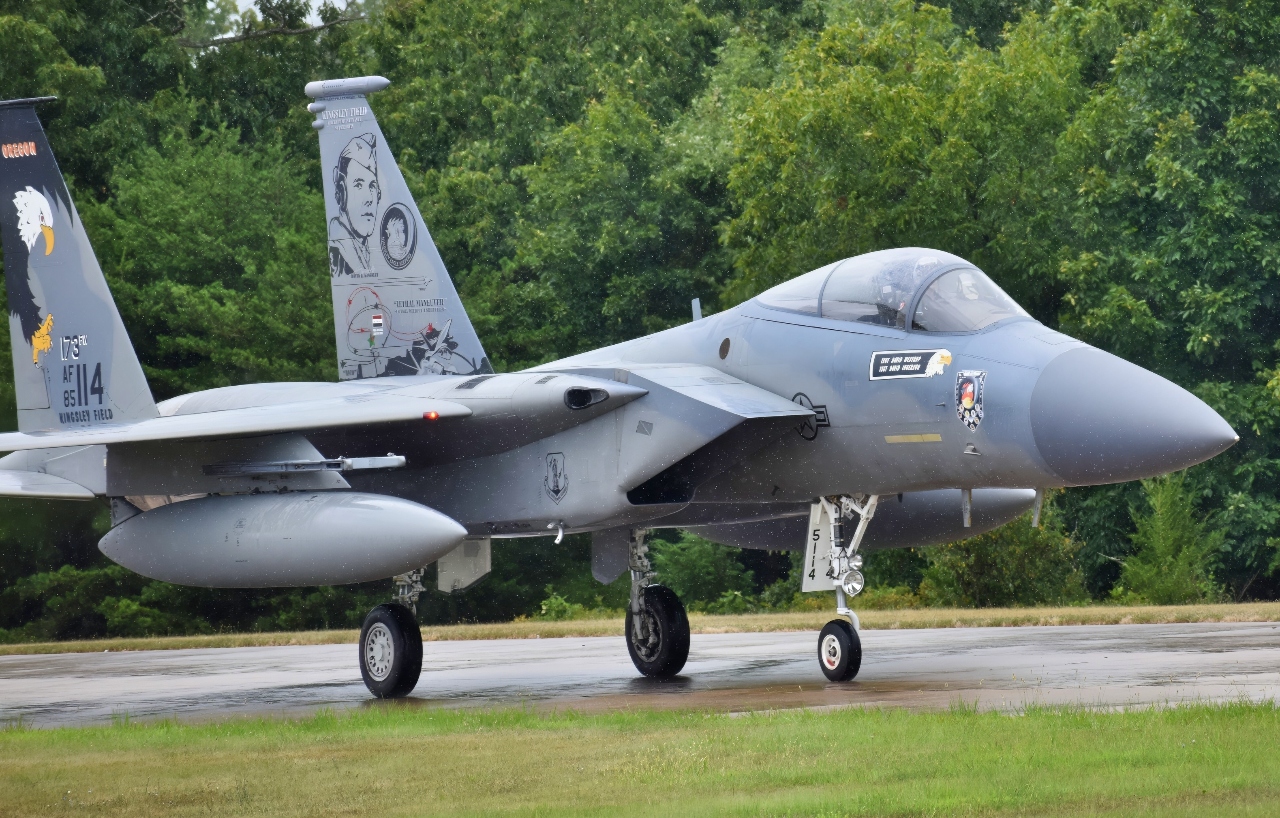
F-15C Fighter on the Tarmac. Image Credit: National Security Journal. Taken on August 13, 2025.
In this capacity, operating with manned warplanes in a manned-unmanned teaming style, LongShots offer adversaries a much more complex picture of the battle space, one that is made much more deadly by the force-multiplying effects of one armed fighter jet turning into three armed aircraft, two unmanned, and perhaps more expendable and risk-tolerant than a pilot would be.
“The LongShot program is developing and flight demonstrating an air-launched system capable of engaging multiple adversary targets from standoff ranges using existing air-to-air missiles. LongShot will be deployed either externally from existing fighters or internally from existing bombers,” DARPA’s budget request for Fiscal Year 2026 reads.
“This system will capitalize on a slower speed, fuel-efficient air vehicle for ingress, while retaining highly energetic air-to-air missiles for end-game target engagements, which provides several key benefits that increase weapon effectiveness,” the budget documentation adds. “This program will address the stability and control challenges of launching air-to-air missiles from a relatively small uninhabited system in an operational environment. Potential transition partners include the Navy and Air Force.”
Though there are obvious applications for LongShot to manned fighter jets, including the fourth-generation fleet of F-16s and F-15s, as well as fifth-generation aircraft like the F-35 and F-22, and future sixth-generation aircraft, there are more immediate applications for much larger aircraft like transport aircraft, with the potential to turn the fleets of unarmed cargo aircraft into heavily-armed, long-range combat aircraft.
The Cargo Bomber
Cargo aircraft typically haul dozens of tons of equipment, ammunition, and other war materiel long distances for use by troops on the ground. Less typical are transport planes armed with potent offensive weapons — but that is a future that could be just over the horizon.
“There is a next generation of UAS that is under work that is much, much more survivable, much more autonomous, much more cognitive,” Mike Atwood, the Vice President of Advanced Aircraft Programs at General Atomics, said on an episode of The Merge, a podcast, last summer.
“It lives inside the DARPA LongShot program … We can’t talk too much turkey on it, but it’s essentially taking all the principles that we’ve talked about today to I think an extreme—affordability, survivability, and cognitive autonomy—and it’s exciting.” Though scant on the details, the affordability and mass aspect of LongShot lend themselves well to one of the Air Force’s projects.
As a part of the United States Air Force’s Rapid Dragon project, standardized pallets of cargo are transformed into cases of long-range standoff munitions and dropped from the cargo bays of transport aircraft. “Rapid Dragon could ultimately lead to a roll-on, roll-off system that transforms mobility aircraft into lethal strike platforms that augment the strike capacity of tactical fighters and strategic bombers,” the Air Force Research Laboratory explains.
“The retargeting methodology used is transferrable to other strike and cargo platforms, potentially increasing lethality of all JASSM-capable strike assets. These new capabilities can provide combatant commanders additional flexibility to prosecute targets en-masse in the high-end fight, thus changing the adversary’s calculus in an increasingly complicated and dynamic near-peer conflict.”
Photos made from some Rapid Dragon flight tests show “JASSM-ER simulants” in quadruple packs dropping out of the back of various cargo aircraft. The Air Force Research Laboratory has previously written that once Rapid Dragon has been refined and operations with JASSM-ER munitions are validated, “a follow-on program will look at expanding the Rapid Dragon portfolio to include additional weapon systems and multiple effects capabilities.” Although those tests used “simulants,” the technique could be easily used to palletize LongShot munitions in the future.
What Next for LongShot?
Although scant details are known about General Atomics’ LongShot, including how it might be used or with which aircraft it will be paired, more information about the innovative UAV may be forthcoming from DARPA and General Atomics in the future.
About the Author: Caleb Larson
Caleb Larson is an American multiformat journalist based in Berlin, Germany. His work covers the intersection of conflict and society, focusing on American foreign policy and European security. He has reported from Germany, Russia, and the United States. Most recently, he covered the war in Ukraine, reporting extensively on the war’s shifting battle lines from Donbas and writing on the war’s civilian and humanitarian toll. Previously, he worked as a Defense Reporter for POLITICO Europe. You can follow his latest work on X.
More Military
‘Built for the Impossible Missions’: The A-29 Super Tucano’s Secret Is Out
The J-20A Stealth Fighter: Better Than F-22?
KC-46: The Air Force’s Most Important Plane for a Reason
The F-15EX Eagle Doesn’t Need to Be Stealth
China’s J-20S Stealth Fighter: Just an F-22 or F-35 Copy? Nope.


