


Key Points and Summary – The X-51 Waverider’s 2013 flight—air-launched from a B-52 and accelerating to Mach 5.1—remains the longest air-breathing hypersonic run on record and a pivot point for U.S. hypersonics.
-Its scramjet data validated propulsion, heating, and boundary-layer models that now inform programs like HAWC and the Hypersonic Attack Cruise Missile (HACM), expected to exceed Mach 5 over 300 nm.

X-51A Waverider. Image Credit: Creative Commons.
-The X-51 also spotlighted core hurdles: extreme thermal loads, materials that survive sustained heating, and keeping airflow laminar enough for stable guidance.
-A decade later, its lessons drive propulsion, TPS materials, and integration work that move hypersonic cruise weapons from demo to deployable.
The X-51 Waverider Explained
Waverider’s 2013 flight—air-launched from a B-52 and accelerating to Mach 5.1—remains the longest air-breathing hypersonic run on record and a pivot point for U.S. hypersonics.
Its scramjet data validated propulsion, heating, and boundary-layer models that now inform programs like HAWC and the Hypersonic Attack Cruise Missile (HACM), expected to exceed Mach 5 over 300 nm.
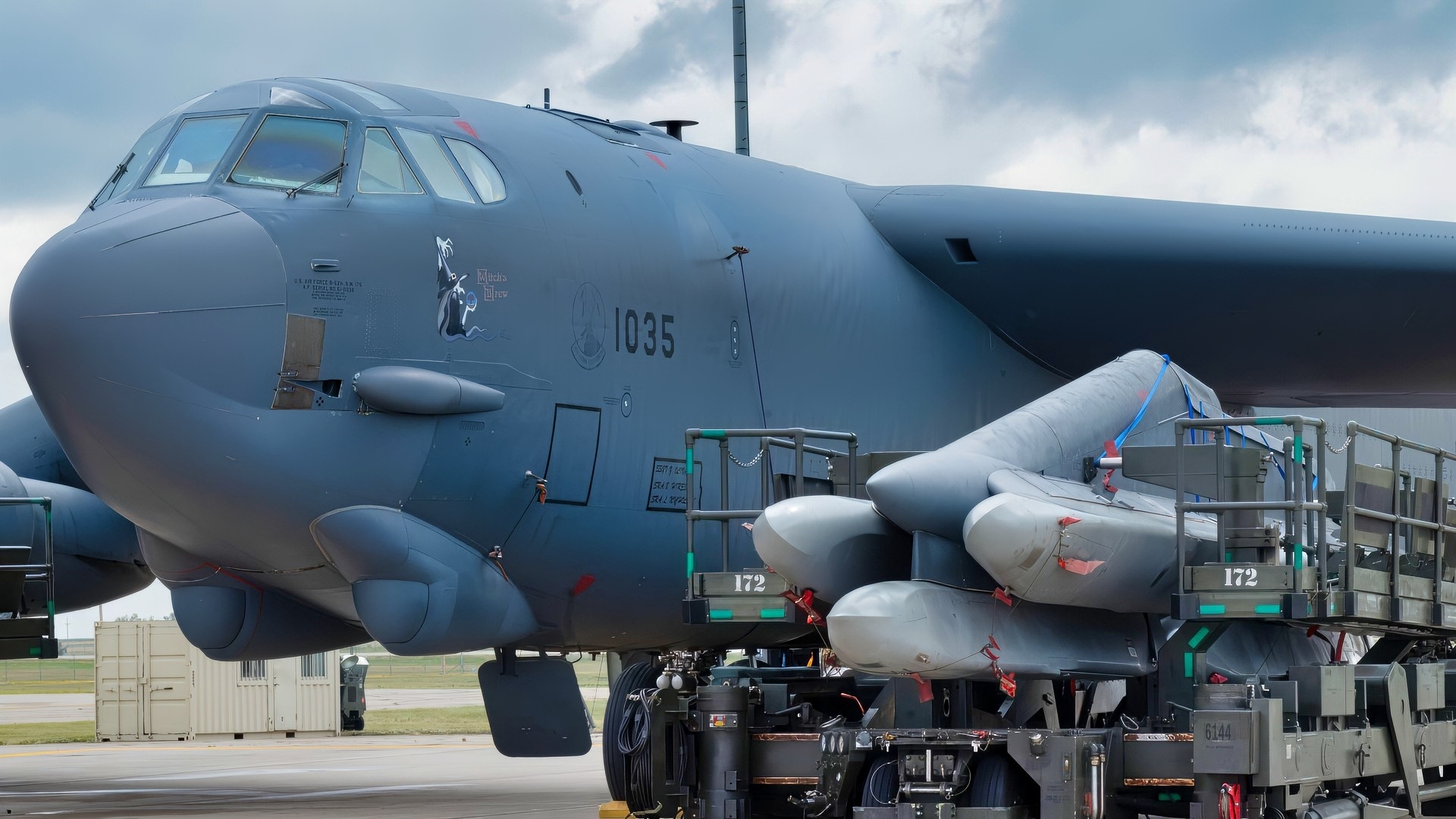
A B-52H Stratofortress sits on the flightline before a munitions load operation at Minot Air Force Base, North Dakota, Sept 5, 2025. The base-wide readiness exercise tested the wing’s ability to generate aircraft, conduct security operations and respond to challenging scenarios. (U.S. Air Force photo by Airman 1st Class Vincent Padilla)

A U.S. Air Force B-52H Stratofortress assigned to the 23rd Bomb Squadron sits on the flightline during exercise Prairie Vigilance 25-1 at Minot Air Force Base, North Dakota, April 12, 2025. Vigilance series exercises are conducted with a focus on the safe and secure handling of equipment. (U.S. Air Force photo by Senior Airman Kyle Wilson)
The X-51 also spotlighted core hurdles: extreme thermal loads, materials that survive sustained heating, and keeping airflow laminar enough for stable guidance.
A decade later, its lessons drive propulsion, TPS materials, and integration work that move hypersonic cruise weapons from demo to deployable.
As hypersonic weapons continue to break through to new levels of operational capability, many military analysts are likely to recall the defining accomplishments of the X-51 Waverider.
This scramjet-powered hypersonic vehicle launched from a B-52 to achieve speeds of Mach 5 before falling into the ocean.
The X-51 Waverider in 2013 flew above the Pacific Ocean at hypersonic speeds—an event that the passage of time now reveals as a defining moment in the development of U.S. hypersonics.
The X-51 Waverider air vehicle used a scramjet engine to propel itself after launching from a U.S. Air Force B-52. After several failed experiments preceding this flight, the scramjet was able to achieve speeds of Mach 5.
X-51 Breakthrough
At that speed—about 3,400 miles per hour—a missile could travel from Washington, D.C., to Atlanta in several minutes.
The speed alone makes such a vehicle a potentially powerful weapon against enemy air defenses.
Achieving hypersonic flight for any period of time, particularly in 2013, can be regarded as a significant breakthrough.
Much progress has been made to address the challenges associated with sustaining hypersonic flight, and much of that progress can be directly tied to the pioneering success of the X-51 Waverider.
The X-51A’s flight occurred more than 10 years ago, but it is still the longest air-breathing hypersonic flight ever recorded.
The specifics are important. The X-51 flew on the wing of a B-52H before being released at 50,000 feet of altitude. Amazingly, the aircraft was able to accelerate to speeds of Mach 4.8 in 26 seconds, before ultimately reaching Mach 5.1.
Although the X-51 crashed into the ocean, as it was designed to do, the platform sent back crucial data that proved critical to the scientific advancement of hypersonic flight.
Hypersonic Attack Cruise Missile
New scramjet-propelled weapons have built upon the technology pioneered by the X-51 Waverider.
The Hypersonic Attack Cruise Missile (HACM) now in development, for example, will build on the successful tests of its precursor, the Hypersonic Air Breathing Weapon Concept (HAWC).
Built by Raytheon with a Northrop Grumman scramjet, the HAWC was successfully tested in 2022. Once operational, the HACM will be able to travel 300 nautical miles at speeds over Mach 5.
The complexity of hypersonic flight is well known to Pentagon weapons developers. One factor is temperature: Hypersonic projectiles or platforms need to be built with composite materials capable of operating at the extreme temperatures generated by travel at hypersonic speed.
Thermal management becomes critical to maintaining flight stability, which is one reason developers continue to experiment with various combinations of materials.
For several years now, scientists at the Army Research Laboratory have been researching different combinations of composites in anticipation of discovering new heat-resistant materials.
Heat management of a hypersonic vehicle affects other aerodynamic variables, such as the flow of the air-boundary layer surrounding hypersonic projectiles.
Weapons developers hope to engineer a projectile able to generate a smooth, or “laminar” air boundary.
This is because turbulent airflow can move particles at high temperatures in the air surrounding the weapon, derailing its flight trajectory and throwing it off course toward its target.
About the Author: Kris Osborn
Kris Osborn is the President of Warrior Maven – Center for Military Modernization. Osborn previously served at the Pentagon as a highly qualified expert in the Office of the Assistant Secretary of the Army—Acquisition, Logistics & Technology. Osborn has also worked as an anchor and on-air military specialist at national TV networks. He has appeared as a guest military expert on Fox News, MSNBC, The Military Channel, and The History Channel. He also has a Masters Degree in Comparative Literature from Columbia University.
More Military
Why the U.S. Navy Finally Said No to the F-14 Tomcat
Israel’s Merkava Tanks Have a Message for Any Army On Earth
The Mach 1.4 X-59 Could Create Military Nightmares for Russia and China


bis-biss
November 1, 2025 at 11:23 am
X-51A really or truly at the end of the day, was a nothingburger.
Majority of its flights were duds, and when it actually flew, the flight was measured in number of seconds. Not much else.
Compare it to the feitian.
Feitian made it through, from low mach 5 to high mach 12.