


Key Points and Summary – The U.S. Navy’s abrupt decision to effectively kill the Constellation-class frigate program after just two ships is more than another acquisition failure—it’s an indictment of America’s naval industrial system.
-A design sold as “low risk” collapsed under requirements creep, workforce shortages, fragile suppliers, and unrealistic timelines.

Arleigh Burke-class guided-missile destroyer USS Michael Murphy (DDG 112) sails alongside Nimitz-class aircraft carrier USS Abraham Lincoln (CVN 72) on Dec. 8, 2025. USS Abraham Lincoln (CVN 72), flagship of the Abraham Lincoln Carrier Strike Group, is underway conducting routine operations in the U.S. 7th Fleet area of operations, demonstrating the U.S. Navy’s long-term commitment to a free and open Indo-Pacific. (U.S. Navy photo by Mass Communication Specialist 3rd Class Nathaly Cruz)

The aircraft carrier USS Nimitz (CVN 68) arrives at Joint Base Pearl Harbor-Hickam, Hawaii, for a scheduled port visit Dec. 3, 2013. The Nimitz was in the process of returning to its home port, Everett, Wash., following an eight-month deployment to the U.S. 5th Fleet, U.S. 6th Fleet and U.S. 7th Fleet areas of responsibility. (U.S. Navy photo by Mass Communication Specialist Seaman Apprentice Rose Forest/Released)

An F/A-18F Super Hornet, attached to Strike Fighter Squadron (VFA) 195, taxis on the flight deck of Nimitz-class aircraft carrier USS George Washington (CVN 73) while underway in the Celebes Sea, Nov. 29, 2025. George Washington is the U.S. Navy’s premier forward-deployed aircraft carrier, a long-standing symbol of the United States’ commitment to maintaining a free and open Indo-Pacific region, while operating alongside allies and partners across the U.S. Navy’s largest numbered fleet. (U.S. Navy photo by Mass Communication Specialist 2nd Class Tyler Crowley)
-The result is a growing gap between U.S. maritime strategy and the fleet needed to execute it, even as China better aligns shipbuilding with its ambitions.
-This piece argues that unless Washington rebuilds industrial depth and discipline, American sea power will slowly give way—not in wargame slides, but on the slips and drydocks that matter.
-America once built warships with industrial confidence. Its shipbuilding prowess intimidated rivals and reassured allies.
The U.S. Navy’s Warship Crisis
That era feels distant now. The abrupt decision to effectively terminate the Constellation-class frigate program—marketed for years as the Navy’s return to disciplined, low-risk design—after two ships exposes a deeper truth that can no longer be brushed aside. The Navy is struggling not with one failed ship class, but with a procurement system that cannot reliably deliver even the ships it claims are essential to its future force.

PACIFIC OCEAN (Oct. 1, 2024) The Independence-class littoral combat ship USS Mobile (LCS 26) comes alongside the Nimitz-class aircraft carrier USS Theodore Roosevelt (CVN 71) for a fueling-at-sea, Oct. 1, 2024. Theodore Roosevelt, flagship of Carrier Strike Group 9, is underway conducting routine operations in the U.S. 3rd Fleet area of operations. An integral part of U.S. Pacific Fleet, U.S. 3rd Fleet operates naval forces in the Indo-Pacific and provides he realistic, relevant training necessary to execute the U.S. Navy’s role across the full spectrum of military operations – from combat operations to humanitarian assistance and disaster relief. U.S. 3rd Fleet works together with our allies and partners to advance freedom of navigation, the rule of law, and other principles that underpin security for the Indo-Pacific region. (U.S. Navy photo by Mass Communication Specialist 3rd Class Richard Tinker)
The Constellation-class was supposed to be a corrective after the Littoral Combat Ship debacle and the Zumwalt-class’ slow-motion collapse. By grounding the design in a proven European frigate already serving NATO allies, the Navy signaled it had learned its lesson: It would simply build a modern combatant based on a stable, mature foundation. Instead, the program stalled, slipped, and finally imploded. A supposedly low-risk platform ended up showing that even seemingly straightforward programs now buckle under the weight of U.S. naval procurement.
A System That Produces Failure on Schedule
The Constellation’s undoing does not mean the U.S. industrial base has collapsed wholesale. Submarines continue to be delivered, the Arleigh Burke line still turns out destroyers, and several yards retain real capability.
But these successes now coexist with unmistakable signs of a systemic doom loop: workforce shortages that delay schedules, fragile suppliers unable to handle demand spikes, capacity limits that pile up backlogs, and a procurement bureaucracy that repeatedly asks industry to do more—and to do it faster—than its current condition allows.
The Navy’s surface fleet has not brought a major new combatant class online in years without significant controversy, delay, or redesign. Promising designs are weighed down by requirements creep, integration challenges, and unrealistic timelines that almost guarantee disappointment. The Constellation’s parent design works. What failed was the U.S. system. No amount of optimistic briefing-room rhetoric can disguise that fact.
Strategy That Floats Free of Machinery
Washington continues to speak as if the United States commands a maritime industrial base capable of sustaining Indo-Pacific deterrence, forward presence, and distributed maritime operations. But the fleet charged with carrying out those missions is aging, overstretched, and overwhelmingly dependent on ships conceived before the turn of the century.
The gap between strategy and machinery is widening.
The Navy’s confused messaging on fleet size reflects this reality. The once untouchable 355-ship goal has dissolved into ambiguity, replaced by shifting, non-committal force structures that bear little relationship to what the industrial base can build.
Instead of grounding strategy in industrial capacity, Washington continues to backfill capacity into a strategy it cannot credibly implement.
The effective termination of the Constellation-class frigate blows a hole in a structure that was already shaky. It widens the gap between destroyers and small combatants, extends reliance on aging Arleigh Burkes, and forces an already overextended fleet to stretch further—and the demands on it were already rising.
The Industrial Base We Pretend Exists
The United States says it intends to compete with China for control of the world’s oceans. But competition requires physical machinery: ships launched on schedule, in sufficient numbers, and sustained at scale.
U.S. shipyards face persistent backlogs and maintenance delays, and its workforce cannot keep pace with demand. None of these issues is new, but all of them are getting worse.
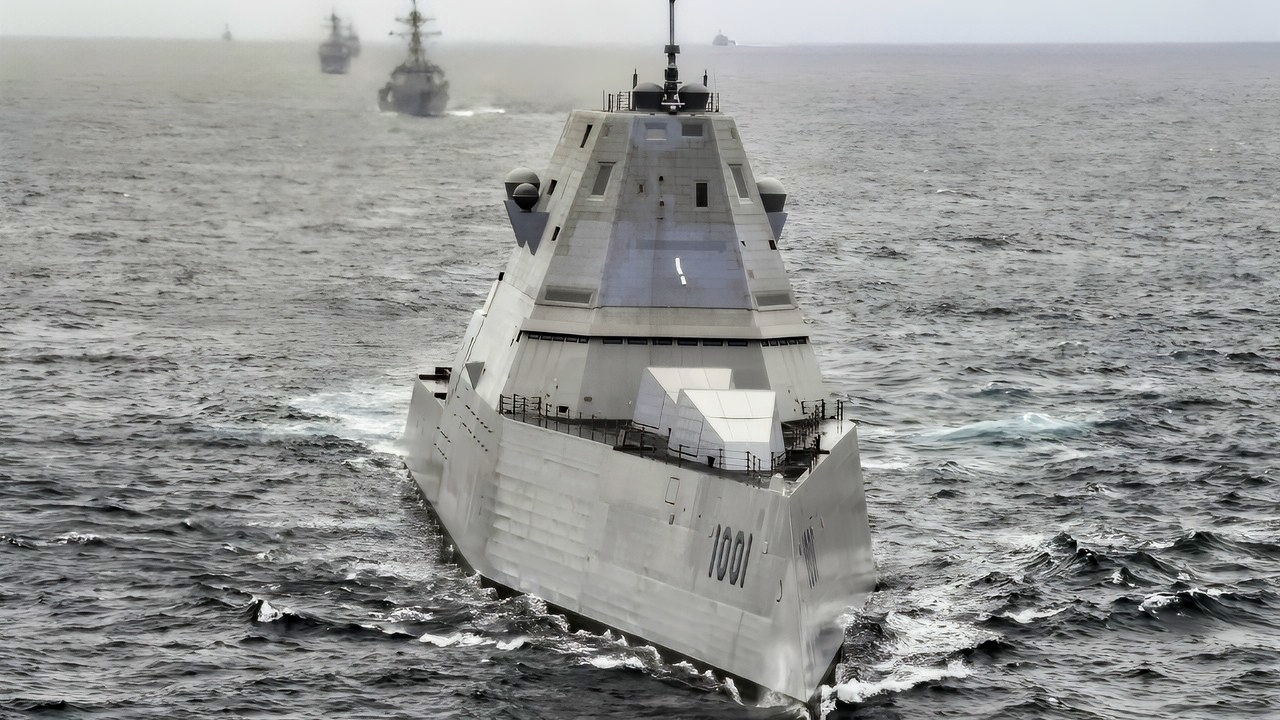
(April 21, 2021) The Zumwalt-class guided-missile destroyer USS Michael Monsoor (DDG 1001) leads a formation including the Arleigh Burke-class guided missile destroyers USS Fitzgerald (DDG 62), USS Spruance (DDG 111), USS Pinckney (91), and USS Kidd (DDG 100), and the Independence-variant littoral combat ship USS Coronado (LCS 4) during U.S. Pacific Fleet’s Unmanned Systems Integrated Battle Problem (UxS IBP) 21, April 21. UxS IBP 21 integrates manned and unmanned capabilities into challenging operational scenarios to generate warfighting advantages. (U.S. Navy photo by Chief Mass Communication Specialist Shannon Renfroe)
This does not mean U.S. shipbuilding is dead. But the system is fragile, and that fragility is now the central risk for U.S. naval power. The Navy must align its ambitions with the industrial base it actually possesses, not the one imagined in strategy documents.
Public data on Chinese shipbuilding is incomplete, but the trend is clear. Beijing is tightening the coherence between strategy and industrial output, while the U.S. system drifts.
The Constellation program should have demonstrated that a mature, modestly adapted design could be delivered predictably. Instead, it proved that even simple programs are vulnerable to the unrealistic expectations and institutional strain that have plagued American naval construction for two decades.
Rebuild or Retreat
Washington can continue pretending that failures such as the Constellation are isolated misfortunes, or it can recognize what this latest collapse reveals. This frigate was not a moonshot. It was precisely the kind of grounded, sensible program the Navy claims it wants—and the system still could not deliver it.
That is not a technical mishap. It is glaring evidence of a procurement and industrial ecosystem that has lost the predictability on which maritime power depends.
Either the United States restores industrial depth—through stable funding, disciplined requirements, integrated supplier networks, and a revitalized workforce—or it quietly accepts that its ability to project and sustain naval power will diminish.
A maritime power that cannot align its ambitions with its industrial reality becomes a maritime power in name only. Until Washington confronts that fact, the Navy’s plans will continue to contract, rivals will continue to build, and American sea power will continue to drift toward a future shaped by others.
About the Author: Dr. Andrew Latham
Andrew Latham is a non-resident fellow at Defense Priorities and a professor of international relations and political theory at Macalester College in Saint Paul, MN. You can follow him on X: @aakatham. He writes a daily column for the National Security Journal.


Kevin Rogers
November 29, 2025 at 3:26 am
My grandson, who’s 14 and has the mathematical aptitude to become a machinist, or similar trade, but can’t find a technical training program despite living a few miles from the Portsmouth Naval Shipyard.
It appears that the manufacturing crisis has reached the level where we’re going to have to draft workers, train them and require they work for 4 – 6 yrs. The navy and pentagon, along with our educational system all have a hand in this crisis, and they need to come up with a plan. Losing a war to China will mean genocide will occurr. Just note how indigenous populations are treated under Chinese rule.
Dean Capelouto US Navy Senior Chief (ret)
November 29, 2025 at 9:17 am
Great article… if we didn’t have the A. Burkes, we would be in big trouble now.. that class is saving us from trouble on the high seas.
TV
November 29, 2025 at 10:32 am
The swamp – Pentagon version.
Mark A Haller
November 29, 2025 at 3:11 pm
This failure is totally on the leadership of NAVSEA and is a continuation of failure since 1993 and the disbanding (braccing) of concentrated Navy engineering in Crystal City. The Industrial Base including supply chain can and will support all aspects of Navy Shipbuilding when there is a realistic demand signal.
NAVSEA has for decades described the industrial base supply chain as greedy, incompetent and too expensive. They purposely left proper wages as a gating parameter out the expected Constellation cost hoping shipyards would absorb the differential while totally misrepresenting the overall cost of each ship to Congress. NAVSEA is so risk averse as demonstrated by the design effort on Constellation that no shipbuilding program will ever get off the ground until major management changes in NAVSEA are made. Until NAVSEA estimates the real cost to build surface combatants, recognizing realistic burdened employee costs that will attract generational skilled labor, we will continue to fall behind a much more aggressive Chinese threat. As of now based upon performance there is very little evidence that NAVSEA sees the existential threat as real.
Mark A Haller, President/CEO
Tri-Tec Manufacturing
Industry Partners Chairman, Shipbuilders Council of America
Vice Chairman, Marine Machinery Association
GhostTomahawk
November 29, 2025 at 4:35 pm
It’s time to retreat from global patrolling and control the western hemisphere while we rebuild our industrial capacity. America needs to learn the lessons from Sweden who virtually collapsed under its own govt weight in the 80s. Privatize things like the post office and social security…or watch them implode in 5 years freeing the tax payers of these garbage programs and services will allow America to start reinvesting in infrastructure and industrial bases. Once we do all this…we can’t just hand the keys to the castle to the same contractors who produce failure after failure. Not can we allow dim wit congressmen dictate what the contractors will produce. Hand them a check and say MAKE XYZ. If you make ONE good one we will buy more at a discounted price. Cost over runs are on YOU. Reading that we have a “COST + overrun+ 15% deal for these people… lol of course it’s always behind schedule and over budget. WE ARE INCENTIVIZING IT
K Mcmaugh
November 30, 2025 at 9:39 am
China has 55 minorities, they are treated far better than the minorities here. They have no ICE to bully. At least China does not actively disenfranchise their minorities.
K Mcmaugh
November 30, 2025 at 9:49 am
Dean, what troubles? No China warships are any where near California or in the Caribbean. Western warships, warplanes are everywhere in the Asia Pacific. US navy blows up Venezuela boats, illegally?? And China does not interfere, they stay in their back yards. But to be Empire, we must make anyone subservient.
James Beebe
November 30, 2025 at 12:49 pm
The NAVY should keep building the Arleigh-Burke class. But maybe modified that class into a different type
Larry Grout
December 1, 2025 at 7:43 pm
The shipbuilding problem is not the shipyard or the shipbuilders fault, it’s the Navy’s vault and that of their technical community. They don’t know what they want, they don’t know how to specify it and they know what’s available. No one in the navy is on the same page.
Jay
December 21, 2025 at 10:58 am
Once a nation forgets God, it loses touch with reality and begins promoting women and homosexuals into technical positions that should have been reserved for the best candidates in order to perpetuate knowledge, wisdom and understanding rather than sexual preferences. It doesn’t take long after the DEI programs take effect before men are replaced by women in the workplace and families break down. The military follows the pattern soon after and the broken, wasteful economy can no longer build a ship, much less support and crew a nuclear submarine.
Ryan Sellers
December 21, 2025 at 3:45 pm
There are many many layers to this dumpster fire. My little contribution is that the pentagon needs to be sent back to contracting and project management 101. Today every introductory class on PM and contract management should use the pentagon as an example of what not to do. What happens when you fail to manage scope, when you fail to have a comprehensive plan going into a project. What happens when you write bad contracts that make it difficult to hold contractors accountable and keep the project on track. This is basic stuff folks. Maybe admirals and politicians shouldn’t be allowed at the table.
GhostTomahawk
December 21, 2025 at 7:45 pm
The Navy needs to convert the land it’s trying to flip to housing to dock yards. By the time the dock yards open they’ll have the work force they need for ship building with a robust ship building program they need to roll out
The Administrator
December 21, 2025 at 11:55 pm
This is not a current problem
This is a problem that has been happening since the 1960’s
It is NOT accidental
It is planned sabotage by traitors inside the “deep state”
Follow the names.
Follow what they do when they leave the military.
And follow the money.
You will see the pattern.
Cliff
December 23, 2025 at 4:22 pm
Don’t blame the armed forces it’s not them Trump is at fault for selling and taking stuff away and shutting down businesses and forcing them to go overseas if you’re treated like crap then that’s what you’ll get from people he is trying to control America like he owns it it is not freedom as long as he is in office he stands with Pussin and Hitler are all the same pieces of crap they need to all be taught a lesson. One trump dump has never servered in the military he chickened out and paid his way threw life like he did in school he thinks money is everything he is stealing from the Americans just like Pussin is robbing his own country.this is a let down for all those who served in the past to bring America to what it is for some dump to tear it down. Just like all this so called money they found where is it trump your ballroom maybe or in your bank account so you can say your the richest person in the sh^t house up there.we also as Americans did not sign up to pay for your golf outings that should come from your pocketbook. I hope thumper knows Greed is not excepted in heaven.only the devil knows what that is and has the hottest spot waiting for you and Pussin roly-poly in north Koreaand tubby in china you all think with your Buttocks and not your right head cause the other one is to busy up each other’s butt.FREEDOM OF SPEECH when it is heard it tends to sting and hurt when the truth comes out comes out all four of you are criminals not just all your family too that created it cause you don’t just take one you take the whole group that follows with it. You are some sick individuals that take a advantage of your countries and your people. like Hitler and need to be brought to justice and it would be a better world. The courts need to shut down Trump and peaches butt unless they’re a part of it and if they are guilty party, they should be trying to to the fullest extent America was for freedom for all Trump Trump. You cannot control America we the people it says it does not say we Trump we the people of the United States of America never to be Trump the people as long as you treat people like slaves and treat them dirty, steal from them selling them for gain in your country sell for bait in another country like North Korea sell their people to Russia and tell them they can never come back because they got a taste of what it’s like in the real world. He needs to give up his little world over there and let his people live a true lie instead of running a slavery camp in Korea, can you you are nothing but a piece of crap that follows Hitler’s steps thinking you can get your way hit one day he will face your maker and you will face the hottest spot in Hell for the crime you have done. All of you will! Out ancestors put their lives on the line to make America what it is for Trump to try to take it away don’t think so. He stole so much from the American people. It ain’t funny that’s criminals get by with things as long as they have money and pay him off then they’re good. You’re only good in his eyes if you have money that’s why the so-called money that Elon Musk found lost treasure money billions nobody has ever really seen because it never was it’s a fat lie from Trump because he always has to make an excuse why he can’t do something, but he can tear the White House up and build something that he wants for his doing but not for the Americans that is not for the Americans. The ballroom is not for Americans it is for his friends, his rich idiots not all people that are rich or idiots, but Trump‘s friends are idiots because you gotta pay to be his friend or be a part of him. If you have to pay someone to be around them it’s not worth being around because all they are is piece of dirt useless that’s why he’s never fought in the war or anything. It’s too chicken yes to hide behind these walls in his buddies and can’t face forever reality in real life. Yes, he putting on his own. He don’t want no one there because he has to have his own privacy with him and have his way and phone behind closed doors that’s how putting his way money pay your way you got it Trump you just can’t own everything. You can’t take everything gree does not get you anywhere. Creed is a dirty nasty word. You can’t take it with you. you think you can, but you can’t cause as soon as you hit that hotspot down there in the hell that’s waiting on you. It’s gonna go up in ashes. The devil‘s got your name where in grade on a spot for you right next to Pussin and the others like you all and your followers.