


Article Summary – China’s long-range DF-21D and DF-26 “carrier-killer” missiles have fueled claims that U.S. aircraft carriers are obsolete, forcing them thousands of miles offshore and seemingly out of strike range.
-Expert Kris Osborn argues that picture is incomplete.

A MQ-25 Stingray sits parked in Hangar 1 on Scott Air Force Base, Illinois, May 12, 2023. The MQ-25 Stingray will be the world’s first operational, carrier-based unmanned aircraft and provide aerial refueling and intelligence, surveillance and reconnaissance (ISR) capabilities that enhance capability and versatility for the Carrier Air Wing (CVW) and Carrier Strike Group (CSG). (U.S. Air Force photo by Staff Sgt. Solomon Cook)
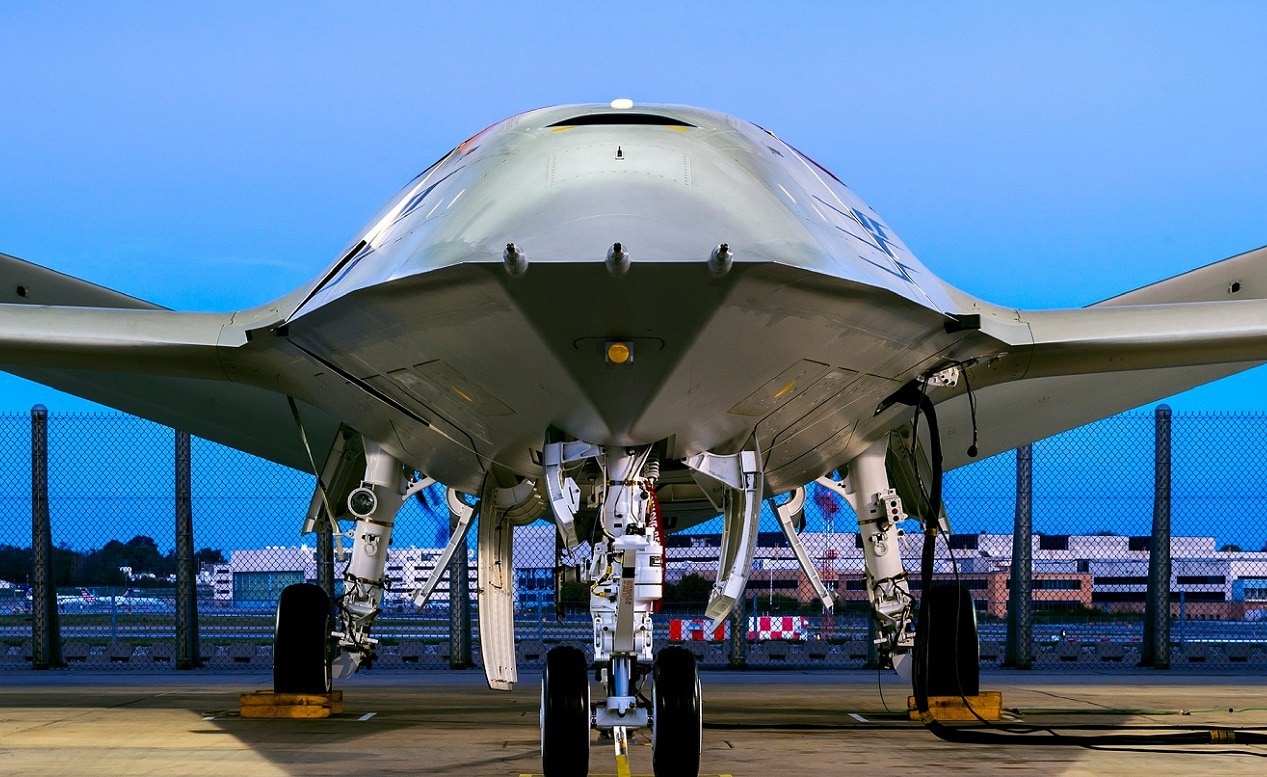
MQ-25. Image Credit: Creative Commons.
-The Navy is racing to extend its air wing with the MQ-25 drone tanker and harden Carrier Strike Groups with upgraded SM-6, SM-2, ESSM, and SM-3 interceptors.
-Emerging layers—advanced electronic warfare via SEWIP Block 3/4 and shipboard lasers able to burn out incoming missiles—shift the math.
-Carriers are more vulnerable, but with deeper, smarter defenses, they’re far from finished. Maybe the aircraft carrier won’t become an obsolete battleship after all.
China’s ‘Carrier-Killer’ Missiles Have a Problem the Navy Won’t Say Out Loud
The question of whether new long-range precision weapons have made aircraft carriers obsolete has become so widely discussed it almost seems a cliche.
Yet the tactical, technological, and conceptual variables affecting the argument are evolving quickly.
The question gained salience with the introduction of long-range Chinese anti-ship missiles often labeled as “carrier killers”—such as the DF-26 and DF-21D.
Their purpose is to prevent carriers from operating within their striking range, which for the DF-26 is about 2,000 miles.
Without adequate defenses or evasive capabilities, carriers would have to operate thousands of miles off the coast of mainland China to stay safely beyond the range of these carrier-killer missiles.
Back Aircraft Carriers Out of Range
U.S. Navy Carrier Strike Groups (CGSs) would be caught in quite a tactical predicament trying to operate from such extended ranges, considering the 1,000-to-1,300 mile range of an F-35B or F-35C. Would Navy carriers, then, be completely unable to project power near the coast of China?
Does this mean the South China Sea area or the waters off Taiwan are essentially off-limits to carriers during a conflict? After all, stealth is essential to a carrier air wing.
The addition of external fuel tanks can increase a jet’s radar cross section, and most fixed-wing aerial refuelers are large and not stealthy at all.
This is why the Navy wants to fast-track a first-of-its-kind carrier-launched drone refueler known as the MQ-25 Stingray.

China UUV Drones. Image Credit: X Screenshot.
Ship Defenses
The Navy has maintained for years that its aircraft carriers can operate anywhere in the world, projecting power at all times and conducting successful air campaigns when needed.
While Navy weapons developers are often understandably reluctant to discuss specific ranges and capabilities related to ship defense systems, senior service leaders emphasize that layered ship defense technologies continue to evolve and break paradigms.
Aircraft Carrier Strike Groups are armed with interceptor missiles such as the SM-6, SM-2, ESSM Block II and longer-range SM-3.

Members of the US Navy F/A-18F Super Hornet Demo Team performs a maneuver at the Wings Over South Texas Air Show. This year’s air show marks the first return of Wings Over South Texas to Naval Air Station Corpus Christi since 2019.
Missiles have been upgraded in recent years with improved seeker technology, longer-range, more precise targeting or intercept technology, and multi-domain networking.
In essence, the munitions have all become much more adept at targeting and intercepting moving threats.
The SM-6 operates with an active seeker, meaning it can adapt to moving targets in flight and does not need a ship-based illuminator. Such increased targeting and maneuverability massively improves the probability of a successful intercept.
Lasers & Electronic Warfare
The arrival and rapid maturation of laser weapons and of non-kinetic countermeasures such as Electronic Warfare (EW) and jamming technologies could provide the margin of victory.
A disabled or jammed Chinese DF-26 could not successfully continue on to its target.
Navy warships are now armed with Surface Electronic Warfare Improvement Program (SEWIP) Block 3, an advanced EW countermeasure able to deconflict the spectrum, distinguish signals and frequencies, and effectively jam, disable, or attack Radio Frequency guidance systems essential to the effectiveness of the carrier-killer missiles.
Northrop is now developing, testing, and fast-tracking a SEWIP Block 4 variant as well.
U.S. Navy destroyers are also now looking to integrate laser weapons that are not only low-cost and scalable, but are also able to incinerate incoming enemy missiles at the speed of light.
An advanced precision laser weapon could simply burn a hole through the metal of a Chinese anti-ship missile to drop it into the ocean.
About the Author: Kris Osborn
Kris Osborn is the President of Warrior Maven – Center for Military Modernization. Osborn previously served at the Pentagon as a highly qualified expert in the Office of the Assistant Secretary of the Army—Acquisition, Logistics & Technology. Osborn has also worked as an anchor and on-air military specialist at national TV networks. He has appeared as a guest military expert on Fox News, MSNBC, The Military Channel, and The History Channel. He also has a Masters Degree in Comparative Literature from Columbia University.


