


Key Points and Summary – The U.S. Navy wants to grow fast but faces a shrunken industrial base, aging shipyards, thin workforces, and chronic cost and schedule overruns.
-FY26 asks for 26 ships and $47.3B, while the 2025 plan targets 381 manned and 134 unmanned vessels built over 30 years.
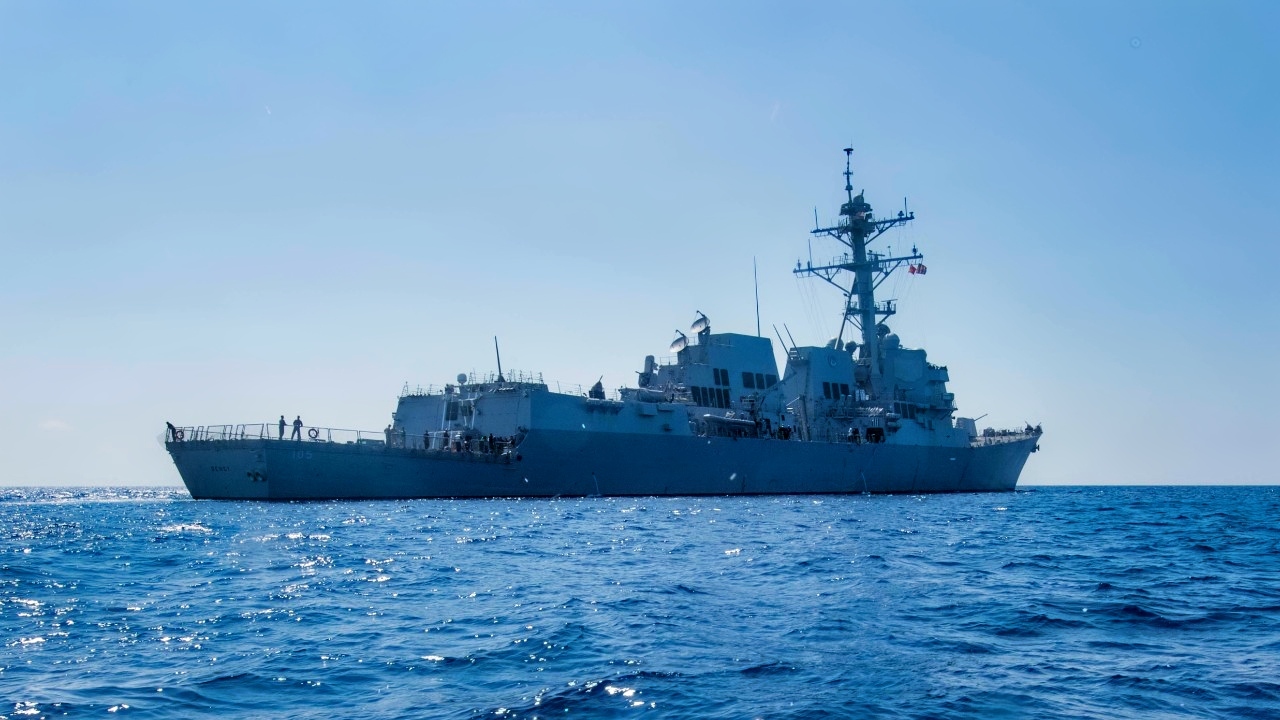
Arleigh Burke-class guided-missile destroyer USS Dewey (DDG 105) transits the South China Sea. Dewey is part of the Sterett-Dewey Surface Action Group and is the third deploying group operating under the command and control construct called 3rd Fleet Forward. The U.S. 3rd Fleet operating forward offers additional options to the Pacific Fleet commander by leveraging the capabilities of 3rd and 7th Fleets. (U.S. Navy Photo By Mass Communication Specialist 3rd Class Kryzentia Weiermann/ Released)
-Priorities include subs, destroyers, hypersonics, directed energy, autonomy, and undersea capacity.
–Fixes: modernize the four public yards (SIOP), expand tooling and labor, streamline acquisition, pull in commercial tech, and co-produce smaller combatants with Japan and South Korea.
-Without urgent reform, readiness, maintenance backlogs, and combat repair capacity will erode as China surges output and capability.
The U.S. Navy Needs to Grow Bigger and Quickly: How Can It Happen?
The U.S. Navy needs the United States to rekindle its shipbuilding industry.
The “Arsenal of Democracy” was once the envy of the world, but now it is an arsenal’s mere shadow. Congress allowed the shipbuilding industry to wither, yet another horrible, shortsighted decision, among many made after the Cold War.
At the start of World War II, the U.S. had 345 ships, consisting of 225 surface warships, 8 aircraft carriers, and 112 submarines. In less than four years, at the end of the war, the U.S. operated 6,768 ships, making it the largest navy the world had ever seen.
The massive fleet included 23 battleships, 28 fleet aircraft carriers, 71 escort carriers, 72 cruisers, 377 destroyers, 232 submarines, and thousands of amphibious, supply, and auxiliary craft.
But now, the goal is not to place blame, but to ask how decision-makers can fix what they broke and bring the U.S. back to the forefront of naval shipbuilding.
This is a complex issue with various perspectives and challenges, some of which the Navy has no control over. The shipbuilding industry in the United States is one of the cornerstones of the nation’s security and economic resilience.
The U.S. Navy Wants 26 New Ships? Was The Moon Not Available?
The Navy’s budget request for the 2026 fiscal year is its most ambitious (or unrealistic) shipbuilding push in years. After asking Congress for just six new ships in the 2025 fiscal year, and nine in the one before that, the service now wants 19 more. That number includes attack submarines, destroyers, amphibious ships, and support vessels totaling about $47.3 billion.
Some requested areas are extremely needed and well thought out. The Navy wants continued emphasis on developing hypersonic missiles, directed energy weapons, unmanned systems, and undersea capabilities. The service’s central focus is still on building more ships to help close the gap with China’s rapidly growing navy.
Despite the Chinese Navy outnumbering the U.S. Navy in the number of its ships, the U.S. still has a sizable edge in tonnage. But while asking for this many ships may sound great, to quote Chad “Ocho Cinco” Johnson, “Child, please!”
Significant improvements are needed to accomplish shipbuilding goals.
Infrastructure and Global Supply Issues
Global shifts in industry and supply-chain trends threaten the Navy’s competitiveness and its ability to meet growing demands. The U.S. government allowed its shipbuilding industry to deteriorate, however, the industry has its strengths, and it benefits from public-sector initiatives aimed at revitalizing its infrastructure and workforce.

Constellation-Class Frigate U.S. Navy. Image Credit: Industry Handout.
It needs a shot in the arm to improve aging infrastructure and create new jobs to attract the skilled workers the industry needs.
The U.S. Navy and the War Department are taking steps to help private companies with shipbuilding. For example, they’ve invested billions of dollars to help increase shipbuilding capacity, such as helping with infrastructure improvements at shipyards and with workforce development, according to the GAO’s Shelby Oakley.
The U.S. Navy’s Plans For 2025, 2026, And Beyond
The U.S. Navy has a clear goal. Its 2025 plan aims for a larger fleet (381 manned ships and 134 unmanned vessels) with more distributed firepower. To achieve its goal of 381 battle force ships, the Navy would buy 364 vessels over the next 30 years – 293 combat ships and 71 combat logistics and support vessels.
Significant investment is underway in shipbuilding, with the budget nearly doubling over the past two decades.
A focus on advanced technologies, including artificial intelligence, autonomy, cyber resilience, and unmanned systems, is intended to enhance capabilities and accelerate modernization.
The Navy is working to streamline acquisition processes and integrate commercially available technologies faster.
Concerns and Challenges
U.S. shipbuilding capacity has significantly declined since the Cold War. The sector struggles with workforce shortages and aging infrastructure, and it relies on a small number of specialized yards.
Shipbuilding programs are consistently over budget and behind schedule, with some ships facing delays of up to three years.
Partner With Japan And South Korea ASAP
Collaboration with allies such as Japan and South Korea could help address shipbuilding challenges.
With the U.S. building the larger ships toward which its shipyards are geared, Japan and South Korea could take up the mantle of building smaller vessels, such as corvettes and frigates.
The U.S. Navy is reportedly 20 years behind schedule in maintaining its existing fleet, which could lead to the potential decommissioning of viable ships. That is unacceptable.
The Navy’s fleet is projected to decrease in size over the next few years before eventually growing, according to the Congressional Budget Office.
The 2025 shipbuilding plan is estimated to cost significantly more than previous plans, requiring a substantial increase in the Navy’s overall budget.
How Is Readiness Currently Capable?
The Navy’s ability to deter and respond to threats effectively is questioned, with concerns about its readiness for sustained combat operations against near-peer adversaries, notes War on the Rocks.
There are concerns about the Navy’s capacity to repair ships damaged in combat, which would be crucial in a conflict with a near-peer adversary. The Navy is actively working to rebuild and modernize its force for modern warfare, with ambitious goals and significant investments in technology.
However, significant challenges remain in shipbuilding capacity, workforce, costs, and maintenance that have slowed shipbuilding to a crawl.
Task and Purpose has reported that the U.S. Navy is asking for $989 million in funding for the Shipyard Infrastructure Optimization Program, compared to last year’s request of $513 million.
The program focuses on modernizing the Navy’s four shipyards in Norfolk, Virginia; Portsmouth, Maine; Puget Sound, Washington; and Pearl Harbor, Hawaii, which the GAO reported in 2019 were, on average, 76 years old.
The success of the Navy’s rebuilding efforts will likely depend on its ability to overcome these challenges and effectively adapt to the evolving geopolitical landscape.
About the Author: Steve Balestrieri
Steve Balestrieri is a National Security Columnist. He served as a US Army Special Forces NCO and Warrant Officer. In addition to writing on defense, he covers the NFL for PatsFans.com and is a member of the Pro Football Writers of America (PFWA). His work was regularly featured in many military publications.
More Military
The B-21 Raider Bomber: China and Russia Should Be Afraid
A U.S.-China War Over Taiwan: Who Wins?
F/A-XX: How Many Stealth Fighters Does the U.S. Navy Need?
China’s J-36 Stealth ‘Something’ vs. America’s F-22 Raptor: Who Wins?
China’s J-20 Stealth Fighter Might Be ‘Better’ Than F-22 and F-35 for 1 Reason


