

Key Points and Summary – Northrop Grumman’s B-21 Raider is deliberately smaller than the B-2—roughly a 132-ft wingspan vs. 172 ft, a lower MTOW (≈225k–260k lbs vs. 376.5k), and an estimated payload around 30,000 lbs vs. the B-2’s 40,000.
-The payoff: a far lower radar cross-section, fewer surfaces to maintain, two engines instead of four, easier basing, and much lower acquisition/operating costs—key for fielding the Raider in the hundreds.
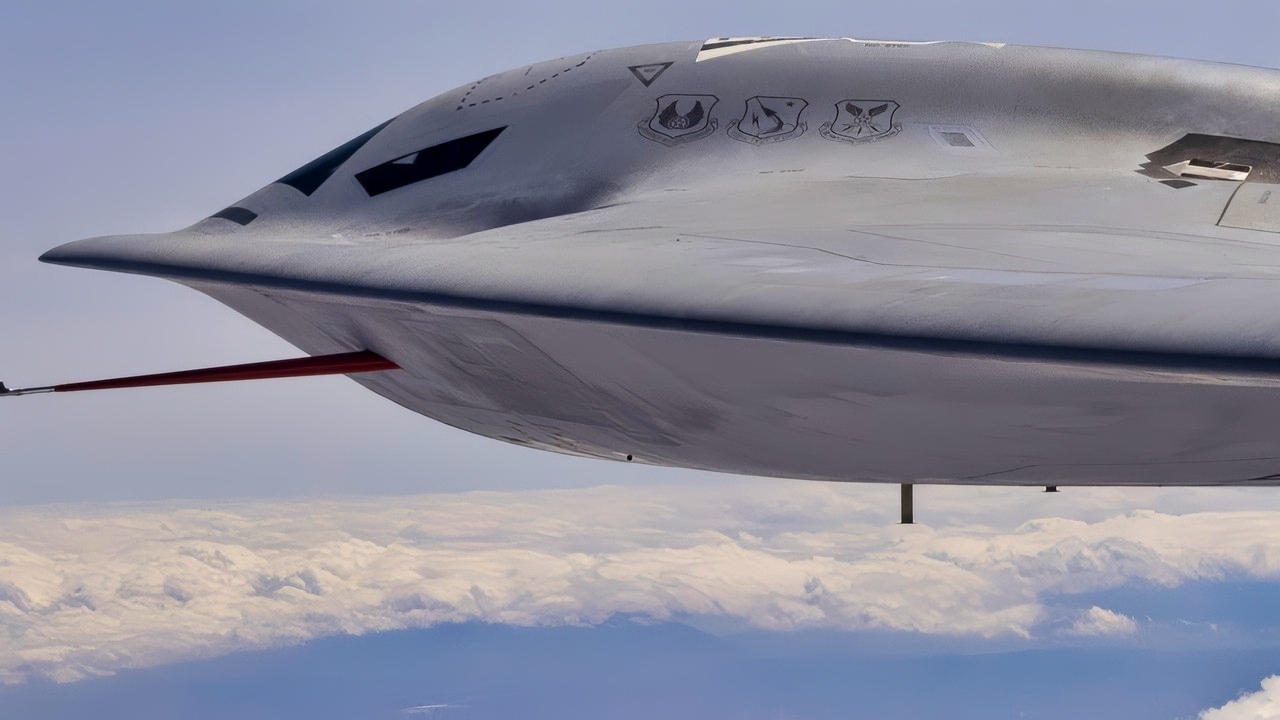
B-21 Raider. Image Credit: U.S. Air Force.
-While a smaller airframe can mean less internal fuel and payload per sortie, efficiency gains and fleet size aim to offset that.
-Bottom line: the B-21 trades bulk for stealth, sustainment, flexibility, and affordability.
Why the B-21 Is Much Smaller Than the B-2
The U.S. Air Force’s forthcoming B-21 Raider is designed to be the next generation of stealth strategic bomber.
Built by Northrop Grumman under the Long Range Strike Bomber (LRS-B) program, it is intended to replace the iconic – but aging – B-2 Spirit, and eventually join with the B-52 as part of a modern, long-range bomber force.
But one of the most curious features of the new aircraft, which has gradually become evident based on unclassified information and official releases, is its size; the B-21 is smaller than the B-2.
That includes reduced wingspan, lower maximum take-off and gross weight, and likely smaller internal weapons payload.
Why Smaller?
The news may come as a surprise to observers expecting to see something larger and capable of delivering heavier payloads, but there are many important factors to consider.
Size, in aircraft design, affects everything from stealth, maintainability, payload, range, and cost – and the B-21 is designed to be stealthier, cheaper and simpler to maintain, and more cost-effective. It is also expected to be fielded in dramatically higher numbers than its predecessor.
These factors have all come into play when determining the eventual size of the aircraft.
Why Size Matters in a Bomber
Among the most apparent reasons why size matters for a strategic bomber is its payload capacity.
Larger aircraft can house more bombs, bigger bombs, more fuel, and potentially larger or more varied weapons bays.
When designers reduce size, they may be limiting how much an aircraft can carry.
In terms of range and fuel efficiency, a combination of bigger wings and a greater internal volume help ensure an aircraft can travel long distances without refueling. However, size also adds weight, drag, and new structural requirements.
A larger plane requires more refinement to ensure it remains fuel-efficient. That’s a huge trade-off, and one that the Raider’s designers understand well. Bigger isn’t always better in terms of range and fuel efficiency, especially when more fuel-efficient engines can allow smaller aircraft to fly longer distances.

B-21 Raider. Image Credit: Creative Commons.
But the Raider isn’t just designed to travel long distances – it is a stealth aircraft designed to evade early warning systems and aerial threats. A smaller airframe has fewer surfaces to reflect radar, all else being equal. When an aircraft has a smaller physical footprint – including its wingspan, thickness, and length, it typically also benefits from a lower Radar Cross Section (RCS).
Former Northrop Grumman analysts Dr. Christopher Bowie described in a paper published in 2023 that the B-21 radar signature was so small that the aircraft is effectively no larger than an insect.
And then there’s the matter of maintainability and cost. From stealth coatings to moving parts, the bigger and more complex the aircraft, the more expensive it is to build, maintain, store, base, and deploy. A smaller footprint may also reduce costs – and crucially for the B-21, take up less hangar space. That’s important for an aircraft expected to be fielded in its hundreds.
Bigger bombers not only take up more hangar space, but they also need larger runways. A more compact bomber might not only be stealthier and easier to store, but it’s more flexible. The B-21, for example, will be more easily accommodated by bases all over the world, including in allied air fields that might not be able to accommodate something as large as the B-2.
B-21 vs. B-2: Here’s What We Know
While many specifics remain classified, a lot is known about the B-21 Raider. The project is no secret, and two prototypes have been seen flying. The B-2 Spirit’s wingspan is 172 feet, while multiple sources estimate that the B-21’s wingspan is 132 feet.
The B-2’s maximum take-off weight is 376,500 lb, while analysts estimate that the B-21’s maximum take-off weight is much lower, between 225,000 and 260,000 lb.
In terms of payload capacity, the B-2 is capable of carrying approximately 40,000 lbs, while the best estimates so far suggest that the B-21’s maximum load could be around 30,000 lbs – just enough to carry the “bunker buster” GBU-57 A/B Massive Ordnance Penetrator (MOP) that was used to destroy Iran’s nuclear facilities in June.
The Good and the Bad
With those specifications in mind, it’s possible to determine a number of potential advantages and disadvantages. It’s worth noting, of course, that the designers of the aircraft are well aware of the benefits and tradeoffs – and the decision to make the B-21 smaller will have been made with the intention of making it more effective.
With a smaller wingspan and platform, the B-21 has fewer surfaces to reflect radar. Combined with its modern, low-observable design and more advanced materials, the B-21 will be stealthier than the B-2.
The smaller wingspan and size means it’s easier to maintain; stealth coatings are notoriously costly to maintain.
And, with less material and fewer engines – the B-2 has four, while the B-21 is expected to have just two – the acquisition and operating costs are expected to be much lower. Some estimates have suggested that the B-2, adjusted for inflation, cost more than $2 billion per airframe – far more than the expected cost of the B-21.
But despite all the benefits, there could be some drawbacks. With a lower maximum payload, the B-21 may be capable of delivering fewer bombs or less heavy ordnance per sortie. While this could limit some kinds of missions, the fact that the Air Force is investing in hundreds of these aircraft could offset that downside.
Smaller size often means less internal fuel capacity, too – so unless it is compensated with more efficient engines and improved aerodynamics, there’s a chance the B-21 will need to refuel more often than its predecessor.
The decision, however, reflects the reality that the B-2 – though iconic, effective, and formidable – is a demanding platform that costs too much and requires too much maintenance to make it a reliably combat-ready bomber. The B-21, though smaller, is set to outperform its predecessor in all areas except size. And that’s a good thing.
About the Author:
Jack Buckby is a British author, counter-extremism researcher, and journalist based in New York who writes frequently for National Security Journal. Reporting on the U.K., Europe, and the U.S., he works to analyze and understand left-wing and right-wing radicalization, and reports on Western governments’ approaches to the pressing issues of today. His books and research papers explore these themes and propose pragmatic solutions to our increasingly polarized society. His latest book is The Truth Teller: RFK Jr. and the Case for a Post-Partisan Presidency.
More Military
The B-1B Lancer Bomber Can Come Back ‘From the Dead’ Thanks to the Boneyard
F-15EX Eagle II vs. China Brand New J-35 Fighter: Who Wins a Fight?
The B-21 Raider Has a New Enemy You Likely Never Heard Of
The Navy’s Biggest Nightmare: The Aircraft Carrier Is Obsolete


