

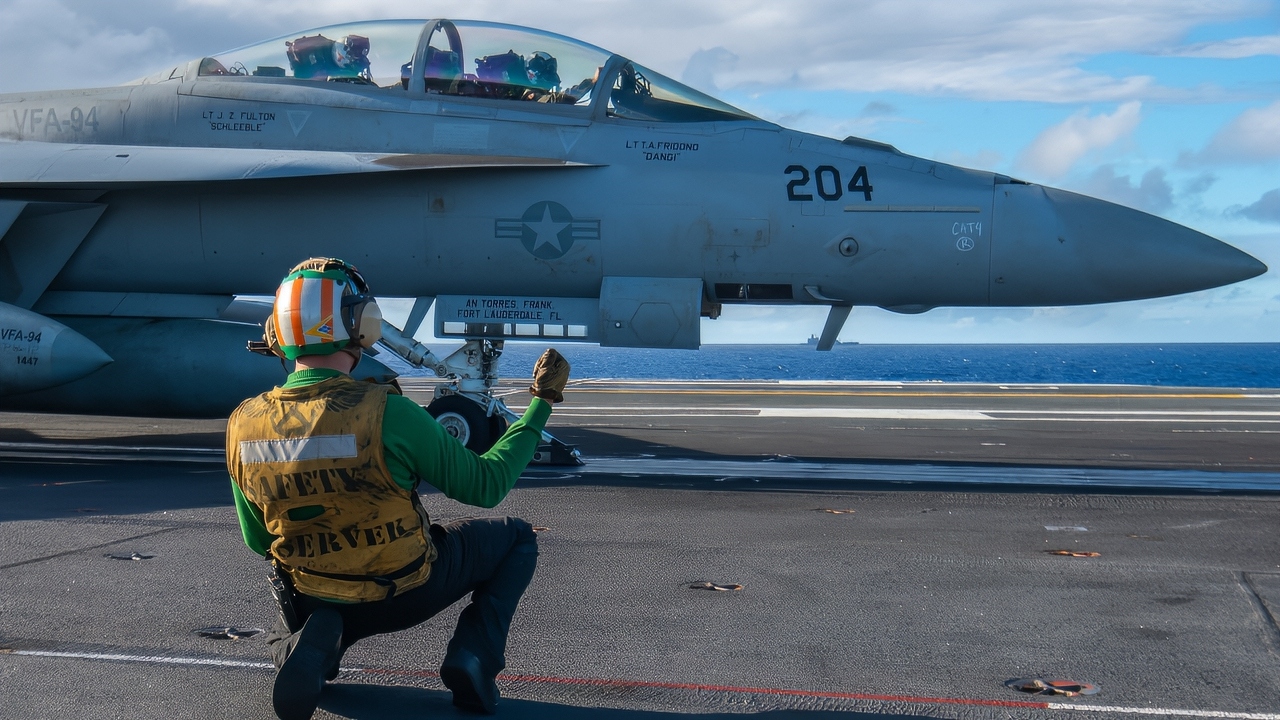
Key Points and Summary – U.S. and Chinese aircraft carriers are evolving for fundamentally different roles, not as mirror images.
-China’s carriers are “mobile nodes” designed to operate under the protective “umbrella” of their land-based missile and sensor networks, thickening their anti-access bubble in their near seas.
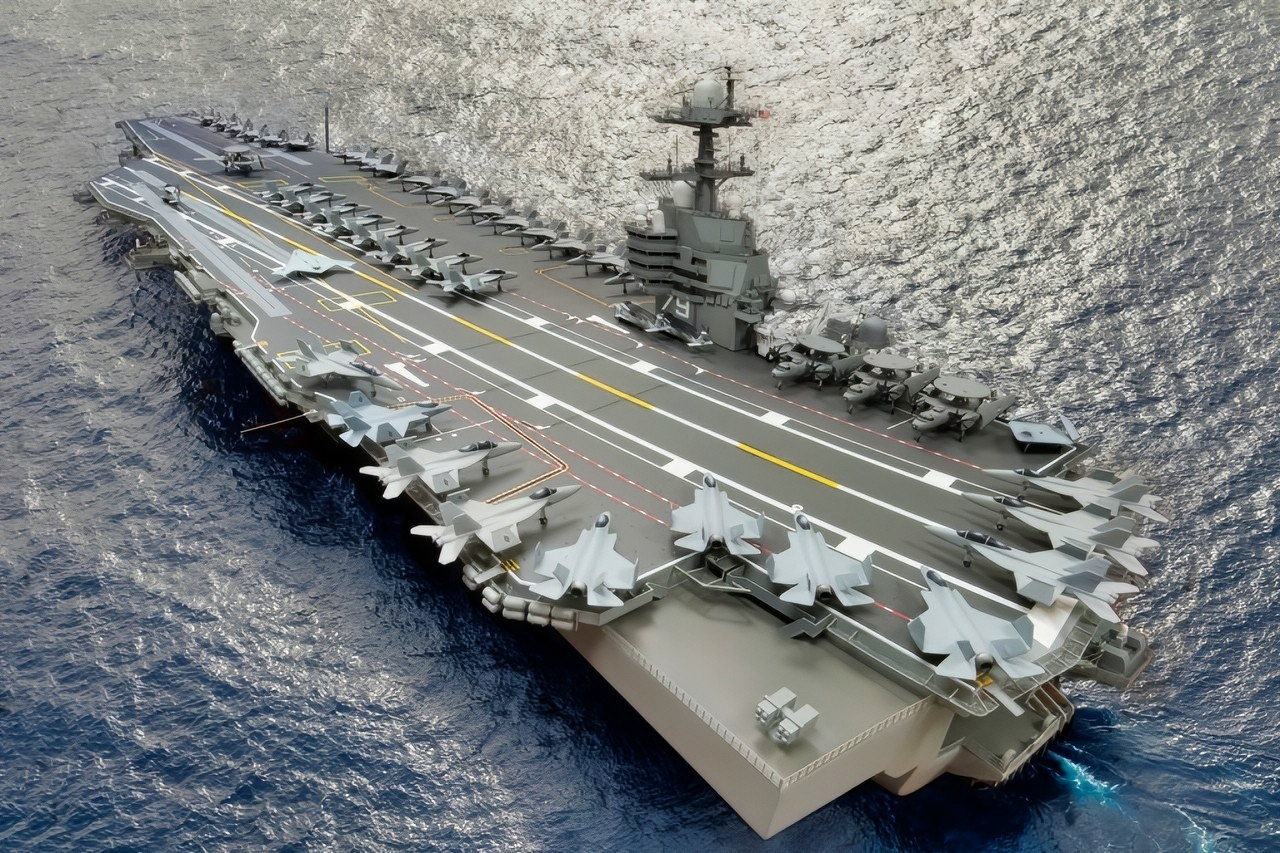
USS John F. Kennedy Aircraft Carrier Model

Pacific Ocean, July 25, 2005 – USS Ronald Reagan (CVN 76) performs a high speed run during operations in the Pacifc Ocean. Ronald Reagan and Carrier Air Wing One Four (CVW-14) are currently underway conducting Tailored Ships Training Availability (TSTA). Official US Navy Photo by Photographers Mate 1st Class James Thierry. (RELEASED)
-In contrast, America’s Ford-class carriers are becoming “roaming nerve centers” for distributed warfare.
-Operating from safer distances, their air wings act as quarterbacks, finding targets and cueing strikes from other ships, submarines, and allies, thereby managing a theater-wide battle network.
China and the U.S. Are Building Aircraft Carriers for Two Completely Different Wars
With hypersonic and ballistic anti-ship missiles, persistent multi-sensor nets, subsurface and undersea threats, and electronic disruption saturating the maritime battlespace, both China and the United States are reassessing the role of the aircraft carrier in their naval strategies.
China has adjusted to this new ecosystem by turning its flattops into floating nodes in an anti-access umbrella rather than self-contained mobile strike platforms.
The United States is adapting by reimagining carriers as roaming nerve centers of distributed kill chains at range: emphasizing endurance, hard-to-target networking, deception and magazine management while cueing third-party shooters and keeping big decks outside the densest threat rings until the fight can be shaped.
The Kill-Chain Reality
Naval warfare in that ecosystem is less about platform versus platform than it is about the creation, protection, and destruction of kill chains—continuous loops of find, fix, track, and strike that crisscross sea, air, space, cyber, and the electromagnetic spectrum.
Wide-area surveillance, passive RF sensing, and long-range missiles link coastal launchers, aircraft, submarines, and drones into a distributed hunting system. Carriers are threatened less by a single knockout blow in that context than by persistent, layered targeting that compresses the space and time in which they can operate.
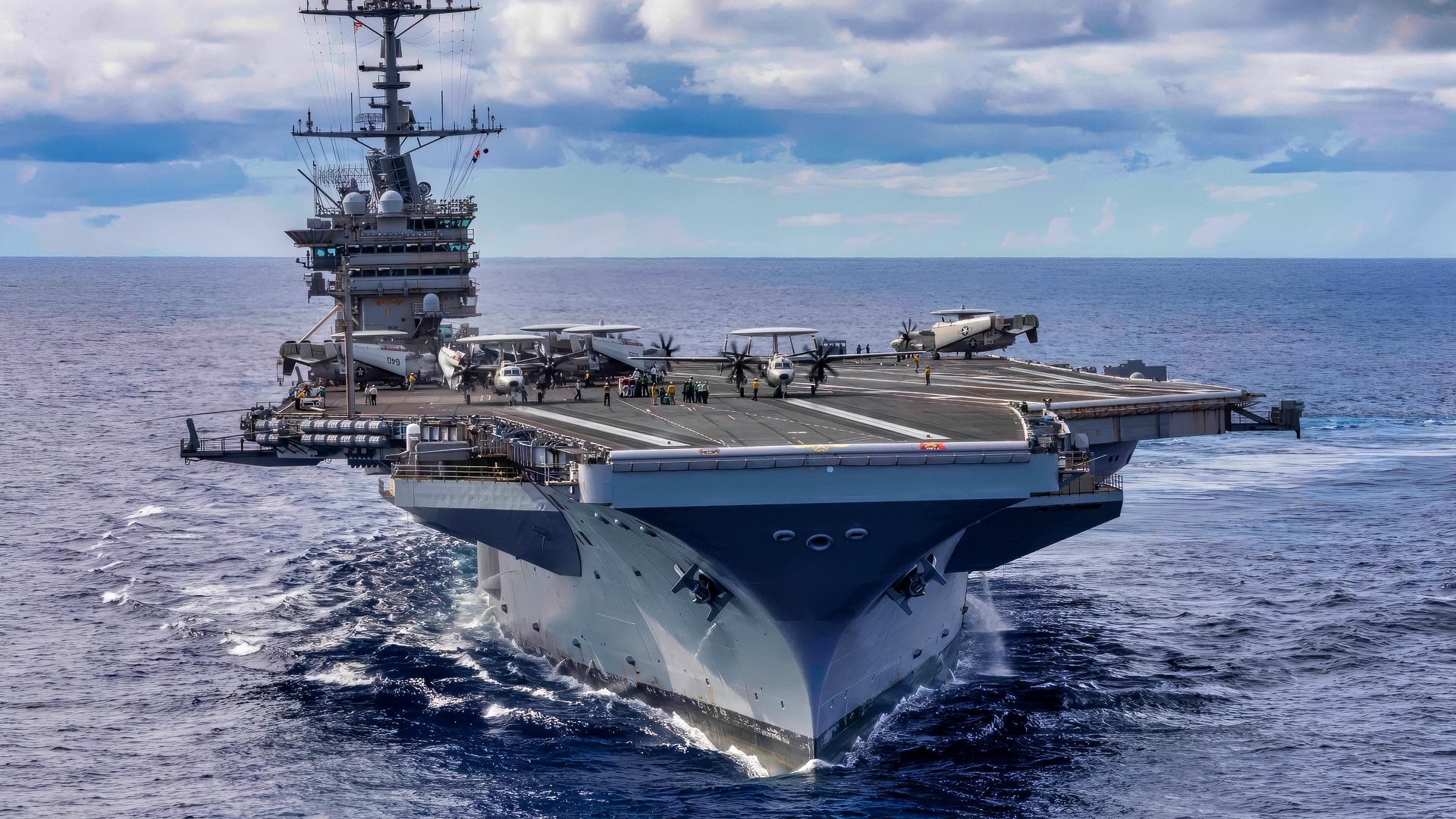
250923-N-FY193-1405 ATLANTIC OCEAN (Sept. 23, 2025) The Nimitz-class aircraft carrier USS Harry S. Truman (CVN 75) conducts carrier qualifications in the Atlantic Ocean. Truman is currently underway carrying out routine operations that support the Navy’s commitment to readiness, innovation, and future fleet lethality. (U.S. Navy photo by Mass Communication Specialist 2nd Class Mike Shen)
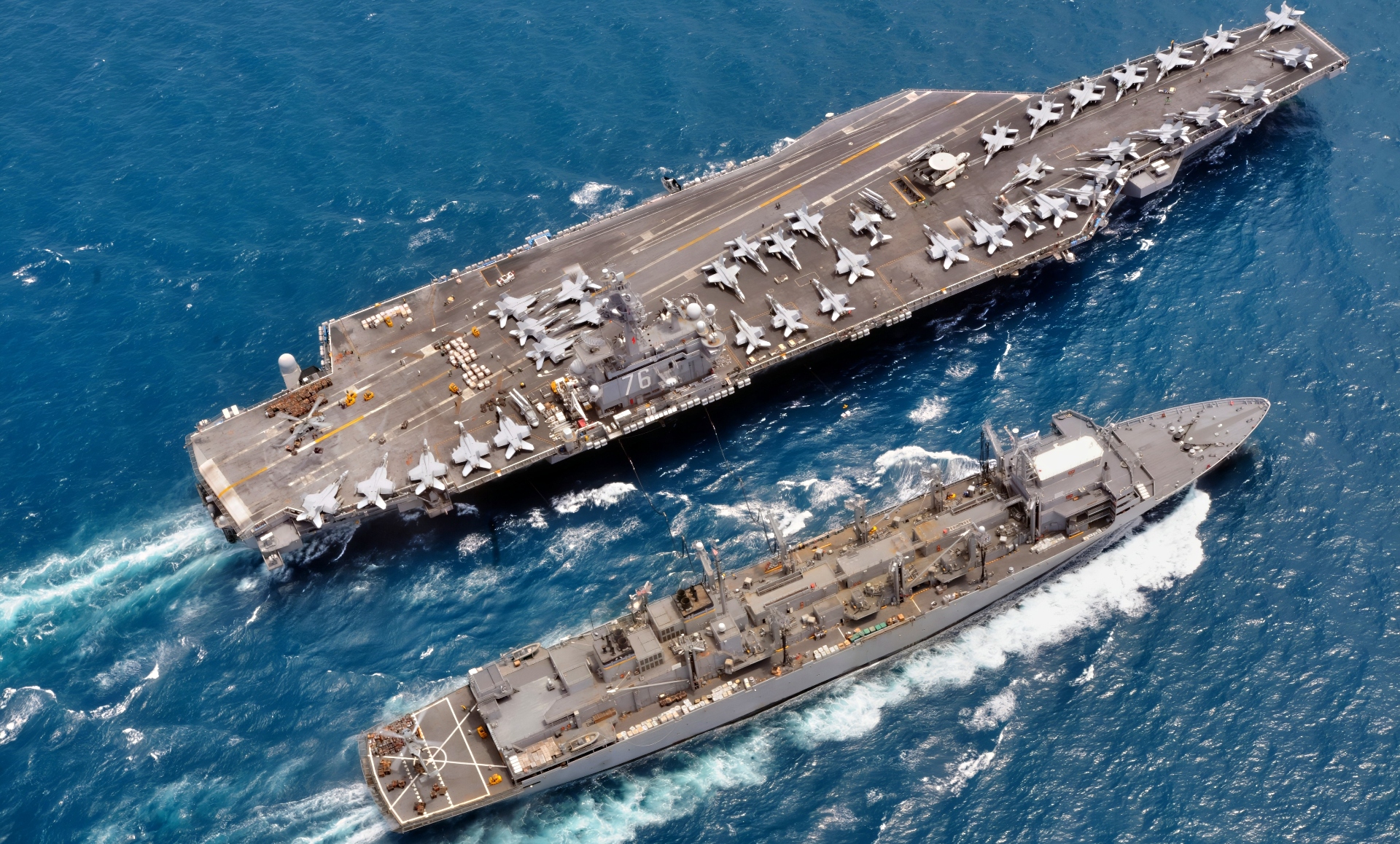
(August 15, 2008) With SH-60 helicopters moving pallets of supplies both USS Ronald Reagan (CVN 76) and USNS Bridge (T-AOE 10) work together during a replenishment at sea or RAS. With Reagan’s six galleys and approximately 4,100 Sailors it takes a lot of produce to feed that many folks and the Nimitz-class aircraft carrier got what it needed from USNS Bridge to do so.
The Ronald Reagan Carrier Strike Group is on a routine deployment in the 7th Fleet area of responsibility. Operating in the Western Pacific and Indian Ocean, the U.S. 7th Fleet is the largest of the forward-deployed U.S. fleets covering 52 million square miles, with approximately 50 ships, 120 aircraft and 20,000 Sailors and Marines assigned at any given time.
U.S. Navy photo by Senior Chief Mass Communication Specialist (SW/NAC) Spike Call
The solution begins upstream: break the sensor web, degrade track quality, and seed doubt about where and when the carrier matters. Layered defenses and cooperative engagement can provide some time when salvos do come—but only if that earlier disruption has already blurred the enemy’s picture.
China’s Carriers Under the Umbrella
China’s newest deck aviation should be read through this lens.
The shift from ski-jumps to catapults enables heavier takeoff weights, longer legs, and a richer mix of sensors and jammers. A catapult-launched AEW&C aircraft expands the radar horizon and tightens fire-control quality for land-based shooters, while a stealth-capable deck fighter promises scouting and limited penetrating strike under the protection of the mainland’s air-defense and missile canopy.
Add updated strike and electronic-attack variants of familiar airframes and the result is a carrier air wing that amplifies the reconnaissance–strike complex already radiating from China’s coastline.
This concept is purposeful and bounded. China is not trying to achieve absolute control but to make nearby seas more usable for its forces and more unpredictable for others inside the first and second island chains. Within that geography, the carrier extends combat air patrols, pushes sensors outward, and offers flexible presence for crises short of war. Beyond that geography, value falls as attrition rises.
The farther a Chinese carrier sails from the umbrella of land-based ISR, long-range fires, and protected logistics, the more its air wing must shoulder tasks that shore networks have previously carried. That means more organic tanking, more persistent AEW, deeper magazines, and hardened command-and-control—capabilities that are improving but still maturing for long-range operations.

The world’s largest aircraft carrier, USS Gerald R. Ford (CVN 78), conducts flight operations in the North Sea, Aug. 23, 2025. Gerald R. Ford, a first-in-class aircraft carrier and deployed flagship of Carrier Strike Group Twelve, is on a scheduled deployment in the U.S. 6th Fleet area of operations to support the warfighting effectiveness, lethality, and readiness of U.S. Naval Forces Europe-Africa, and defend U.S., Allied and partner interests in the region. (U.S. Navy photo by Mass Communication Specialist 2nd Class Maxwell Orlosky)
Measured against its primary mission—thickening denial close to home—China’s latest carrier is a significant step forward. Catapults and AEW&C are the big enablers; a stealthy deck fighter and improved electronic attack give the wing a sharper edge; and integration with shore-based sensors and missiles turns the ship into a mobile node rather than a standalone punch. The practical limits are equally clear: survivability hinges on remaining under the lattice; endurance and maintenance cycles will be tested by distance; and sustained high-tempo operations far from protected waters will demand logistics depth and training density that take time to build. Inside the umbrella, the platform’s contribution is meaningful and growing. Outside it, risk and cost rise quickly.
America’s Carriers as Roaming Nerve Centers
The United States is solving a different problem. Its carriers must help hold a theater together when satellites are dazzled, shore bases are cratered, and allies are dispersed. The Ford class brings electrical margin, electromagnetic launch and recovery, and a flight-deck architecture built for higher operational tempo. Those are not ends in themselves. They enable a carrier that operates as a roaming nerve center: an AEW&C platform that quarterbacks the network; fifth-generation fighters that scout, fuse, and pass tracks while managing their own signatures; electronic-attack aircraft that strangle search radars and degrade datalinks; and third-party shooters—surface, subsurface, and ashore—that fire on cues from the air wing.
This orchestration extends to defense. The same network that enables long-reach offensive fires stitches together layered air and missile defenses, extending intercept envelopes through off-board sensing and cooperative engagement.
Magazine management becomes as decisive as raw strike tonnage: deck cycles that replenish interceptors, tankers that keep fighters on-station, and deception that soaks enemy shots into decoys rather than hulls. Resilience is the coin of the realm—multiple paths for targeting data, emissions control to reduce exposure, and tactics that keep the big deck moving outside the hottest threat rings until the conditions for a push are set.
Range and endurance remain the unforgiving math of the Pacific, and here the U.S. mix is being recalibrated. Organic tanking from a deck-based unmanned aircraft promises to restore reach and on-station time for the air wing, allowing standoff to become plan rather than aspiration.
Paired with a next-generation fighter designed for persistence, the carrier can operate from safer geometry while still arriving at decisive places fast enough to matter. The Ford’s electrical margin supports future sensors and directed-energy defenses; its launch-and-recovery systems are maturing into reliable tools for higher sortie generation and heavier bring-backs.
None of this substitutes for disciplined maintenance, parts pipelines, and training, but where those foundations hold, the class is well-suited to the mission of managing kill chains across theater scale.
Against its mission—keeping allies stitched together, coordinating third-party fires, and preserving tempo under pressure—the Ford-era carrier is fit for purpose. It is not optimized to batter coastal batteries on day one; it is optimized to make the adversary’s targeting brittle, keep friendly magazines fed, and create the windows in which joint and allied forces can deliver decisive effects. That requires ruthless employment concepts: keep big decks at range until sensors are stunned, complicate enemy scouting with deception and decoys, and pulse forward only when magazine depth and off-board fires justify the exposure.
Strategy, Survivability, and the Bottom Line
Taken together, the two carrier programs now look less like mirror images and more like complementary studies in purpose. China’s carrier thickens a denial architecture close to home, extending sensors, CAP, and electronic warfare under a protective canopy.
America’s carrier manages tempo at distance, orchestrating a dispersed magazine while insulating the fleet from the worst threat rings. Each approach is coherent when judged against its intended fight; each is vulnerable when employed against type.
The strategic implication is clear. China’s newest deck—enabled by catapults, AEW&C, and a maturing stealth fighter—will complicate operations for others inside the island chains and make nearby seas more hospitable to Chinese forces.
America’s Ford-era deck—anchored by AEW&C, fifth-generation fighters, electronic attack, cooperative engagement, and the coming unmanned tanker—serves as the theater’s management layer, preserving options when the shooting starts and the lights flicker. Survivability for both will depend less on steel and more on geometry, deception, and allied depth.
Judge them on those terms and the logic clarifies. Use China’s carriers to capitalize on the umbrella; use America’s to preserve options beyond it. Employed as close-in battering rams, both will be squandered. Employed as the brains and lungs of their respective systems, both will shape the fight in precisely the ways modern carrier air wings are designed to do.
About the Author: Dr. Andrew Latham
Andrew Latham is a Senior Washington Fellow with the Institute for Peace and Diplomacy, a non-resident fellow at Defense Priorities, and a professor of international relations and political theory at Macalester College in Saint Paul, MN. You can follow him on X: @aakatham. He writes a daily column for the National Security Journal.
More Military
F-22 Raptor vs. China’s New J-35 Fighter: Why You Might Not Like the Answer
China Has An F-35 Stealth Fighter Problem It Never Saw Coming
The F-35 Fighter’s Real ‘Secret Weapon’ Isn’t Its Stealth
Hwasong-20: North Korea’s New Solid-Fueled ICBM Has Arrived
Midway-Class Aircraft Carrier USS Coral Sea (CV-43) Has a Message for the U.S. Navy


George Taylor
October 13, 2025 at 1:13 pm
I’ll make this a much quicker read. Chinese aircraft carriers are primarily defensive while project power American carriers are primarily offensive.
Bruce S. Conklin
May 5, 2026 at 8:47 am
Will I be able to respond….
Bruce S. Conklin
May 5, 2026 at 8:51 am
If George Taylor is correct, the Chinese carrier program is a dead end. Using a carrier for defensive purposes is contrary to the logic of war; offense always beats defense, and a big ship’s best protection is range and distance. – BSC