

It’s the worst bloodbath since World War Two, and there is no let-up in sight. The war in Ukraine has now caused over 2 million casualties. The Russians alone have suffered 450,000 dead. The total in Russian dead, wounded, or missing has eclipsed 1.4 million. This has been a meat grinder of epic proportions, and no one seems to want it to end.
When will the killing stop? There must be some way these two countries could at least entertain a ceasefire. The best way to achieve a roadmap to peace would be for both armies to back away 10 miles from existing battle lines and establish a Korea-like demilitarized zone while they negotiate larger aims, such as Ukraine’s entry into NATO and other territorial concerns.

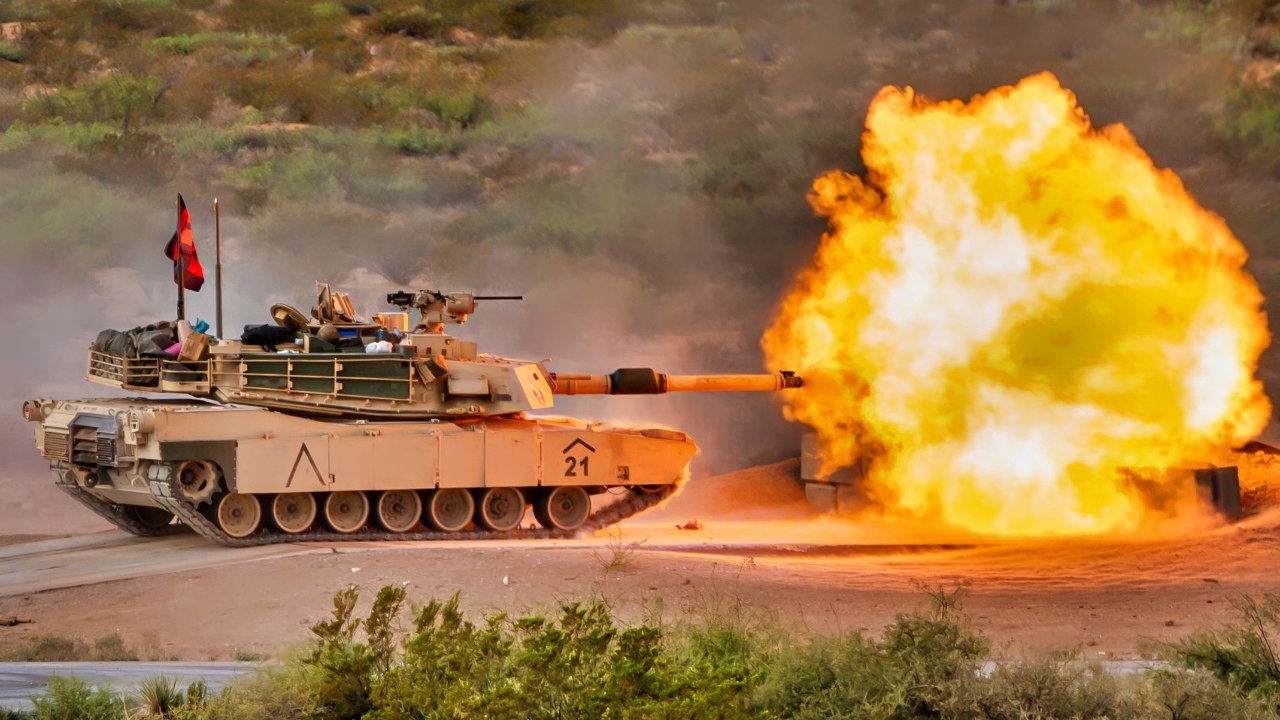
An M1A2 Abrams Tank fires a round at Fort Stewart, GA., June 23, 2025. (U.S. Army photo by Sgt. David Resnick)
Think Tank Has Tragic Numbers of Dead and Wounded
Until then, the killing continues, and those totals noted above do not include civilian casualties. The deaths among armed combatants are incredible. Russia has lost about 1 percent of its population, according to estimates from the Washington-based CSIS think tank.
Russian Victims Include Low-Income Conscripts
Like the Vietnam War, Russian casualties are hurting those in the lower socio-economic classes the worst. Poor and uneducated civilians are being drafted into the army, and some are dying within hours, if not minutes, when sent to the front. Whole economically disadvantaged villages are being wiped out, CSIS found during its research.
Wealthier Russians are able to avoid conscription. Some have left the country or found other ways to dodge the draft. Russian military-aged men are reportedly being kidnapped off the street and sent to basic training before they serve as cannon fodder on the battlefield. But despite the draft, Russia cannot easily replace the soldiers it is losing so quickly.
Orders of Magnitude of Death
“These rates are astounding,” Seth G. Jones and Riley McCabe, the authors of the study, wrote, as CNN noted. “Russian fatalities in Ukraine are more than four times greater than all U.S. fatalities in all wars combined since World War II, and more than nine times greater than all Soviet and Russian fatalities in all wars combined since World War II.”

Soldiers with 1st Battalion, 68th Armor regiment, 3rd Armored Brigade Combat Team, 4th Infantry Division execute platoon live fire exercises Dec. 7, 2021, Fort Carson, Colorado. Platoon live fire exercises prove a platoon’s ability to engage targets and maneuver together on their M1A2 Abrams main battle tanks. (U.S. Army photo by Capt. Tobias Cukale)
Many Times Worse than the Soviet-Afghan War
Even the disastrous Soviet war in Afghanistan was not nearly as bad. The Russians lost 15,000 soldiers in that conflict, and those totals were seen as unacceptable at the time. Now, Russia can sometimes lose that many fighters in just a month.
Ukraine’s manpower has been devastated too. There have been more than 525,000 casualties and perhaps a toll as high as 625,000. The number of deaths is around 125,000 to 150,000.
Russia Can’t Go On Like This
The authors of the CSIS report suggest that Russia is losing eight soldiers for every Ukrainian wounded or killed. This is unsustainable, and it is unclear whether Vladimir Putin will order another mass mobilization to continue the fight.
This is likely due to the Ukrainian use of anti-personnel drones that kill anything that moves at the front. The Russians have tried using motorbikes to quickly sneak into Ukrainian territory, but they are still being mowed down by loitering munitions.
World War One With Drones
The front has devolved into networks of World War One-style trenches.
Both sides are unable to mass troops for a spearhead advance with tanks and armored personnel vehicles. Russia tries human-wave attacks but lacks the element of surprise.
The drones are in the sky 24/7, and the eerie buzzing sound above the battlefield is a sign of certain death to come. Russia has hoped to wear the Ukrainians out with more and more soldiers, but this style of warfare has not been successful.
“Russia’s attrition strategy, its failure to effectively conduct combined arms and joint warfare, its poor tactics and training, corruption, and low morale,” the authors wrote.
The War Against Civilians
It is clear the fighting is going nowhere, and the only thing that either side can do is send one-way attack drones and ballistic missiles toward civilian targets in cities. The front lines are not effective at winning new territory or holding it for long periods. The stalemate continues, and it is not known when the fighting will end.
No Crossing Red Lines
Volodymyr Zelensky and Putin do not seem inclined to negotiate. Both sides are far apart in their strategic objectives. Ukraine demands that Russia withdraw from all Ukrainian territory it occupies. Russia wants to keep this ground. Ukraine would like to join NATO and the EU. This is anathema to the Russians.
Try to Institute a Ceasefire and DMZ
The only thing left to do would be to create a demilitarized zone to keep the peace in this frozen conflict. But even a short two-day ceasefire, like the one the Russians instituted during the celebration of the end of the Great Patriotic War, does not seem likely to come anytime soon.
These casualties are worse than anyone imagined when the war started. There are sometimes bursts of momentum, but no earth-shattering victory that could be decisive. The war just continues to drag on, and the killing fields have expanded to swallow up entire divisions and brigades. It is a time of tragedy for both countries and the international community. Instead of cheerleading for some type of clear victory for Ukraine, people must recognize that a ceasefire and demilitarized zone are the best ways to stop the killing.
About the Author: Dr. Brent M. Eastwood
Author of now over 3,500 articles on defense issues, Brent M. Eastwood, PhD, is the author of Don’t Turn Your Back On the World: A Conservative Foreign Policy and Humans, Machines, and Data: Future Trends in Warfare, plus two other books. Brent was the founder and CEO of a tech firm that predicted world events using artificial intelligence. He served as a legislative fellow for US Senator Tim Scott and advised the senator on defense and foreign policy issues. He has taught at American University, George Washington University, and George Mason University. Brent is a former US Army Infantry officer. He can be followed on X @BMEastwood.


