

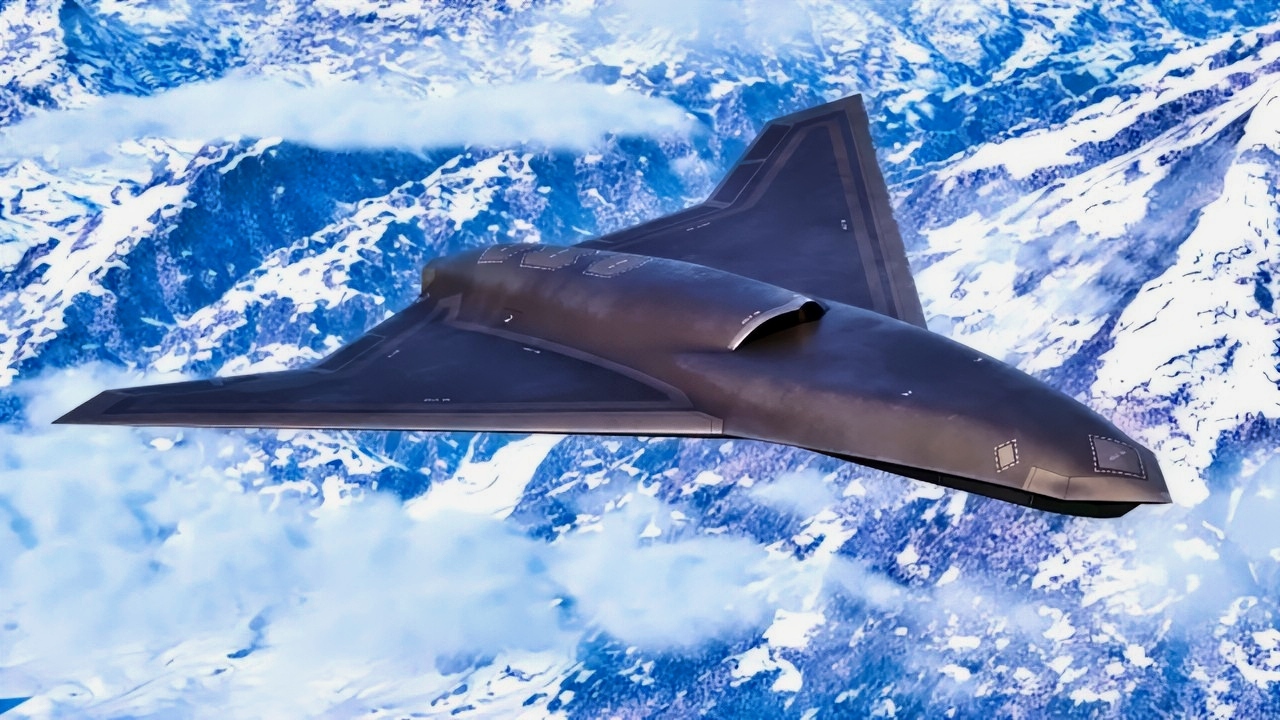
Key Points and Summary – Lockheed Martin’s Skunk Works has unveiled “Vectis,” a Group 5 stealth Collaborative Combat Aircraft built to fly alongside F-22s and F-35s as part of a next-gen “family of systems.”
-Revealed ahead of the Air Space & Cyber conference, Vectis fits Lockheed’s Agile Drone Framework and is sized between an F-16 and smaller CMMT drones.
-Early renderings show a tailless, lambda-wing design with a top intake and conformal apertures, optimized for sensing, electronic warfare, precision strikes, and air combat.
-Lockheed targets a first flight by late 2027 and says supersonic speed isn’t required. Vectis enters a hot CCA race against Boeing, Northrop, General Atomics, and Anduril.
Lockheed Martin Takes the Wraps Off Its Vectis Stealth Drone
On Sunday, Lockheed Martin’s Skunk Works took the wraps off the Vectis, which it describes as “a Group 5 survivable and lethal collaborative combat aircraft (CCA) to advance unparalleled air dominance for American and allied militaries.”
The Vectis, meant to work with 5th-generation aircraft and beyond, to advance what Lockheed describes as “the Family of Systems vision for next-gen air dominance.”
The Vectics’ development, Lockheed’s Skunk Works said, “is underway.”
“Parts are ordered and a team is executing,” Lockheed says.
The introduction arrived ahead of the Air Force Association’s Air Space and Cyber conference, which starts Monday in National Harbor, Maryland.
“Vectis is the culmination of our expertise in complex systems integration, advanced fighter development, and autonomy,” said OJ Sanchez, vice president and general manager, Lockheed Martin Skunk Works, in the announcement of the Vectis project.
“We’re not simply building a new platform – we’re creating a new paradigm for air power based on a highly capable, customizable, and affordable agile drone framework.”
First Flight?
Breaking Defense reported that Lockheed plans to fly the Vectis by the end of 2027. Sanchez told the outlet that the company “doesn’t point toward supersonic [speeds]” as a requirement for the Vectis drone. He also told them that the Vectis has been paired with the F-22 and F-35 in “operational analysis and simulations.”
In its own story, The War Zone reported that the new drone’s unveiling follows the company’s losing bid for the Air Force’s CCA program. It’s all part of what Lockheed calls the Agile Drone Framework.
While dimensions for the Vectis have not been revealed, Lockheed told The War Zone that the Vectis will be smaller than Lockheed’s F-16 fighter, but larger than Common Multi-Mission Truck (CMMT) drones.
Sanchez also told TWZ that Lockheed has been developing and fielding uncrewed platforms since the 1960s.
“That development spans across a spectrum of sizes and missions, to include the acknowledged L.O. [low-observable; stealthy] survivable system, the RQ 170, and other systems in the classified spaces,” he told the outlet.
A First Look
Per The Aviationist, Lockheed released a 30-second video mock-up of the Vectis, which “hints at Vectis being able to sense the battlespace, with multiple sensor apertures resembling the F-35’s EOTS and conformal antennas shown in the rendering.” The simulated video also shows the F-22, behind the Vectis, acting as the “quarterback” of the formation, in The Aviationist’s words.
“Renderings of Vectis from Skunk Works show a tailless drone with a lambda wing planform and a top-mounted air intake,” TWZ said of the released renderings of the Vectis.
“There is a pronounced chine line around the forward end of the fuselage and a shovel-like shape to the nose, as well as various conformal antennas and/or sensor apertures, all of which are indicative of low-observable (stealthy) design considerations.”
Axios described the Vectis as “a drone wingman,” which is “designed for surveillance, electronic warfare, precision strikes and aerial combat,” while noting that public rollouts from the normally secretive Lockheed Skunk Works.
Vectis, per Defense One, was not developed in order to win any specific contract. However, per Defense Daily, the new drone would likely fit the needs of Increment 2 of the U.S. Air Force Collaborative Combat Aircraft (CCA).
“Whether you call them drones, autonomous collaborative platforms or collaborative combat aircraft, we’ve been developing and fielding them since the early 1960s,” Sanchez told Axios.
Axios added that the drones could be used in such regions as the Indo-Pacific, the Middle East, and Europe, and that they will be “competitively priced,” although there was no dollar figure released.
Heavy Competition
Per The Aviationist, there’s a major competition underway, with American defense giants — Boeing, Northrop Grumman, General Atomics, and Anduril — working on the Air Force’s CCA program.
Back in early April, Air and Space Forces announced that the Air Force planned to “spend big and make Collaborative Combat Aircraft drones an essential part of its tactical fleet in the near future,” while the Navy was also looking to put manned and unmanned aircraft together as well.
As of then, at least two such drones, General Atomics’ YFQ-42 and Anduril Industries’ YFQ-44, had already been unveiled. In late August, in what the Air Force described as a “key development milestone” in the CCA program, the YFQ-42A took flight, less than two years from the program’s launch.
The flight took place at a test location in California.
“This milestone showcases what’s possible when innovative acquisition meets motivated industry,” Secretary of the Air Force Troy Meink said at the time of the launch.
“In record time, CCA went from concept to flight — proving we can deliver combat capability at speed when we clear barriers and align around the warfighter.”
Halfway Around the World
The drone competition within the U.S. is taking place as drones are more important than ever to the continuing war between Russia and Ukraine. Ukraine began the war with a drone advantage, but Russia appears to have closed the gap, thanks in part to its deal with Iran for the Shahed-136 drone, although the aftermath of that deal, which allows Russia to build the drones in its own territory, has reportedly left the two countries at odds.
Some Russian drones even ended up over Poland earlier this month, leading to a major international incident that included the scrambling of NATO jets. China has been developing advanced drones as well.
With the use of drones becoming increasingly important in modern warfare, USNI News reported earlier this month that five aviation companies had agreed to contracts with the Navy to “develop armed, unmanned aircraft and control systems for use on the Navy’s fleet of 11 aircraft carriers.”
Lockheed Martin was under contract for the common control system, with the other four companies, General Atomics, Boeing, Anduril, and Northrop Grumman, on board for the “conceptual design.”
That project is for the Navy, while the Vectis is more oriented to the Air Force.
About the Author: Stephen Silver
Stephen Silver is an award-winning journalist, essayist, and film critic, and contributor to the Philadelphia Inquirer, the Jewish Telegraphic Agency, Broad Street Review, and Splice Today. The co-founder of the Philadelphia Film Critics Circle, Stephen lives in suburban Philadelphia with his wife and two sons. For over a decade, Stephen has authored thousands of articles that focus on politics, national security, technology, and the economy. Follow him on X (formerly Twitter) at @StephenSilver, and subscribe to his Substack newsletter.
More Military
The U.S. Army’s Big Strategic Long Range Cannon (1,150 Mile Range) Mistake Still Stings
The F-4 Phantom II Has a Message for the U.S. Military
The Iowa-Class Battleships Have a Message for the U.S. Navy
Russia’s Kirov-Class Battlecruisers Have a Message for the U.S. Navy
Russia’s PAK DA Stealth Bomber Has a Message for the U.S. Air Force


