


When the Trump administration signed the Memorandum of Understanding (MoU), Washington never could have guessed that they were basically giving Iran a renewed lease on economic life.
But that is precisely what they did.
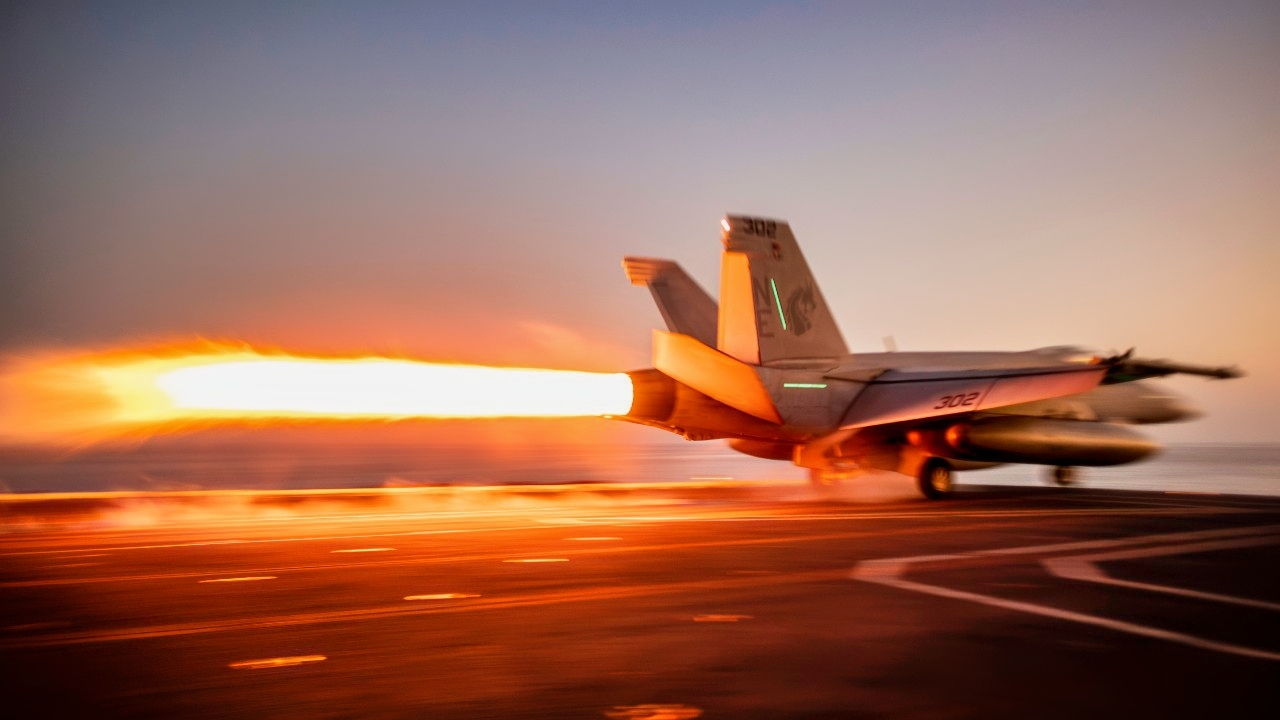
250429-N-FS097-1154 U.S. CENTRAL COMMAND AREA OF RESPONSIBILITY (April 28, 2025) An F/A-18E Super Hornet, attached to Strike Fighter Squadron (VFA) 192, launches from the flight deck of the Nimitz-class aircraft carrier USS Carl Vinson (CVN 70) in the U.S. Central Command area of responsibility. (Official U.S. Navy photo)

Members of the US Navy F/A-18F Super Hornet Demo Team performs a maneuver at the Wings Over South Texas Air Show. This year’s air show marks the first return of Wings Over South Texas to Naval Air Station Corpus Christi since 2019.
In fact, recent reporting indicates that the Iranians used the MoU period to further insulate themselves from the pressures of the US Navy’s counter-blockade, Washington’s economic sanctions, and the damage that the US military campaign against the Islamic Republic had imposed upon Tehran.
During the pause in hostilities, Iran exported around 70 million barrels of oil. That netted the besieged Tehran nearly $6 billion in gross value.
The sale of those 70 million barrels was about one month’s worth of Iran’s normal prewar exports to China, showing Iran’s ability to adapt and sustain itself despite pressures, which should inspire respect for its resilience.
What’s more, those funds will continue arriving in Iranian coffers for many weeks–possibly months–to come because the oil has already entered commercial channels (the oil has been shipped but payment occurs as cargoes are delivered and settled).
Tehran spared no time once the ceasefire and succeeding MoU (now over, of course) went into effect. On June 17, Washington dropped its opposition to Iran temporarily exporting oil to the market.
A week later, Iranian tankers moved out toward Malaysia unencumbered by the United States military (as per the dictates of the ceasefire agreement).
Earlier this month, dozens of cargoes flowed out of Iran. On July 6, though, attacks on commercial shipping triggered renewed US military action.
A week thereafter, on July 14, the US Navy reimposed its counter-blockade on the SoH.
Basically, Iran used every available day of that ceasefire period to maximize its exports before Washington closed the window on it again.
With that in mind, it becomes more obvious as to why the MoU collapsed. Washington recognized that Tehran was completely outmaneuvering it.
China Keeps Buying Iranian Oil
Essentially, there’s nothing that has yet stopped Iran’s sanction-busting network for selling oil on the global market.
Iran produces the oil, moves it out through the Strait of Hormuz (SoH), brings the shipments to Malaysia’s Eastern Outer Port Limits, conducts ship-to-ship transfers, and then those sources of oil are deployed to Chinese “teapot” refineries.
China’s independent refiners have had no compunction about purchasing discounted Iranian crude, even though the US has piled on sanctions over the years.
Indeed, ship-to-ship transfers make it harder to trace the origin of the oil, highlighting the limitations of US efforts and raising concerns about the effectiveness of the US counter-blockade of the Strait of Hormuz.
Washington’s Strategy Hits a Wall
As it turns out, Washington’s immediate leverage over Tehran is clearly weaker than anticipated.
The Trump administration assumed that it could effectively starve Iran out of its critical oil revenue basically overnight.
But that is not what happened. Indeed, Washington had hoped that its combination of counter-blockade and sanctions would have collapsed Iran’s ability to produce oil at all, forcing Tehran into a more pliant position.
The opposite occurred. Iran has a robust enough system for evading sanctions and the kind of pressure the US military imposed, allowing it to keep its production going (albeit at a reduced level compared to prewar rates), which was just enough to keep Iran’s economy afloat during the war.
Meanwhile, the US moves to stymie Iran have backfired in the sense that Iran has choked off movement of ships via the SoH; there are now concerns that Iran’s Houthi proxies in Yemen will do the same to the Strait of Bab el-Mandeb and the Red Sea, and Mideast oil producers see their capability to produce energy greatly reduced from both the blockades and the war itself.
These moves by Iran, therefore, have preserved some semblance of Iran’s economy whilst under siege. In contrast, the economies undergirding the West, such as the Gulf Arab states, totally imploded under the weight of the war.
If Washington Gets Serious
Washington finds itself in the difficult position of having to break a clearly stronger Iran than they were anticipating. The initial economic pressure campaign failed.
For the US to have any success in this domain, then, Washington will be required to maintain the counter-blockade for much longer than expected.
Since the counter-blockade has always been leaky, there remain questions as to how this will help the US war effort.
US intelligence must now spend its time identifying the shadowy ship-to-ship networks and working with the rest of the US government to sanction those movements.
While that is a possible task, it is a time-consuming one. And each day that Iran can do those ship-to-ship transfers is another day Iran grows stronger.
Washington could try to pressure Chinese buyers more aggressively. However, this method has proven inconclusive from the start.
Of course, the US Navy could interdict tankers farther downstream from the SoH. At the same time, such interdictions could risk evoking the ire of the thirsty Chinese (and the rest of the world depending on those critical Iranian energy supplies), which could lead to something worse for the US geopolitically.
Failure to do any of these things, however, will ensure that Iran benefits from the sale of its cargo already outside the Gulf.
What Does This Mean?
From a strategic perspective, this episode illustrates a recurring challenge in sanctions enforcement: timing matters as much as the sanctions themselves do.
If the reported figures are accurate, then temporary suspension gave Iran enough time to export roughly a month’s worth of oil before restrictions returned.
That doesn’t necessarily mean the renewed counter-blockade was totally ineffective–it may still reduce future exports if maintained–but it suggests that Tehran entered this new phase of the war with a larger financial cushion than it would have had.
These moves also explain why energy markets remain intensely fixated on shipping activity in the SoH. With the conflict escalating once more, renewed disruptions to exports and shipping are spiking oil prices again.
About The Author: Brandon J. Weichert
Brandon J. Weichert is Senior National Security Editor. He also manages The Weichert Brief on Substack. Weichert also hosts “National Security Talk” on Rumble. He is the author of four bestselling national security books, the most recent of which is A Disaster of Our Own Making: How the West Lost Ukraine (Encounter Books). Follow him via Twitter/X @WeTheBrandon.


