


Can Trump’s Tariff-First Foreign Policy Survive a Supreme Court Rebuff?
U.S. President Donald Trump is a fan of tariffs. Against decades of advice from economists and politicians on both sides of the aisle, Trump has made tariffs the cornerstone of his foreign and domestic policy.
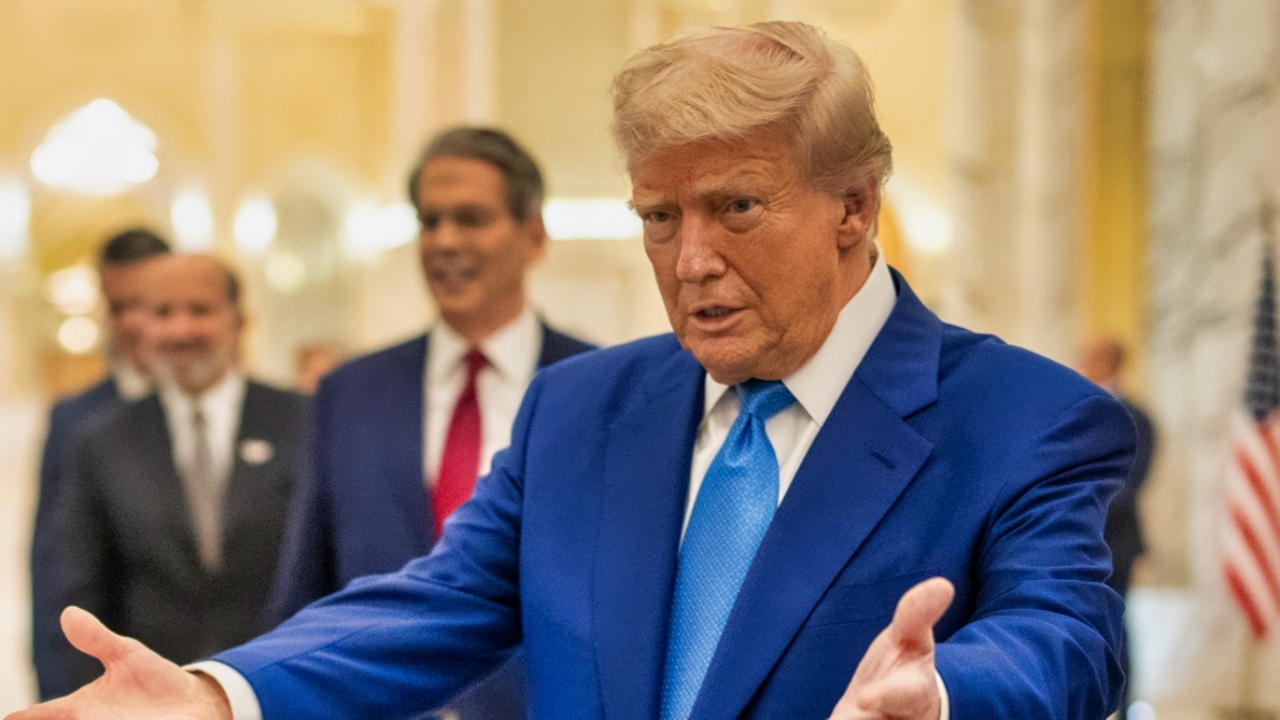
President Donald Trump participates in an welcome line at Qasr Al Watan in Abu Dhabi, United Arab Emirates, Thursday, May 15, 2025. (Official White House Photo by Daniel Torok)
He uses the threat of tariffs to make peace between foreign antagonists and to help out friends in duress.
Unfortunately for the administration, however, its authority to levy and manage tariffs is in question, and a case on the issue before the U.S. Supreme Court seems poised to go against Trump.
What effect might a check from the Supreme Court have? For one, it might seriously complicate the effort to use tariffs to craft a coercive foreign policy.
Tariff Authority
The U.S. Constitution places revenue-generating activities firmly under the authority of the legislative branch.
However, over the years Congress authorized the executive to use a variety of legal tools to manage tariff policy without direct congressional intervention. Trump has used the International Economic Emergency Powers Act (IEEPA) to levy tariffs.
The Act is a grant of emergency executive authority Congress made in the 1970s.
It allows a president to conduct a wide range of policies (including tariffs) without Congressional supervision in the case of an economic emergency.
Trump’s authority to use this act is now under serious threat. The Supreme Court has been largely sympathetic to the Trump administration this year, but justices sharply questioned the government’s position at a recent hearing on the IEEPA. The administration might have to find a new legal justification for tariffs if it wants to maintain its policy approach.
Long and Short Run Thinking
Tariffs do have short-term effects. They generate some revenue but increase prices to consumers; they change patterns of trade by forcing partners to seek better arrangements elsewhere; and they generate bad feelings diplomatically.
However, the important effects of tariffs occur over the long term.
Historically, interest in tariffs is driven less by revenue and more by their effects on domestic industry.
Sufficiently high tariff rates can protect industries from foreign competition and can even drive industrial revival by creating downstream demand for domestic products.
Crucially, however, investors must have a sufficiently long time horizon to build new factories, supply chains, and workforces. This means producers have to believe the tariff protections will be around for a long time.
Trump has also used tariffs as a coercive foreign-policy tool. When war flared between Thailand and Cambodia, Trump threatened tariffs to bring both parties to the table. Same with India and Pakistan. Trump has threatened tariffs on Russia’s trading partners, including India.
When Brazil displeased Trump by prosecuting a former president accused of instigating a coup, Trump threatened tariffs. And tariffs are core to the long-term trade deals Trump has reached with various trading partners. Most of the deals offer lower tariff rates in exchange for investment over a long period of time.
This is where the Supreme Court’s decision matters. If Trump cannot legally impose tariffs, or manage them from the executive branch, these deals all become precarious.
Will South Korea pony up the $300 billion in investment that it promised in exchange for lower tariffs, if Trump doesn’t actually control tariff policy? Probably not. Every deal that Trump has compelled a foreign government to undertake, economic or political, becomes worthless if he loses the ability to levy tariffs.
Other Tools
If the Supreme Court strikes down Trump’s tariff authority, all is not immediately lost. The administration has multiple other avenues for imposing and maintaining tariffs, although none is as flexible or legally sound as what Trump has already tried.
These methods include a variety of legal tools that have gathered dust for decades and are generally unsuited to the tariff war the president wants to wage. But in certain cases, some of them may work for a time. What they will not do, however, is give the president the flexibility to use tariffs to accomplish coercive foreign-policy ends.
What about Congress? Tariffs are currently polling heavily in the negative, suggesting that Trump’s supporters in Congress would have to take substantial risks to create a legal framework for Trump’s desired tariff policy.
The Senate GOP caucus has already demonstrated little interest in running that kind of risk, which is unsurprising for a party that just a few years ago was categorically committed to free trade.
Conceivably Trump could try to assemble a bipartisan coalition on tariff authority, but that seems extremely unlikely given polarization and negative feelings among Democrats. All things considered, the collapse of Trump’s authority over tariffs seems more a matter of “when” than “if.”
What Happens Next?
These political realities also suggest that the use of tariffs as a coercive foreign-policy tool will not survive the Trump administration, and possibly not even the midterm elections.
Few Republicans have expressed the kind of support for tariffs that would suggest an interest in running on the issue in 2028.
Democrats have become more hostile to trade barriers because of their association with Trump. It is possible that Trump’s scheme to distribute $2,000 to every American based on tariff revenue will shift public opinion—but then again, the plan isn’t even popular in his own party.
All this means that the United States runs an enormous long-term risk by relying on tariff policy to compel foreign countries to bend the knee.
As soon as doubt takes hold about the capacity and willingness of the U.S. to levy and maintain large-scale tariffs, Trump’s coercive power will evaporate.
About the Author: Dr. Robert Farley, University of Kentucky
Dr. Robert Farley has taught security and diplomacy courses at the Patterson School since 2005. He received his BS from the University of Oregon in 1997, and his Ph. D. from the University of Washington in 2004. Dr. Farley is the author of Grounded: The Case for Abolishing the United States Air Force (University Press of Kentucky, 2014), the Battleship Book (Wildside, 2016), Patents for Power: Intellectual Property Law and the Diffusion of Military Technology (University of Chicago, 2020), and most recently Waging War with Gold: National Security and the Finance Domain Across the Ages (Lynne Rienner, 2023). He has contributed extensively to a number of journals and magazines, including the National Interest, the Diplomat: APAC, World Politics Review, and the American Prospect. Dr. Farley is also a founder and senior editor of Lawyers, Guns and Money.
More Military
The Essex-Class Aircraft Carriers Have An Embarrassing Message for the U.S. Navy
‘New’ Mach 4 MiG-41 6th Generation Stealth Fighter Has Warning for U.S. Air Force
Boeing’s F-47 NGAD 6th Generation Stealth Fighter Is No ‘Mission Impossible’


Jim
November 17, 2025 at 1:49 pm
The power to tax is the power to destroy and it rests firmly in the hands of Congress.
As Chief Justice of the Supreme Court, John Roberts, expressed, at oral arguments, core functions or powers, explicitly granted as an organic power in the Constitution cannot be delegated away.
The court over many years has gradually chipped away the non-delegation doctrine, but has never explicitly overruled it, and this case will be a Land Mark case in constitutional articulation and extent upon that doctrine whichever way it goes.
The power of Congress to tax shall not be delegated to the President or the Judiciary.
Even in Royal ol’ England with all the Crown prerogatives, it was the Parliament, who raised taxes. And that power was gained through hard fighting and held tightly by those who wanted to limit the Crown’s arbitrary power.
Trump really worked himself out on the end of a limb on this one… I think the court is poised to cut it off.
Tariffs as a coercive foreign-policy tool to use as a club to force agreements is a grave and great mistake.
There is a place for “balancing mechanisms” to prevent labor arbitrage, lax regulations, say environmental, or state subsidies from creating an unfair advantage in international trade (or encouraging offshoring & outsourcing from domestic producers).
What Trump has done is to turn it into a quasi-method of not just force, but war, as historically, trade embargoes used to compel foreign nations to do specific actions or pay tribute, were considered acts of war.
Congress has the expressed power to declare war, not the President.
And, we see where this untethered power can go.
Trump is poised to engage in an act of military aggression against a foreign country… and seems to be in no hurry to inform Congress.
We wait upon his excellencies’ decision.
Supreme Court tea leave readers suggest the court will strike down Trump’s tariffs as an unconstitutional usurpation of power against the express intent of the Constitution’s granting of power to tax to Congress.
But who knows, anyway, we’ll see.
if struck down, talk about a spanner in the works… that’s for sure.
But throwing the Constitution’s strictures out the window for the sake of Trump’s unfettered power is short-sighted and a grave mistake for the long-term future of this great republic and the rule of law among men.