

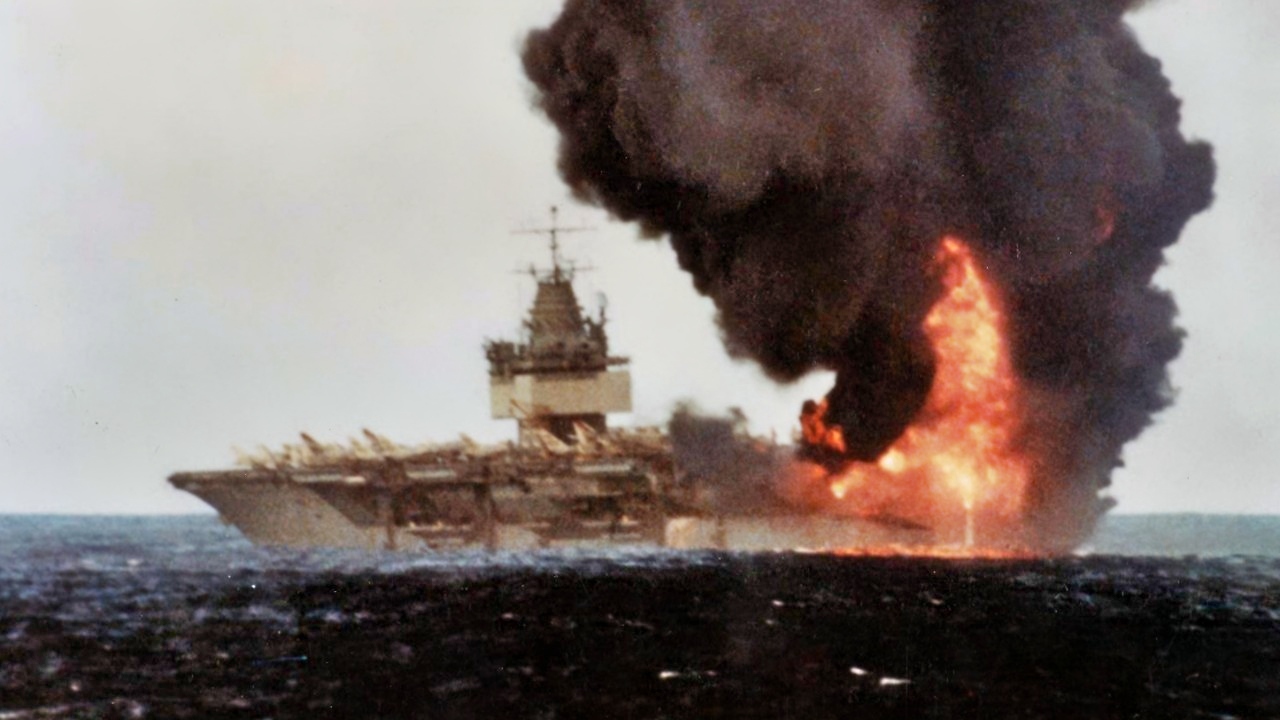
Fire remains the most dangerous threat to a U.S. aircraft carrier — and the U.S. Navy’s newest, the USS Gerald R. Ford, just proved it. During the Operation Epic Fury campaign against Iran, a fire in the carrier’s laundry burned for 30 hours, displaced more than 600 sailors from their berthing racks, injured 3 directly, and caused as many as 200 cases of smoke inhalation. The carrier withdrew to Naval Support Activity Souda Bay, Greece for repairs. The historical record runs deep: Japan lost all four of its aircraft carriers to fire at Midway in June 1942. The USS Forrestal fire of 1967 killed 134 sailors. China does not need to sink a U.S. carrier — it just needs to set one on fire.
Fire Is What Aircraft Carrier Captains Fear
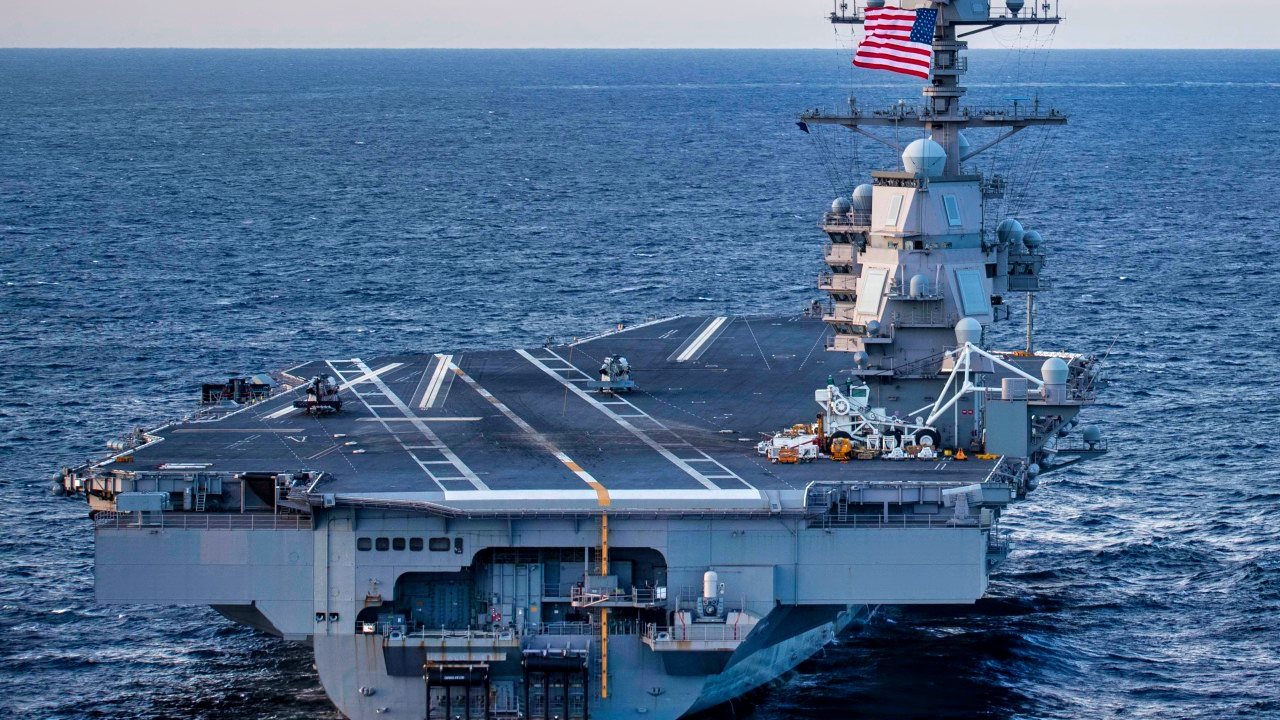
The Ford-class aircraft carrier USS Gerald R. Ford (CVN 78) and the Italian aircraft carrier ITS Cavour (CVH 550) transit the Atlantic Ocean March 20, 2021, marking the first time a Ford-class and Italian carrier have operated together underway. As part of the Italian Navy’s Ready for Operations (RFO) campaign for its flagship, Cavour is conducting sea trials in coordination with the F-35 Lightning II Joint Program Office’s Patuxent River Integrated Test Force to obtain official certification to safely operate the F-35B. Gerald R. Ford is conducting integrated carrier strike group operations during independent steaming event 17 as part of her post-delivery test and trials phase of operations. (U.S. Navy photo by Mass Communication Specialist 3rd Class Riley McDowell)
The age of the aircraft carrier has proven many things in the past 85 years. One is that the aircraft carrier, despite becoming increasingly vulnerable in the 21st century, remains the largest power-projection platform in the world’s oceans.
The other is that fire remains the carrier’s biggest enemy. And a raging fire onboard, while it will frequently lead to the carrier sinking, isn’t necessary to take it out of the fight.
And while carriers have outstanding firefighting equipment and damage control parties, the amount of aircraft, aviation fuel, lubricants, hydraulic fluids, other chemicals, and weapons in their organic armament still makes them highly vulnerable to fire.
Fires aboard U.S. Navy warships are among the most dangerous combat and non-combat threats sailors face at sea.
Our enemies at sea don’t necessarily need to sink American carriers in a conflict, but setting them on fire quickly will suspend air operations and take them out of the fight.
Lessons Learned: The Laundry Fire Of The USS Gerald R. Ford
During the recent air campaign against Iran, the US’s newest carrier, the USS Gerald R. Ford, suffered a devastating fire in the laundry area that burned for 30 hours and displaced more than 600 sailors from their berthing racks.

(July 28, 2017) An F/A-18F Super Hornet assigned to Air Test and Evaluation Squadron (VX) 23 approaches the aircraft carrier USS Gerald R. Ford (CVN 78) for an arrested landing. The aircraft carrier is underway conducting test and evaluation operations.(U.S. Navy photo by Erik Hildebrandt/Released) 170728-N-UZ648-161
The carrier was forced to withdraw from its place during the air campaign and sail to the Naval Support Activity Souda Bay, Greece, for repairs. Three sailors were injured in the blaze, while as many as 200 suffered from smoke inhalation.
This incident wasn’t even combat-related, but it shows the dangers of fire on board a ship.
The Nimitz and The Kitty Hawk Have Suffered Major Fires
The USS Nimitz (CVN-68) has had three major fires on board. None of which occurred in combat.
On May 26, 1981, a deadly disaster and fire struck the aircraft carrier USS Nimitz while operating at night off the coast of Florida. An EA-6B Prowler jet crash-landed on the flight deck, triggering massive explosions and a fire that killed 14 crew members and injured 45 others.
At approximately 11:50 p.m., a fuel-critical EA-6B Prowler drifted to the right during its landing approach and crashed into a cluster of parked, fully fueled and armed aircraft on the flight deck.
The impact and subsequent explosions created a massive fireball. The blaze caused over $100 million in damages, destroying or heavily damaging 11 other aircraft.
The USS Kitty Hawk suffered a major mechanical fire in the engine room in 1973 off the coast of the Philippines. Although it was extinguished in an hour, the blaze killed 6 sailors and injured 38 more.
In 1967, the USS Forrestal fire was one of the worst shipboard fires in American history. In that inferno, 134 sailors were killed after an accidental rocket launch on the flight deck caused a fuel tank rupture and triggered multiple bombs to detonate.
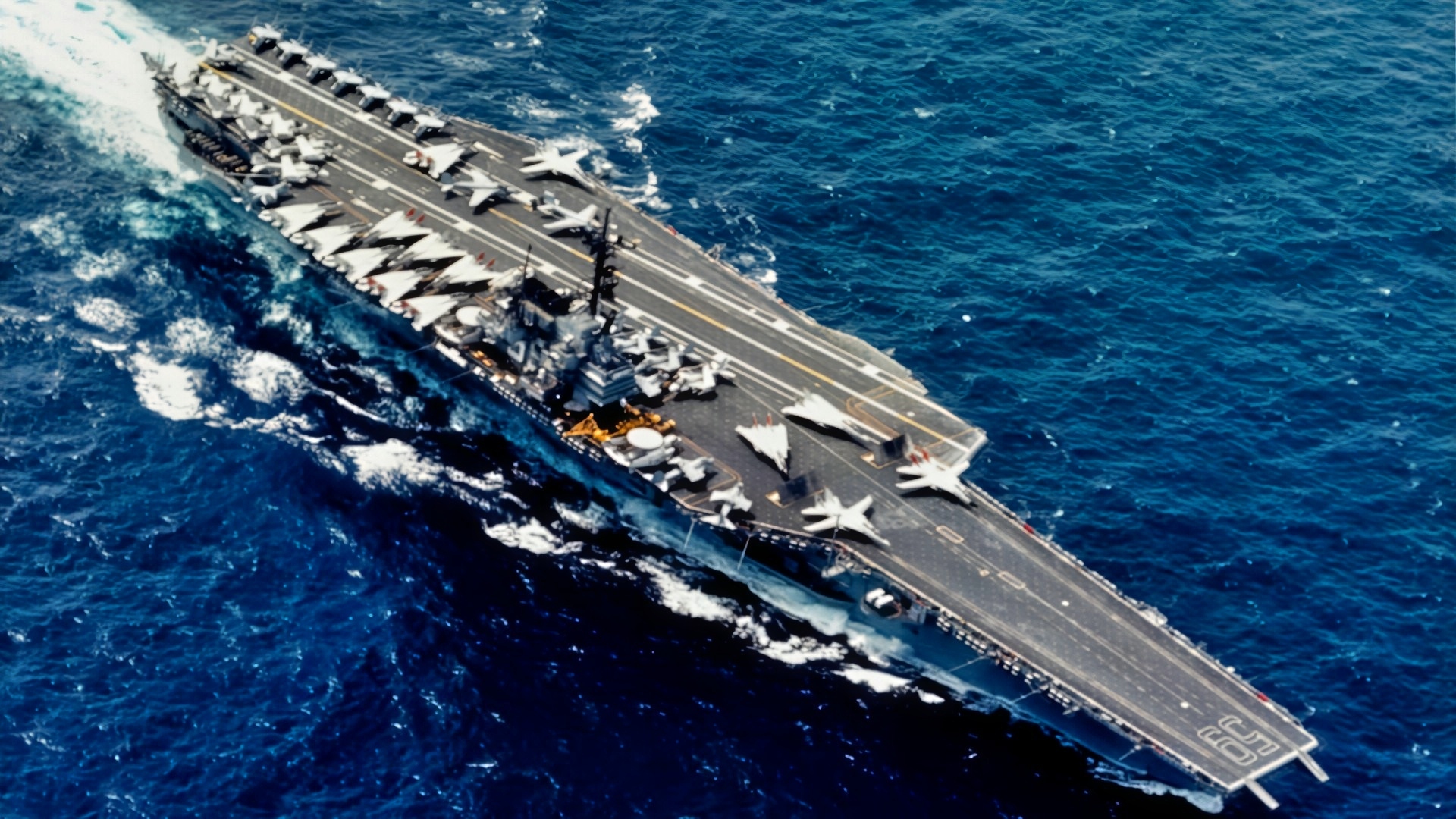
USS Forrestal Aircraft Carrier. Image Credit: Creative Commons.

USS Forrestal. Image Credit: Creative Commons.
The Battle Of Midway, Where Fire Destroyed Japan’s Carriers
During the pivotal battle at sea that turned the tide of the war in the Pacific, the Japanese lost four of the best aircraft carriers that were turned into flaming wrecks, all of which eventually sank.
U.S. Navy dive bombers caught the carriers with decks full of fueled and armed planes, sparking catastrophic, uncontrollable fires that forced the crews to abandon and scuttle them.
Akagi: Struck by U.S. dive bombers on the morning of June 4, 1942. Exploding aviation gas and exposed ordnance ignited uncontrollable fires. She burned through the night and was scuttled by Japanese destroyers on June 5.
Kaga: Hit by at least four bombs from USS Enterprise dive bombers. The blasts ruptured aviation fuel tanks and knocked out the CO2 fire suppression system. After blazing infernos consumed the ship, she was scuttled.

Forrestal-Class Aircraft Carrier in Drill U.S. Navy Photo
Sōryū: Struck by three bombs that caused massive fires and secondary explosions on the hangar deck. She was abandoned and sank later that afternoon.
Hiryū: The only carrier to survive the initial American strike. After her planes successfully attacked the USS Yorktown, Hiryū was struck by U.S. dive bombers, set completely ablaze, and rendered helpless. She was scuttled the following morning.
China’s Anti-Access/Area Denial Strategy
China’s “carrier-killer” missiles are a core component of its broader A2/AD strategy, intended to push U.S. naval forces beyond an effective strike range.
The strategy was influenced by a 1996 incident during the Taiwan Strait Crisis, when China felt humiliated by its inability to counter the presence of U.S. carrier groups.
China has developed a sophisticated “kill chain” network of reconnaissance satellites, over-the-horizon radars, and drones to locate, track, and provide targeting data for its anti-ship missiles.
In a conflict, China would likely launch a coordinated, high-volume salvo of anti-ship missiles to overwhelm a carrier strike group’s defenses.
And the missiles launched at the carriers don’t have to sink the supercarriers. A large fire on the flight deck that disables the EMALS and/or arresting gear will take the carrier out of the fight. Which would take out the entire carrier strike group.
Fire Remains The Biggest Enemy To US Carriers
Despite the risks to US carriers by Chinese or Iranian ballistic missiles (some of which were supplied by China), the US places enormous emphasis on fire prevention and response.
However, it should be noted, “reports have surfaced that Iran fired 50 of the much-ballyhooed Chinese CM-302 anti-ship missiles at American carriers in the Gulf, and that they were either all shot down or destroyed on the ground.
American warships are equipped with sophisticated detection systems, including heat sensors, smoke detectors, and automated alarms. Fire suppression systems—ranging from sprinklers to specialized foam and gas-based extinguishing agents—are designed to quickly contain outbreaks.
Fires, however, remain the most dangerous onboard threat to US carriers, capable of disrupting operations.
Which is why, even in peacetime, the Navy must balance deployment scheduling, damage control training, and maintenance scheduling to keep its ships in prime condition.
About the Author: Steve Balestrieri
Steve Balestrieri is a National Security Columnist. He served as a US Army Special Forces NCO and Warrant Officer. In addition to writing on defense, he covers the NFL for PatsFans.com and is a member of the Pro Football Writers of America (PFWA). His work was regularly featured in many military publications.


