

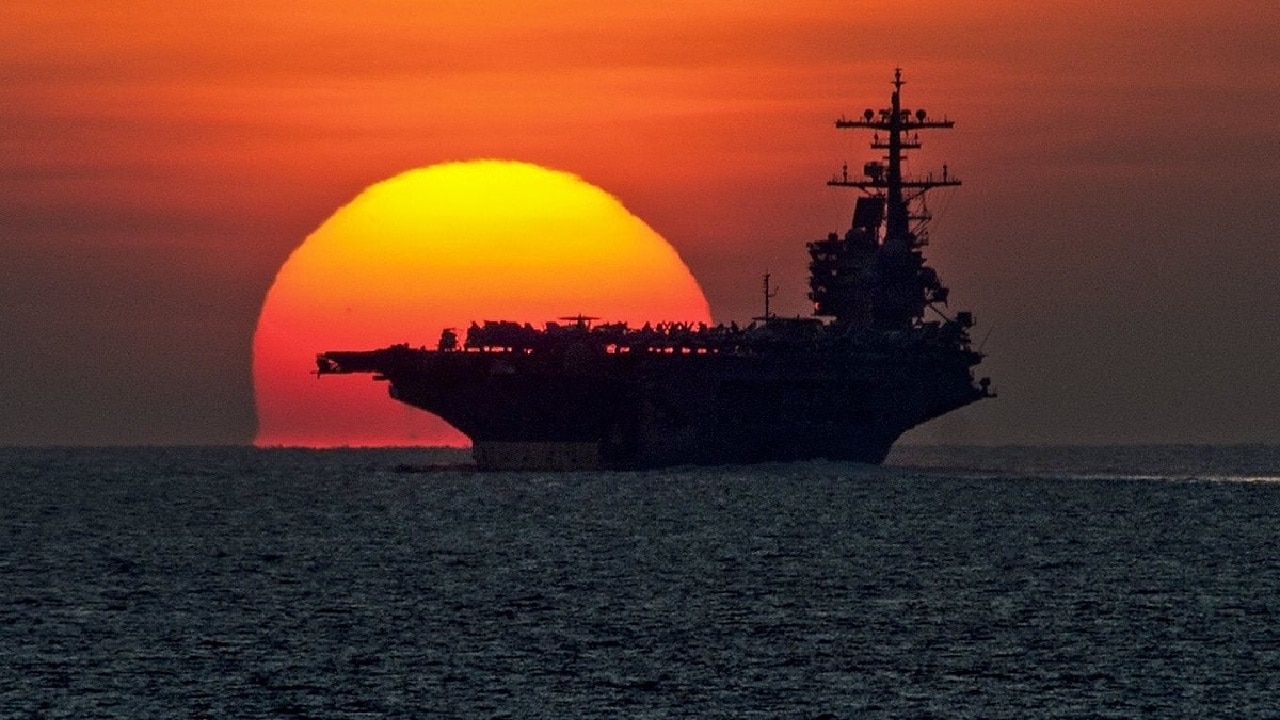
The Strait of Hormuz Standoff Is A Game of Economic Chicken. Neither Iran Nor The West Can Win: Iran held its fire on Monday, declining to answer Israel’s overnight strikes with another missile barrage, and the immediate relief is real. But the missile-by-missile drama has been obscuring the more important contest, the one that will actually decide how and when this ends. It is an economic staring match over the Strait of Hormuz, and the longer it runs, the more both sides lose. The strait has been effectively shut since late February, the world is draining the emergency reserves that have so far prevented catastrophe, and Iran is strangling its own economy to keep its grip on the chokepoint.
The only rational way out is a deal.
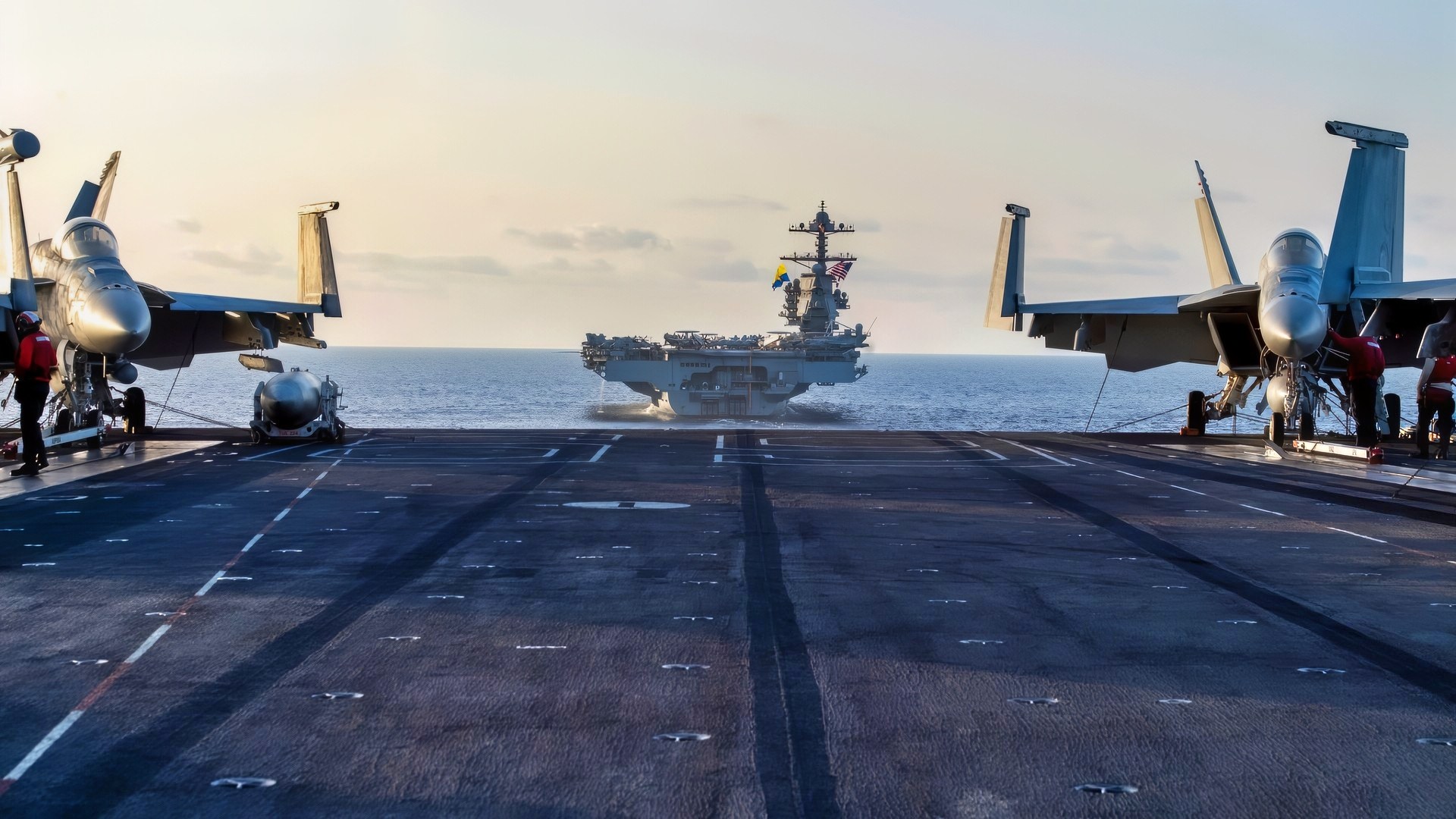
USS Eisenhower Aircraft Carrier. Image Credit: U.S. Navy.
The danger is that neither side blinks before the buffer runs dry.
The Shrinking Cushion: SPR Releases And The IEA Drawdown
The reason this has not already become a global catastrophe is that governments opened their emergency taps.
After Iran closed the strait, the International Energy Agency’s members announced an emergency release of more than 400 million barrels from government stockpiles, roughly 301 million of it crude, to offset a supply shock on the order of a fifth of the world’s oil.
That intervention, and America’s comparative insulation from its own Strategic Petroleum Reserve and domestic production, is the only thing that has kept benchmark prices below the records set after Russia’s 2022 invasion of Ukraine.
But a stockpile is a one-time cushion, not a faucet you can leave running. The world has been burning through its oil inventories at record speed, with Morgan Stanley estimating that global stockpiles fell by about 4.8 million barrels a day over a roughly eight-week stretch this spring, far exceeding any prior quarterly drawdown in the IEA’s records, as more than a billion barrels of normal supply vanished from the market.
The arithmetic is brutal. Measured against world consumption of around 105 million barrels a day, the entire emergency release covers only a handful of days of global demand, and only about twenty days of the strait’s normal flows.

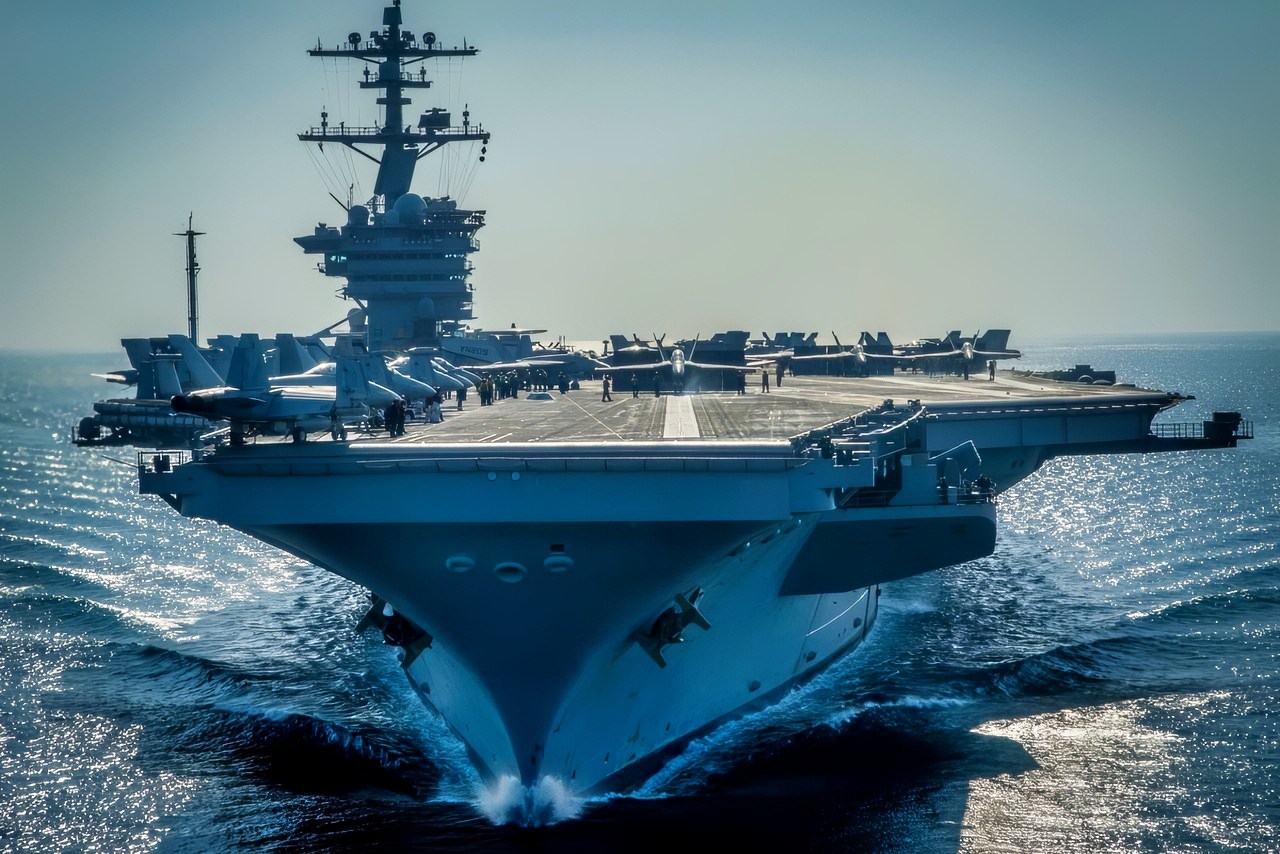
Aircraft Carrier Nimitz-Class Back. Image Credit: Creative Commons.
Reserves can calm a panicked market, but they cannot manufacture new oil or reopen a closed waterway.
When The Risk Premium Becomes A Physical Shortage
So far, the crisis has been expensive but manageable, a fear premium baked into prices rather than empty tanks at the refinery. That is changing. The IEA has called the closure the largest supply disruption in the history of the global oil market, with worldwide production driven to four-year lows and Gulf exports at their lowest since 2016. The longer the Strait stays shut, the more the problem shifts from a tradable risk premium to a genuine physical shortage that no financial maneuver can paper over.
The forward projections are grim. Analysts warn that if the closure drags into September, the market could face severe disruption, with roughly 12 million barrels a day of export supply at risk and Brent crude, already up sharply since the war began, potentially reaching $150 a barrel. The pain is not evenly distributed.
The United States is cushioned for now, but import-dependent economies across the Global South are already in acute distress, and India has raised fuel prices as shortages bite. Each week the standoff continues, the cushion thins, and the eventual shock grows larger.
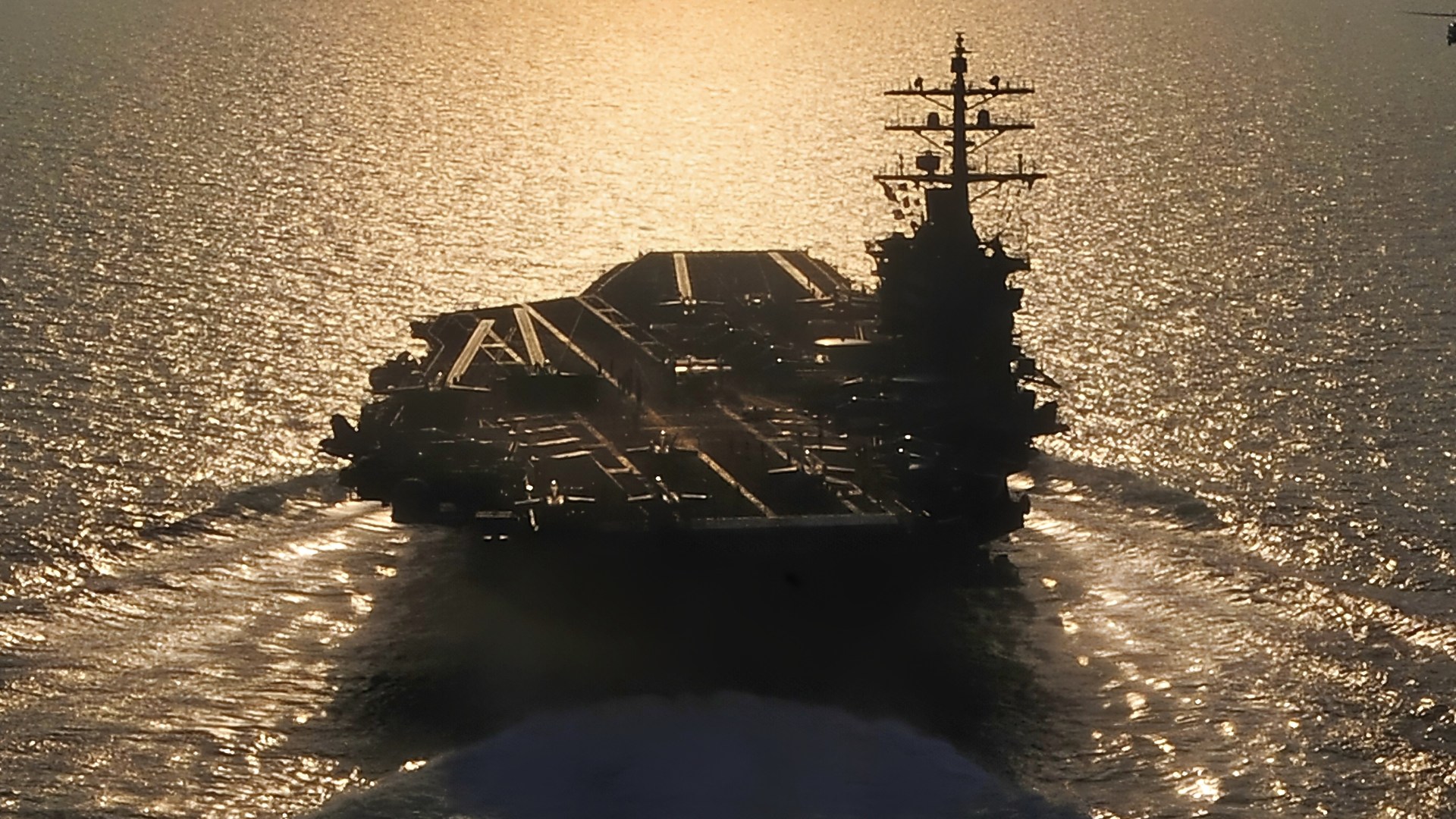
141208-N-WD464-386 ARABIAN GULF (Dec. 8, 2014) The Nimitz-class aircraft carrier USS Carl Vinson (CVN 70) prepares for flight operations in the Arabian Gulf. Carl Vinson is deployed in the U.S. 5th Fleet area of operations supporting Operation Inherent Resolve, strike operations in Iraq and Syria as directed, maritime security operations, and theater security cooperation efforts in the region. (U.S. Navy photo by Mass Communication Specialist 2nd Class Alex King/Released)
Iran Is Bleeding To Make The World Bleed
Here is what makes the standoff a true game of chicken: Iran is inflicting grievous harm on itself to hold its leverage.
Closing the strait is Tehran’s primary weapon, but the same blockade that throttles the West also severs Iran’s own economic lifeline, because more than 90 percent of the country’s trade passes through the very waterway it has shut. The International Monetary Fund projects Iran’s economy will contract by 6.1 percent this year amid inflation approaching 69 percent, with the rial collapsing to over 1.3 million per dollar. Oxford Economics has warned that a sustained US blockade could cut off 70 percent of Iran’s export revenues.
That revenue is not a luxury for the regime; it is survival. Oil exports were worth at least $30 billion last year and have accounted for roughly a quarter of government revenue, with the Islamic Revolutionary Guard Corps (IRGC) processing about half of the country’s oil sales and standing to collect tolls from ships crossing the strait. Strangling the chokepoint chokes the IRGC’s own finances and a state already battered by sanctions, currency collapse, and the protests that produced. Iran is betting that it can endure economic agony longer than its adversaries can endure high oil prices. It is a bet placed from a position of profound weakness.
China Is The Customer Iran Cannot Afford To Lose
The self-harm runs deeper still, because the blockade alienates the one partner Iran most depends on. The overwhelming majority of Iranian crude flows to China, the buyer that has kept the sanctioned economy afloat, and the war is now damaging China’s economy too, depressing demand for Chinese exports and exposing Beijing to the energy shock rippling out of the Gulf. A prolonged closure squeezes the customer whose purchases fund the Iranian state, giving Beijing every reason to lean on Tehran to end the disruption. Iran has effectively pointed a gun at the wallet of its own indispensable patron. That is not the posture of a country with a strong hand; it is the desperation of a regime with few cards left, playing the one card it has as hard as it can.
120710-N-RY232-571 MEDITERRANEAN SEA (July 10, 2012) – An SH-60F Seahawk from the Nightdippers of Helicopter Anti-Submarine Squadron (HS) 5 flies alongside Nimitz-class aircraft carrier USS Dwight D. Eisenhower (CVN 69), July 10. Dwight D. Eisenhower is on a regularly scheduled deployment in support of Maritime Security Operations (MSO) and Theater Security Cooperation (TSC) efforts in the U.S. 5th and 6th Fleet areas of responsibility. IKE deployed as part of Eisenhower Carrier Strike Group (CSG), which includes CSG 8, IKE, guided-missile cruiser USS Hue City (CG 66), guided-missile destroyer USS Farragut (DDG 99), guided-missile destroyer USS Winston S. Churchill (DDG 81), USS Jason Dunham (DDG 109), the seven squadrons of Carrier Air Wing (CVW) 7, and Destroyer Squadron 28. (U.S. Navy photo by Mass Communication Specialist 2nd Class Julia A. Casper/Released)
The Deal Both Sides Need And Keep Avoiding
The logic of a settlement is overwhelming, which is why an agreement has reportedly been within reach. Reopening the Strait relieves the physical shortage before the world’s reserves are exhausted, lets Iran sell oil again and stop the freefall in its currency and its budget, and defuses an inflation threat that menaces American consumers, Chinese factories, and European households alike.
Even the crisis itself contains its own off-ramp, since the energy emergency could ease quickly the moment the shooting stops and transit resumes. Washington has signaled it wants the waterway reopened by negotiation, even as it has raised the prospect of using force to reestablish free passage if diplomacy fails.
The obstacle is the nature of the game. Each side believes it can outlast the other, and that conviction is precisely what keeps both from folding. Iran ties any deal to a broader settlement that includes Lebanon, layering a political demand on top of the economic one. And draining reserves creates a perverse incentive: as the cushion shrinks, the cost of miscalculation rises, which can make a cornered regime more reckless rather than more pragmatic. Weekend escalations like the one just survived show how a single bad decision can torch a near-complete agreement. The economics point relentlessly toward a deal that reopens the strait and lets everyone stop bleeding. Whether Tehran and Washington can stop daring each other to flinch long enough to sign it is the question the oil market and the world economy are now waiting on.
About the Author: Harry J. Kazianis
Harry J. Kazianis (@Grecianformula) was the former Senior Director of National Security Affairs at the Center for the National Interest (CFTNI), a foreign policy think tank founded by Richard Nixon based in Washington, DC. Harry has over a decade of experience in think tanks and national security publishing. His ideas have been published in the NY Times, The Washington Post, The Wall Street Journal, CNN, and many other outlets worldwide. He has held positions at CSIS, the Heritage Foundation, the University of Nottingham, and several other institutions related to national security research and studies. He is the former Executive Editor of the National Interest and the Diplomat. He holds a Master’s degree focusing on international affairs from Harvard University.


Dr. Hujjatullah M.H.Babu Sahib
June 8, 2026 at 2:29 pm
Despite the many points that one may disagree with, this is a very responsibly articulated write-up that briefly surveys the global impacts of the ongoing crisis which it, however, wrongly bills as energy-linked. In actuality, the high-techno-savvy world is oozing energy through all its pores, be it day or night, if we consult the world’s competent scientists. Just recently, reports have emerged that scientists are capable of reaping viable energy of the moon on Earth itself even during night time, not to also mention the numerous other alternative and renewable energies that are cheaply exploitable too. So, it is not really an ENERGY crisis but rather a petro-chemicals and hydro-carbons crises for which crude remains the rude king at least for the near to mid-term futures. Kazianis is on the dot when he says: “a bet placed from a position of profound weakness” by Iran. As a matter of fact, I.R. Iran has bled right from the time of the Iraq-Iran war sponsored by the U.S. and its Middle Eastern allies, while its allies spread across the world, inexplicably, watched and silently prayed for a Iraq-U.S. victory ! So, we can’t be sure, if I.R. Iran is now bleeding just for leverage or also in revenge ? Trump may know something that the rest of the world don’t !