


The Iran Ceasefire Won’t Fix the Energy Crisis Anytime Soon: With the markets and Washington breathing a deep sigh of relief over the informal signing of a Memorandum of Understanding (MoU) between the Islamic Republic of Iran and the United States, the forty-seventh president of the United States is giddily speaking about the prospects of the Strait of Hormuz reopening “immediately.”
Markets Are Celebrating. Energy Reality Is Different
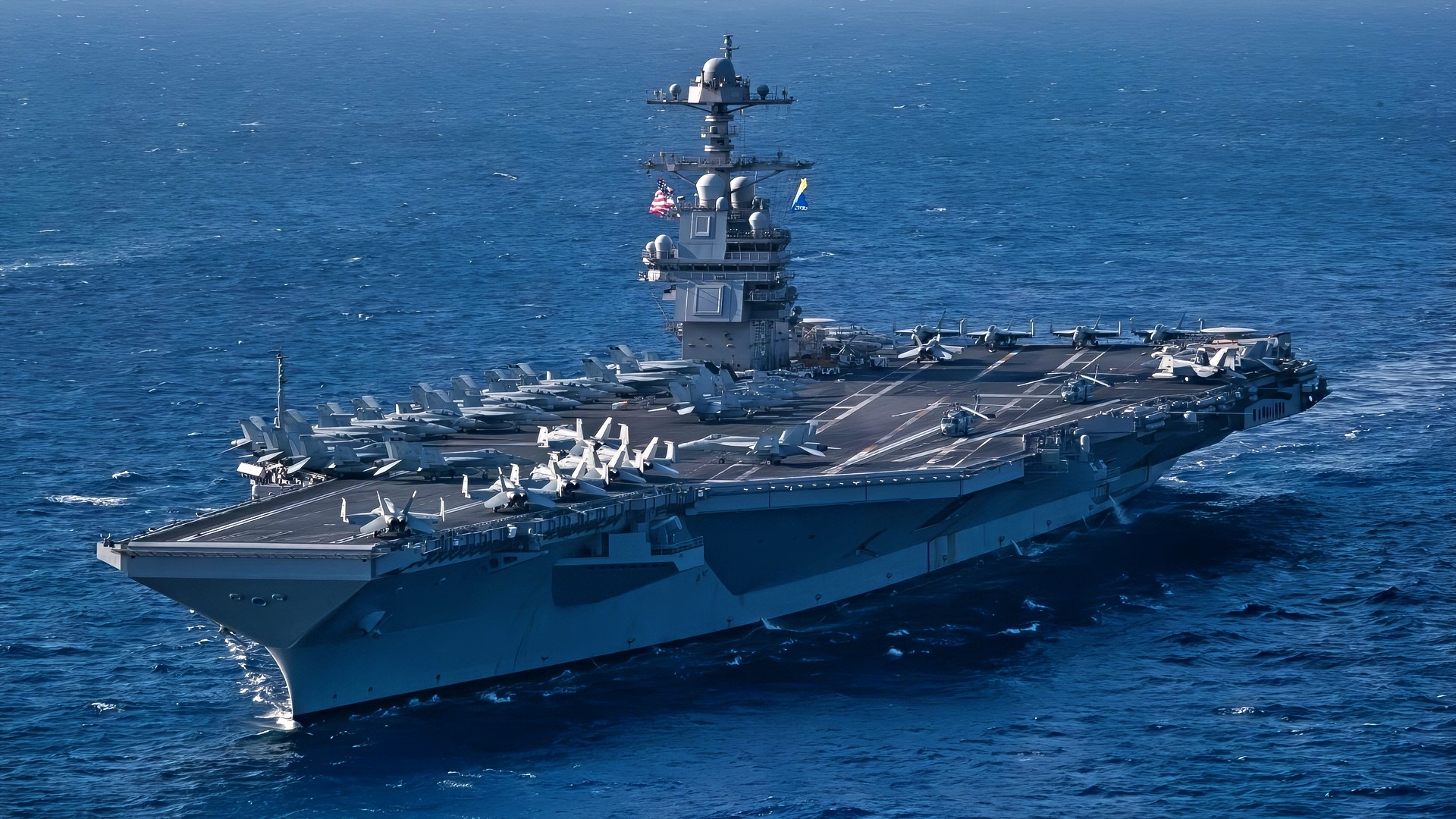
USS Gerald R. Ford Aircraft Carrier At Sea. Image Credit: Creative Commons.
The Gulf Arab states, among the world’s top energy producers, are undoubtedly breathing a (cautious) sigh of relief, too.
After all, their economies are inextricably linked to their countries’ ability to move their vast energy supplies from the Middle East to global markets.
Since the Iran War began on February 28, the Gulf Arab states have been unable to either produce much oil and natural gas or to move those supplies safely out of the region.
Some states, like Saudi Arabia, have been able to maintain some degree of production and shipment of their supplies, but that is not the case for many other countries in the region.
What few seem to understand in the media and what few appear unwilling to acknowledge in Washington is that the region has not only been harmed by the Iranian quasi-blockade of the Strait of Hormuz and the rather leaky American counter-blockade outside of the Strait, but the production facilities in the region themselves have been damaged by the war.
Many of those facilities were directly hit by missiles and drone strikes during the course of the more than 100-day war.
Meanwhile, the facilities that weren’t directly damaged by the war were indirectly damaged by it.
Why Energy Infrastructure Cannot Simply Be Switched Back On
That’s because production facilities had to be shut down.
Once massive oil refining and production facilities, with their complex web of machines, must be shut down due to a temporary halt in operations, restoring those complex systems is difficult, to say the least.
Restarting the facilities in question is not like flipping a switch. During more than 100 days of the war, major oil fields were shut down, refineries were damaged, and export terminals were significantly disrupted.
At the same time, the critical functions of the region’s top Liquified Natural Gas (LNG) facilities were interrupted. Maintenance schedules for these already complex systems were thrown into chaos, too, which will have serious, long-term negative impacts on their viability.
Qatar is the Biggest Story Here
One underappreciated issue highlighted by multiple energy analysts is natural gas.
Oil production can be restarted more quickly and easily than LNG infrastructure. The damage and disruptions to Qatari production will last longer than what many traders have priced into their models for the rest of the year.
Indeed, The Guardian reports that, should this very tenuous 60-day ceasefire hold–and if it does lead to the unlikely outcome of a real peace deal occurring between the warring parties in the region–the normalization of regional energy exports will not occur until mid-to-late 2027 at best.
Europe and Asia (specifically key regional allies such as South Korea, Japan, and Taiwan) will be adversely affected by the prolonged recovery, as they rely disproportionately on imported Mideast LNG.
Iran War Crisis: The Strait of Hormuz Problem Isn’t Solved
At the same time, many commentators in the West are pretending as though the Strait of Hormuz has been fully reopened.
It has not. What’s more, the Iranians have made plain their intention to enact tolls on any ships utilizing that strategic waterway after the 60-day MoU terminates, regardless of whether a greater peace deal is forged between Washington and Tehran or not.
Nearly one-fifth of the world’s LNG and oil trade relies upon safe and easy transit through the Strait. Even if everything between Iran and the United States go as the two sides hope it will (ceasefire leading to peace deal), the international shipping industry and its attendant insurance firms, notably Lloyd’s of London, will not fully return to normal functions for months, if not years, after the war ends (which, again, there is little probability that the war will, in the long term, be over).
Remember, the Iranians did not fully, physically blockade the Strait of Hormuz. Tehran merely threatened to do so, which was more than enough to send the risk-averse actuators of Lloyd’s of London into a price spiral, hiking insurance rates on any and all ships transiting through the Strait of Hormuz. They even pulled the insurance of those ships when the war got really bad.
Of course, the Iranians have admitted to mining parts of the Strait of Hormuz. Reuters reports that the removal of those mines could take between 40 and 50 days, even after a lasting political agreement is reached. Shipping companies and their insurers will not resume normal operations, then, until they are convinced the route is safe and well-regulated. And Iran will only give such assurances if its desire to share control of the waterway with neighboring Oman is respected by the international community (a key point of contention).
So, Why Did Oil Prices Fall Anyway?
Markets trade expectations. Right now, there is almost irrational exuberance among traders about the war ending. The immediate fear was a prolonged closure of the Strait of Hormuz, which could lead to a wider regional war. But President Trump used, however improperly, the bully pulpit of the presidency to goad the markets into believing that a true, lasting peace deal was just around the corner. Markets bought into the hope rather than the reality.
And when Trump appeared to take umbrage with Israeli Prime Minister Benjamin Netanyahu’s surprise airstrikes on suspected Hezbollah targets in Lebanon, coupled with his insistence on Sunday that peace was at hand, markets took the forty-seventh at his word. When the US and Iranian governments announced an informal ceasefire pending an official signing ceremony on Friday this week, markets rallied, and Brent crude prices collapsed to the low-$80-per-barrel range. West Texas Futures dropped to around $80 per barrel, too.
But those lower prices do not necessarily mean the underlying problems are resolved. Plus, the markets are clearly pricing out a catastrophe while not pricing in a full recovery. Few appear willing to ponder what might happen if the ceasefire falls apart and reverts to conflict in the coming days and weeks–especially since Israel continues saying they’re not bound at all by the MoU signed between Iran and America.
The Inflation Problem Remains Thanks to Iran War
European Central Bank policymaker Joachim Nagel issued a particularly stark warning to the world earlier today. Per the central banker, even if the Strait of Hormuz reopened fully, inflationary pressures won’t disappear immediately because restoring the energy supply, as you’ve just read above, takes time. Energy inventories, too, have been drawn down precipitously. Critical energy infrastructure, notably in the Gulf Arab states, requires long-term repairs, and transportation networks must normalize, which, again, will take time.
So, the supply shock might be ending. The economic aftershocks, however, are definitely not ending.
What This Means Strategically
Most of the political commentary in the West has missed the story. The war demonstrated that the global energy system remains heavily dependent on the Persian Gulf. Energy infrastructure is easier to damage and destroy than it is to repair and rebuild. Shipping routes everywhere are vulnerable, even after fighting over and around the ends of those vulnerable routes. What’s more, strategic stockpiles can cushion a crisis, as we experienced here in the United States, but they cannot instantly replace lost production.
Should the 60-day ceasefire hold and transform into a lasting peace deal, the world may avoid the worst-case scenario. But no current reporting indicates that things will return to a pre-war normal anytime soon. In fact, just based upon what the Iranian regime has been saying about controlling the Strait of Hormuz, it is highly unlikely we will ever set the status quo ex ante again in our lifetimes.
While the financial markets are celebrating what is, at best, a very shaky, temporary ceasefire, the crisis in the physical energy system is just beginning. Already, energy analysts in the United States are warning that we will reach “barrel bottom” between June 22 and July 4th. And if it takes time, as was just demonstrated in the preceding paragraphs, to restore oil production and the flow of energy out of the Mideast, then we can expect both oil prices to remain relatively high and inflation to stay well above the two percent threshold that the Federal Reserve prefers.
You can expect minimal disruptions to normal energy markets for at least the next six to 12 months. And if the war resumes, as I fear it will, those disruptions will be deeper and longer-lasting than expected.
About the Author: Brandon J. Weichert
Brandon J. Weichert is Senior National Security Editor. He also manages The Weichert Brief on Substack. Weichert also hosts “National Security Talk” on Rumble. He is the author of four bestselling national security books, the most recent of which is A Disaster of Our Own Making: How the West Lost Ukraine (Encounter Books). Follow him via Twitter/X @WeTheBrandon.


