


Satellite images from Shanghai’s Jiangnan Shipyard show a submarine under construction that lacks the traditional sail (sometimes called the fin or conning tower for all you submarine enthusiasts). This feature is found on virtually all modern submarines, regardless of their country of origin.
Based on the satellite images that were made public, it appears this sailless sub has a highly streamlined hull, minimal external structures, X-shaped stern control surfaces, significantly reduced hydrodynamic drag, and potentially a lower acoustic signature than conventional designs.

China SSN Submarine. Image Credit: Creative Commons.

Kilo-Class Submarine. Image Credit: Creative Commons.

China Nuclear Submarine. Image Credit: Creative Commons.
But analysts who’ve had time to look at the images are scratching their heads. Why remove the sail? Traditionally, a submarine’s sail houses important systems, like the periscope, communications masts, electronic surveillance systems, and navigation equipment.
The sail, however, creates drag and turbulence.
From a design standpoint, a sail-less sub could offer China greater underwater speed, improved maneuverability, reduced sonar signature, and better stealth at higher operating speeds.
The reason submarine designers have historically accepted submarines with sails on board is to better support the functionality of crewed submarines. Yet there is some indication that this new Chinese submarine, sans the sail, is either heavily automated or completely unmanned.
Why Chinese Analysts Call It a “Hunt-and-Kill” Platform
That phrase, repeated throughout Chinese media by China’s military analysts when discussing this new submarine, is key.
Traditionally, Chinese maritime warfare strategy focused intently on defending China’s coastal waters, denying access to enemy fleets, and protecting ballistic missile submarines. Yet, a dedicated hunt-and-kill sub suggests a strong emphasis on offensive anti-submarine warfare (ASW).
In other words, these sail-less subs (that might be unmanned) will find and sink American (or American-allied) submarines. So, US attack submarines operating in the Western Pacific are especially vulnerable to this bizarre boat.
What’s more, the Hunt-and-Kill sail-less submarine represents a significant doctrinal shift for China’s People’s Liberation Army Navy (PLAN).
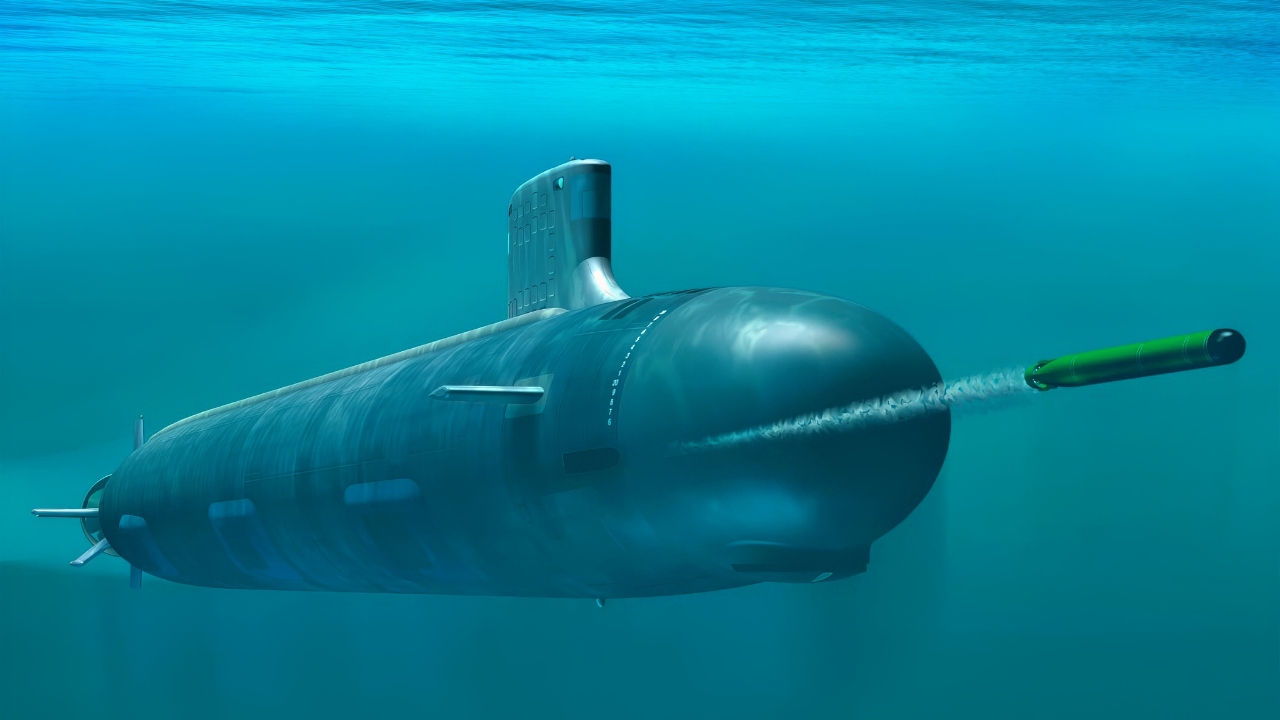
SSN 774 Virginia Class Submarine Artist Rendering from U.S. Navy.
For years, US naval war planners correctly viewed the American submarine force as the greatest strategic advantage against China. With its new sail-less hunter-killer submarine, Beijing is challenging the US’s inherent undersea advantage.
The Bigger Strategic Context
China’s sail-less sub is now the second previously unknown Chinese submarine type identified via satellite imagery in 2026. Analysts view that as evidence of an unusually rapid expansion and modernization of China’s undersea fleet, which has long been China’s weakest naval capability.
That’s all changing, thanks in part to China’s superior shipbuilding capacity as well as Beijing’s strong commitment to overthrowing the established maritime order in the Pacific.
What’s notable, too, is that China is not relying on Soviet or Russian designs anymore for its submarine force development. The PLAN is experimenting with unconventional concepts of its own design. And it isn’t just with potentially unmanned or heavily automated sail-less hunter-killer submarines. China is designing extremely quiet diesel-electric boats, advanced nuclear attack submarines, large uncrewed underwater vehicles, and now sail-less submarine architectures.
These developments fit a much broader pattern in which China is increasingly innovating rather than simply reverse-engineering foreign tech.
What We Don’t Know
There are still major unknowns with this new Chinese experimental design. For instance, what’s its power source? Is it nuclear-powered or conventionally powered? Is this submarine an operational combat submersible or merely a tech demonstrator?
How are the sensors and communications handled without a traditional sail? And here’s the really important question (because this has long been a key weakness of the Chinese submarine force): how quiet is this new sail-less sub compared to its American rivals?
China has yet to release any official information about this bizarre submarine recently photographed by curious satellites. Everything we know about it comes from satellite imagery and analysis from outsiders.
Washington Ignores China’s Submarine Advances at Its Own Peril.
For decades, the US Navy assumed that America’s attack subs represented a nearly uncontested advantage in any Pacific war. A submarine optimized specifically for underwater stealth, speed, and anti-submarine warfare (ASW) suggests that Beijing is directly challenging America’s undersea dominance rather than merely threatening surface ships.
Subs are seen as a key factor in any potential Chinese invasion of Taiwan, too.
China is already moving forward with the next phase of the naval competition with the United States that Washington has long assumed was not yet underway: the race for dominance under and above the waves.
China already possesses comprehensive layers of anti-access/area-denial (A2/AD) systems that can easily rebuff US Navy advances on the surface. But American analysts have long assumed that the Chinese could never (at least not anytime soon) truly challenge the supremacy of US attack submarines.
Beijing has other plans.
And it doesn’t yet seem like the Pentagon will acknowledge this painful, rapidly changing circumstance until it possibly loses an attack submarine to one of these sail-less subs from China. For decades, Washington has consistently gotten the China threat wrong.
There’s little evidence that the Pentagon’s misinterpretation of Chinese capabilities and intentions has improved.
About the Author: Brandon J. Weichert
Brandon J. Weichert is Senior National Security Editor. He also manages The Weichert Brief on Substack. Weichert hosts “National Security Talk” on Rumble, too. He is the author of four bestselling national security books, the most recent of which is A Disaster of Our Own Making: How the West Lost Ukraine (Encounter Books). Follow him via Twitter/X @WeTheBrandon.


FOREIGNER
June 10, 2026 at 11:58 am
Can the crew on the Chinese submarine swim? You are in too much of a hurry to declare the end of American dominance. A century of maritime experience and dominance does not end with a submarine and an aircraft carrier from a state that until recently had nothing to do with the sea.