

Key Points and Summary – A hypothetical fight between the F-22 Raptor and F-35 Lightning II reveals a split verdict based on mission.
-In a one-on-one dogfight, the F-22 is the almost certain winner due to its superior speed, stealth, and unmatched maneuverability.

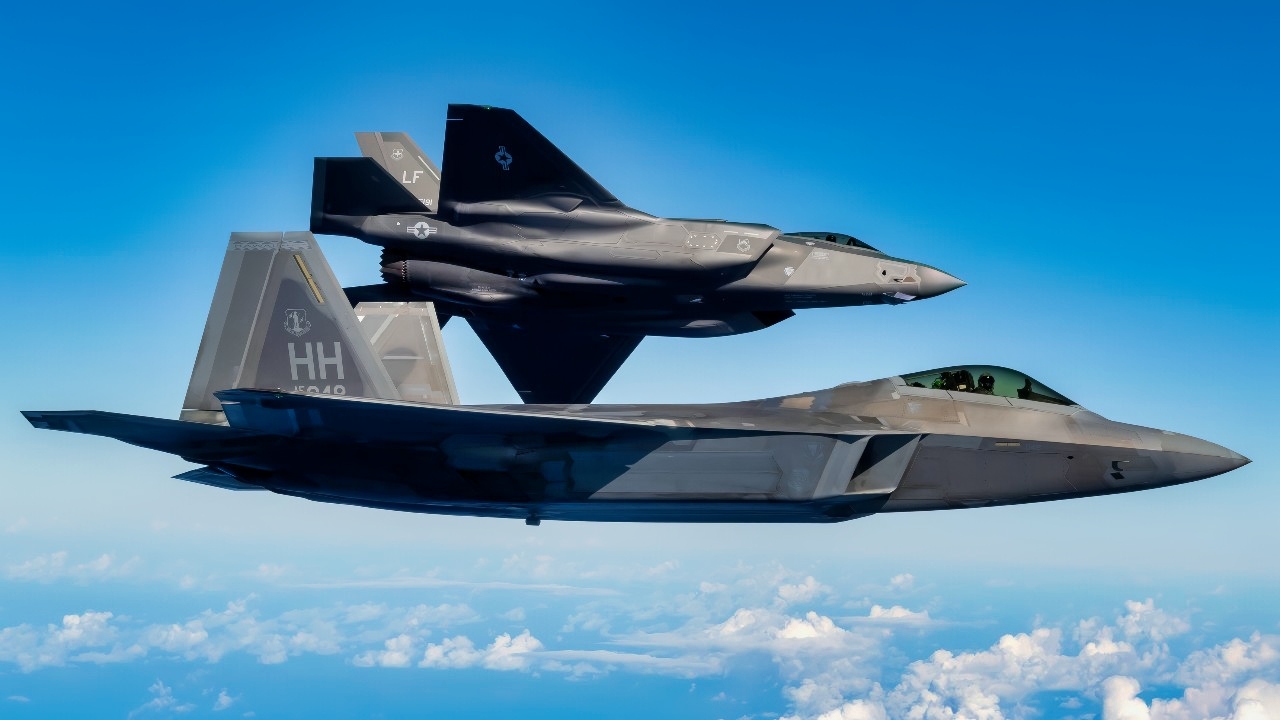
U.S. Air Force Maj. Kristin “BEO” Wolfe, F-35A Lightning II Demonstration Team pilot and commander, flies a U.S. Air Force F-35 during the Dubai Airshow, United Arab Emirates, Nov. 13, 2023. The U.S. maintains a highly agile fighting force, which leverages the most advanced training and platforms to dominate the warfighting landscape for the long-term security and stability of the region. (U.S. Air Force photo by Staff Sgt. Kaitlyn Ergish)
-However, in a beyond-visual-range engagement, the F-35’s advanced sensor fusion and networking capabilities could level the playing field.
-The final conclusion is a paradox: the F-22 would win the battle, but the more versatile, numerous, and logistically practical F-35 is the superior aircraft for winning a war.
The F-22 Wins the Fight, But the F-35 Wins the War
The F-22 and F-35 are often considered to be the undisputed rulers of the skies. With their advanced stealth technology and sophisticated avionics, both fighters are well-suited for air-to-air or air-to-ground missions before anyone knows they’re coming.
But which fighter would win in a one-on-one combat scenario?
As unlikely as this scenario might be, F-22s occasionally participate in training missions against F-35s.
Both possess state-of-the-art stealth technology, avionics, and weaponry, so how would they fare in a hypothetical battle against each other?
The Best America Has to Offer
The F-22 Raptor first flew in 1997 and entered service in 2005. It was developed during the Cold War era with the goal of ensuring U.S. air dominance against peer adversaries. Its design emphasizes speed, stealth, and agility.
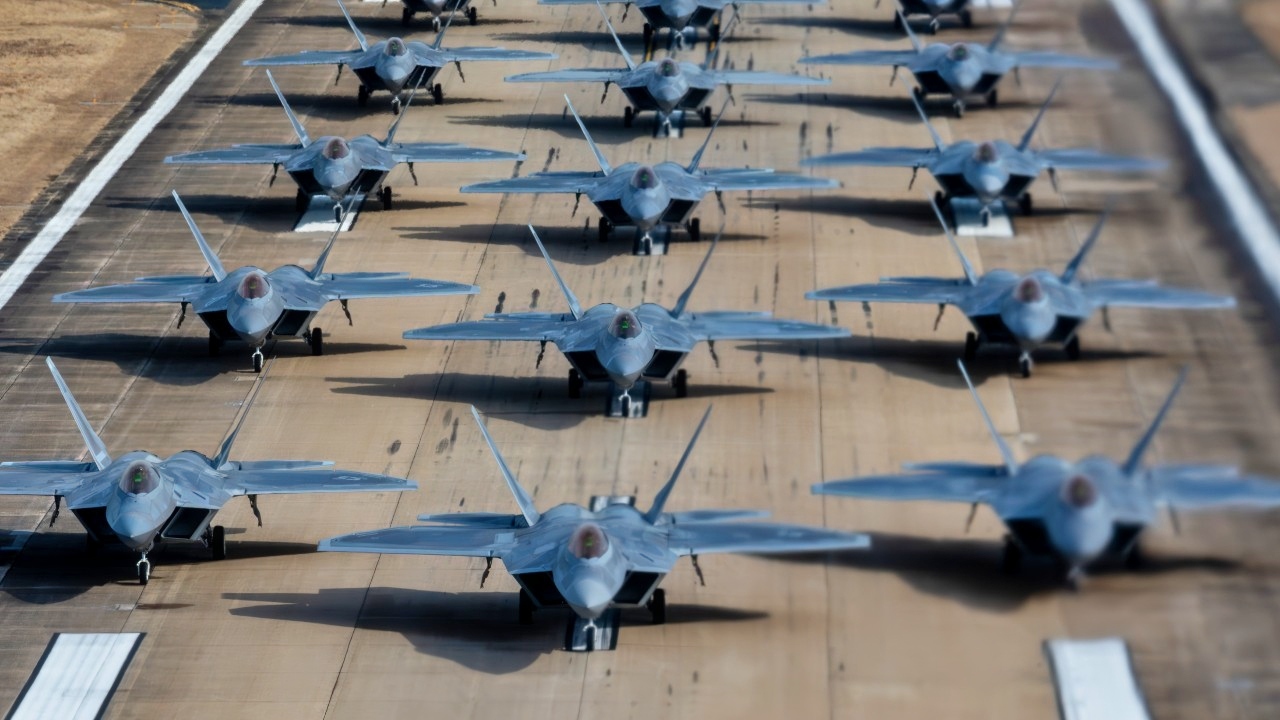
Aircraft from the 1st Fighter Wing conducted an Elephant Walk at Langley Air Force Base, Jan. 31, 2025, showcasing the wing’s readiness and operational agility. This demonstration highlighted the wing’s capability to mobilize forces rapidly in high-stress scenarios. The wing’s fleet includes F-22 Raptors and T-38 Talons. As Air Combat Command’s lead wing, the 1 FW maintains unparalleled combat readiness to ensure national defense at a moment’s notice. (U.S. Air Force photo by SrA Ian Sullens)
The aircraft can reach speeds of Mach 2.25 and is capable of supercruise at speeds above Mach 1.5. It features thrust-vectoring nozzles that give it extraordinary maneuverability in close-range dogfights.
Its radar cross-section is extremely low, making it difficult to detect, and its avionics suite is tailored for air-to-air combat with powerful radar and electronic warfare capabilities.
The F-35 Lightning II, which first flew in 2006 and entered service in 2015, was designed to be a versatile platform that could replace a variety of legacy aircraft across the U.S. military and allied forces.
It comes in three variants: the F-35A for conventional takeoff and landing, the F-35B for short takeoff and vertical landing, and the F-35C for carrier operations. Its top speed is Mach 1.6, and unlike the F-22, it does not have supercruise capability.
However, it compensates with advanced sensor fusion, electronic warfare systems, and stealth optimized for strike missions.
The F-35 is equipped with the AN/APG-81 AESA radar, Distributed Aperture System (DAS), Electro-Optical Targeting System (EOTS), and a helmet-mounted display that gives pilots a 360-degree view of the battlespace.
Designed for Different Missions
In terms of stealth, both aircraft are highly survivable in contested environments. Both utilize smooth airframe shaping to minimize radar cross-section and incorporate radar-absorbent materials.
Judging which is better is difficult, but according to available information, the F-22 has a slight edge in radar cross-section reduction due to its shape and materials.
The F-35’s stealth is optimized for frontal engagements and strike missions, and while it is still tough to detect, it is not quite as stealthy from all angles as the F-22 (keep in mind the F-35 is still one of the stealthiest fighter jets by a long shot).

F-22 Raptor Elephant Walk. Image Credit: Creative Commons.
However, the F-35’s electronic warfare capabilities and sensor fusion allow it to detect threats and jam or evade them effectively, giving it a different kind of survivability.
When it comes to maneuverability and speed, the F-22 is clearly superior. Its thrust-to-weight ratio, thrust-vectoring engines, and aerodynamic design make it one of the most agile fighters ever built. It can outmaneuver virtually any adversary in a dogfight.
The F-35, while agile enough for most combat scenarios, was not designed for extreme maneuverability. It lacks thrust vectoring and has a lower thrust-to-weight ratio, which would put it at a disadvantage in a close-range engagement with the F-22.
Raptor vs. Lightning
In a beyond visual range (BVR) combat scenario, both aircraft would rely on stealth, sensors, and long-range missiles.
The F-35’s advanced sensor fusion and electronic warfare capabilities could allow it to detect the F-22 first, depending on the engagement geometry and environmental factors. However, the F-22’s superior stealth and speed might allow it to close the distance undetected and launch the first missile. In this scenario, the outcome would depend heavily on tactics, pilot skill, and the specific conditions of the engagement.
The F-22’s stealth and speed give it a slight edge, but the F-35’s sensors could very easily level the playing field.
In a within-visual-range (WVR) dogfight, the F-22 would almost certainly overpower the F-35. Its agility, vectoring, and speed make it a lethal opponent in close combat. The F-35 would struggle to keep up in such a scenario, and its pilot would likely be forced to rely on defensive tactics and electronic countermeasures to survive.
From a logistical and operational standpoint, the F-35 has several advantages. It is less expensive to produce and maintain, and it was designed for mass production and export. Over 1,000 units have been built, and it is used by many allied nations.
Its maintenance and upgrade pathways are more streamlined, and it is easier to integrate into joint operations. The F-22, by contrast, is expensive to maintain, was produced in limited numbers (only 187 units), and is not exported. Its complexity and cost have limited its deployment and modernization.
Summed Up In 4 Words: We Have a Paradox
So, which fighter would win in a one-on-one fight? In a pure air-to-air engagement, especially in a dogfight, the F-22 Raptor would almost certainly win.
It was built for air dominance and excels in that role. Its speed, stealth, and maneuverability are unmatched, and it was designed specifically to defeat enemy fighters in combat.
While the F-22 would likely win a one-on-one, the F-35 is overall the superior fighter jet. In a broader military context, the F-35 is much more practical than its older counterpart.
It is far more versatile and can perform a much wider range of missions from CAS to EW making it a valuable tool for the U.S. Military.
It can detect and engage threats before being seen, share data across platforms, and operate effectively in joint and coalition environments.
If you want to win a dogfight, the F-22 is the perfect fighter, but if you want to fight and win a war, the F-35 is the superior pick.
About the Author: Isaac Seitz
Isaac Seitz, a Defense Columnist, graduated from Patrick Henry College’s Strategic Intelligence and National Security program. He has also studied Russian at Middlebury Language Schools and has worked as an intelligence Analyst in the private sector.
More Military
How Do You Replace the Main Battle Tank?
The F-35 ‘Ferrari’ Fighter Might Be ‘Coming Soon’ to a War Near You
The B-21 Raider Bomber Question We Keep Asking
KF-21: South Korea Wants Its Very Own F-35-Style Stealth Fighter
‘Go Home’: F-22 Raptor Flew Right Under Iran’s Old F-4 Tomcat (Unseen)


Chris
September 11, 2025 at 10:21 pm
If the F-35 could beat the F-22 in a fight, there’d be no point to ghe F-22, which is extremely expensive to produce, has twin engines, a much larger airframe, a huge, absurdly powerful radar. The article misses the raw power, radar, and high altitude capabilities of the F-22. Not only would the F-22 detect the F-35 first because of its powerful radar, but would be flying much higher and faster than the F-35. While the F-35 is stealthy and has advanced avionics, the F-22 might as well be a spaceship.
S M Shahid
September 12, 2025 at 5:24 am
F-22 dominates, f-35 Multitasks