

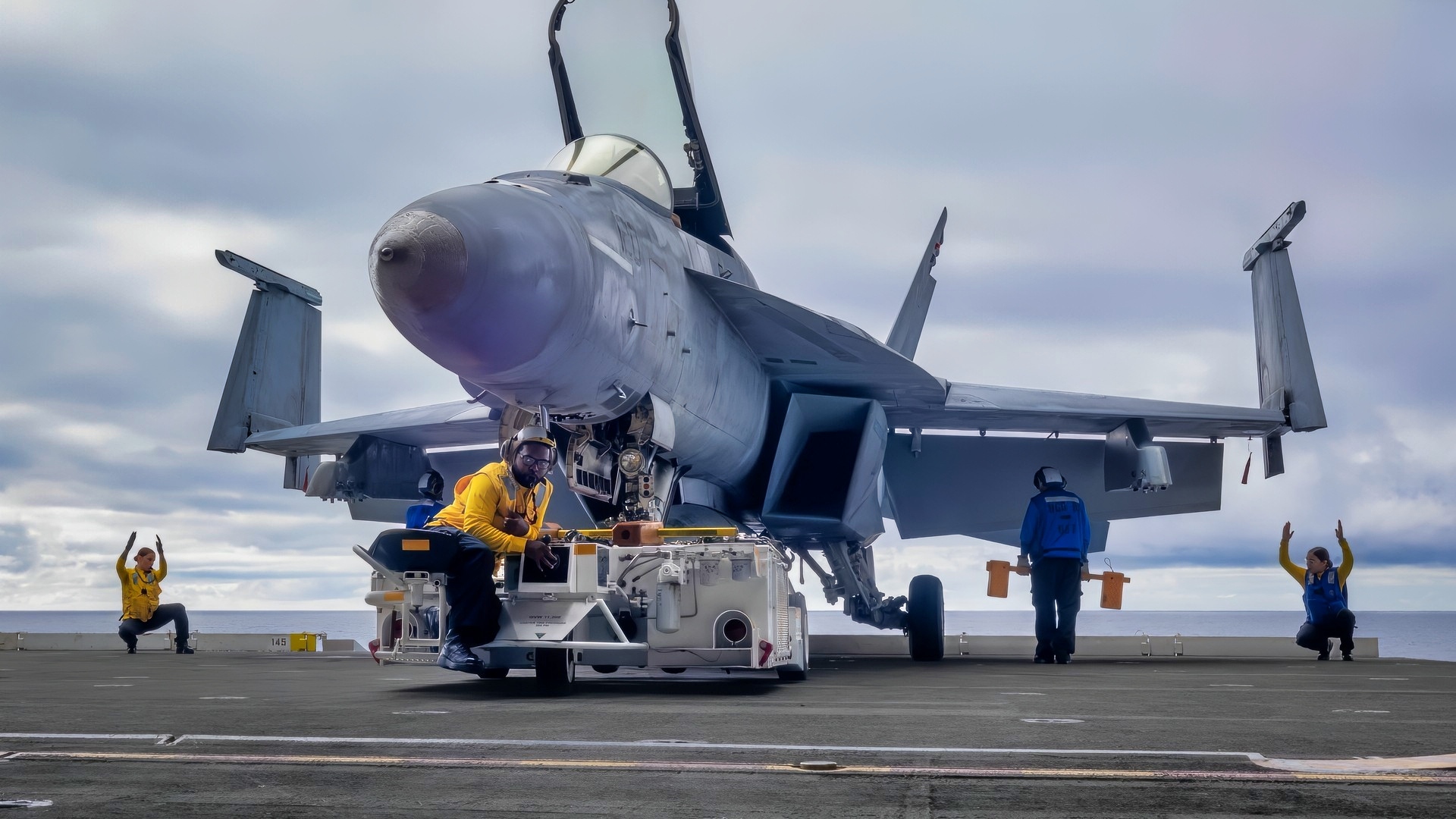
Key Points and Summary – If aircraft carriers are becoming too vulnerable to long-range missiles, hypersonics, and swarms, replace the single “big deck” with a distributed system of systems.
-Field UCAV-heavy air wings for reach, persistence, and attrition tolerance; disperse combat power across light carriers, amphibs, destroyers, and unmanned surface/subsea nodes; and boost survivability with lasers, HPM, AI interceptors, and resilient sensing.
-Make it affordable by modular design, faster timelines, and scaled industrial capacity. Update doctrine and training for degraded comms, autonomous ops, and web-like force design.
-As Corbett argued, command of the sea is relative: in the precision-strike era it’s achieved by networks, not one ship.
Replacing the Aircraft Carrier: Can We Do It?
For generations, the aircraft carrier has been the centerpiece of American naval power: the most visible emblem of US military reach and the clearest expression of maritime dominance. From the Pacific in the Second World War to the Persian Gulf in the late twentieth century, the carrier has been the instrument of force projection, sea control, and alliance reassurance. Today, its preeminence has made it a target.
Technology Developments Pose a Threat
Developments in long-range strike, hypersonic weapons, and autonomous swarms have raised serious questions about the ability of these floating airfields to operate safely in contested environments. Suppose the aircraft carrier is approaching its end of life.
In that case, the key question is no longer whether to continue building them, but rather how to replace them—and what must be done to ensure other capabilities fulfill the critical functions they once performed.
Power Projection
The first step toward answering these questions is to identify what the carrier provided. In terms of capabilities, it projected power by carrying an air wing capable of striking hundreds of miles inland; it sustained sea control by serving as a mobile base for surveillance and interdiction; and it deterred adversaries by its very presence, signaling both capability and political will. Any replacement must reproduce these functions in a manner that is more survivable, affordable, and flexible. This requires moving away from the notion of a single dominant platform and toward the logic of a distributed system of systems.
Unmanned combat aerial vehicles (UCAVs) will be indispensable to this shift. The future of naval airpower lies not in manned strike fighters, but rather in these uncrewed platforms that can loiter over the battlespace at extended ranges, persist where human pilots cannot, and accept risks that would be intolerable for human crews.
A carrier—or its successor—equipped with a largely unmanned wing could help maintain many of the aircraft carrier’s traditional advantages while reducing some of its vulnerabilities. Advances in autonomy and artificial intelligence (AI) will make it possible to coordinate drone swarms, saturate defenses, and conduct surveillance over vast swaths of ocean. Just as important, unmanned aircraft can be built in larger numbers and at lower cost, allowing the fleet to absorb losses without paralysis.
The second pillar of any replacement strategy is distribution. Instead of concentrating its combat power in a handful of super-carriers, the Navy should disperse its capabilities across smaller, more numerous platforms. Light carriers, amphibious assault ships, and missile-heavy destroyers all have a role to play. Paired with unmanned surface and subsurface vessels, these ships can serve as nodes in a larger network. Such a distribution not only complicates enemy targeting and reduces the risk of catastrophic loss but also provides commanders with the option to mass effects when necessary while preserving the fleet’s resilience in the face of attrition.
Survivability must be the third priority for any carrier replacement strategy. Even if ships are smaller and more distributed, they will still face increasingly capable missile threats and unmanned saturation attacks. To meet this challenge, emerging defensive technologies will need to become a central component of fleet design.
Directed energy weapons (lasers and high-power microwaves) are already making progress in development. Paired with AI-enabled interceptors and a resilient sensor network, they could help restore the balance between offense and defense. Such systems will not make ships invulnerable, but they can make distributed platforms survivable at an acceptable cost, which is all deterrence requires.
Equally important is industrial capacity. A fleet based on a constellation of smaller, modular platforms and unmanned systems can only succeed if the Navy can afford to produce them at scale. Current models, based around small numbers of exquisite ships with extensive maintenance requirements, are ill-suited to this task.
To be viable, the Navy will need to shorten development timelines, embrace modularity that allows different payloads to be swapped as threats and tactics evolve, and invest in the industrial agility actually to build such platforms at a competitive pace and cost. Without these reforms, the promise of distributed and unmanned systems will remain on paper, while adversaries continue to field their own arsenals of cheap but effective anti-ship weapons.
The final area that must change is doctrine and training. Operating a partially unmanned and distributed fleet at scale will require new ways of thinking about command, control, and logistics. Exercises and wargames will need to focus on contested environments where communications are degraded, logistics are under attack, and forces must operate semi-autonomously. Commanders must become accustomed to thinking of the fleet not as a series of escorts protecting a single asset, but as a web of mutually reinforcing nodes capable of both independent and collective action. Replacing the carrier is as much a matter of operational culture as technology.
There will inevitably be resistance to this path. The aircraft carrier has become part of the identity of American sea power. It is more than a ship; it is a symbol, deeply embedded in naval culture, political rhetoric, and public imagination.
But strategy cannot be based on nostalgia. Clinging to the carrier as the centerpiece of naval power risks turning it from an asset into a liability. Adversaries are already structuring their modernization programs around anti-access and area-denial capabilities, many of which are designed to neutralize carriers. The longer the United States hesitates to adapt to these threats, the more it will play into their hands.
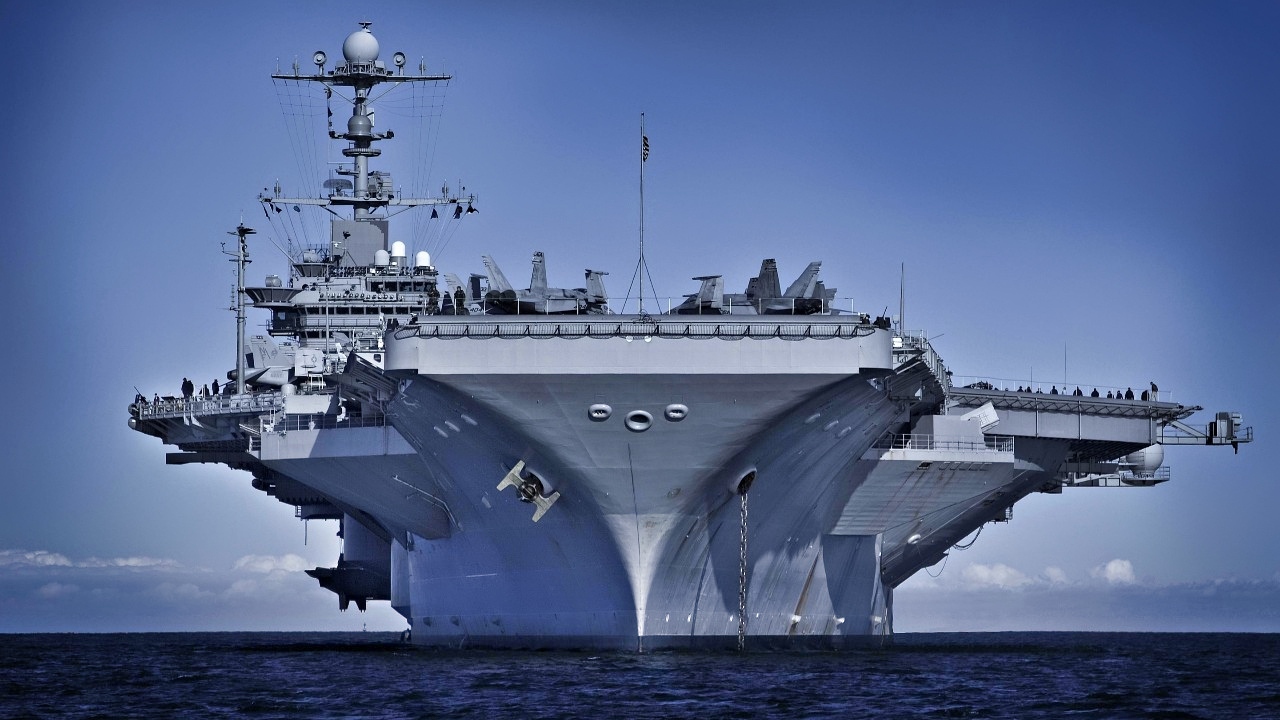
NRL is currently working with Naval Sea Systems Command, Naval Systems Engineering Directorate, Ship Integrity & Performance Engineering (SEA 05P) to transition the new pigment combination into a military specification. The most recent vessel to receive it was USS George Washington (CVN 73).
The Aircraft Carrier: How to Replace a Naval Legend
Replacing the aircraft carrier is not about finding another leviathan to dominate the seas. It is about replicating the functions the carrier served—power projection, sea control, deterrence—through a constellation of smaller, distributed, and technologically advanced systems.
Unmanned aerial vehicles, modular ships, directed energy defenses, and new approaches to doctrine and training all have a role to play. These capabilities, together, can provide the flexibility and resilience that a single platform, no matter how powerful, can no longer guarantee.
And it is here that the great British naval historian and theorist of maritime strategy, Sir Julian Corbett, matters most. Corbett wrote that command of the sea was always relative, never absolute, and that maritime strategy was the exercise of control where and when it is needed and the denial of control where and when it is not. The aircraft carrier once seemed to do this by packing concentrated power into one ship.
In an age of precision strike and distributed lethality, however, that concentration has become a vulnerability. Command of the sea must instead be exercised through a distributed network of capabilities.
Each will project control in its own sphere of operations, and taken together will provide the overall resilience under fire. In other words, to find a replacement for the carrier is to take Corbett seriously, to recognize that sea power is not about one big platform, but about sustained command in degrees, across time and space, with forces flexible enough to endure and adapt.
About the Author: Dr. Andrew Latham
Andrew Latham is a Senior Washington Fellow with the Institute for Peace and Diplomacy, a non-resident fellow at Defense Priorities, and a professor of international relations and political theory at Macalester College in Saint Paul, MN. You can follow him on X: @aakatham. He writes a daily column for National Security Journal.
More Military
Japan Is Test Firing Railguns (America Has None)
5 Reasons the A-10 Warthog Is Obsolete in 2025
F/A-XX – Could NGAD Be the Captain Obvious Answer?
China’s New J-20A vs. F-35: Will the ‘Dragon’ Beat America’s Best Fighter?


Ghost_Tomahawk
September 12, 2025 at 7:54 pm
Design a submersible drone carrier. Something revolutionary. Not a reuse of something already in existence.