


The “Iran Deal” Is a Mirage: Why This 60-Day Ceasefire Won’t Hold: In between irrational exuberance over SpaceX’s initial public offering (IPO) and the UFC fight night scheduled for this Sunday evening, June 14, President Donald Trump appears to have grown bored with the major Middle East regime-change war of choice that began more than 100 days ago.
The New Iran Deal?
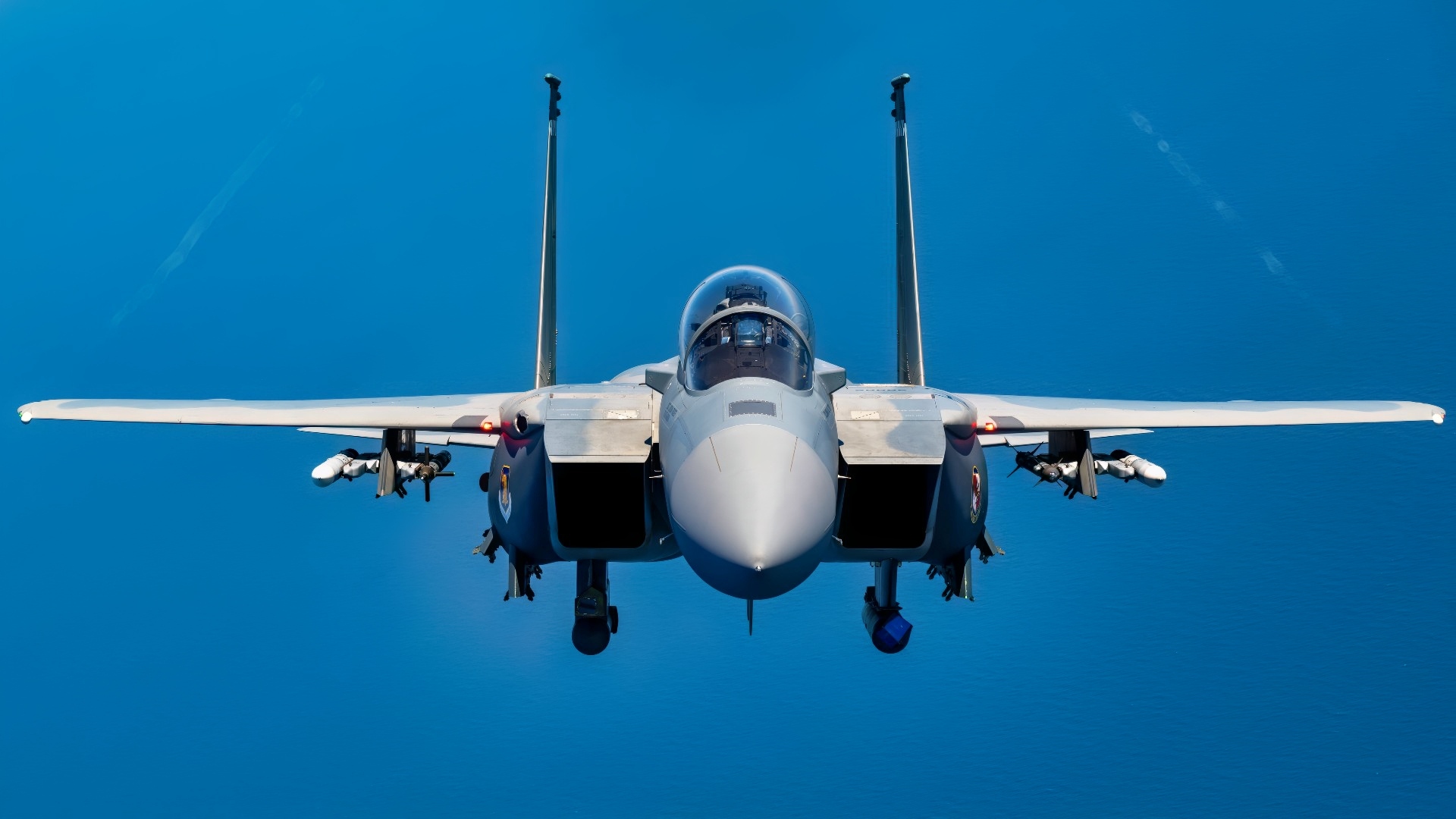
A U.S. Air Force F-15EX Eagle II flies over the Gulf of America, September 16, 2025. The F-15EX, from the 40th Flight Test Squadron at Eglin Air Force Base, Florida, is one of the first F-15EXs in the Air Force, and is going through developmental and operational test series at Eglin to confirm its operational capabilities before it is delivered to the combat Air Force. (U.S. Air Force photo by Staff Sgt. Blake Wiles)
A 96-hour lightning war of decapitation strikes and domestic Iranian uprisings against the Islamic Republic quickly turned into a war of attrition that today threatens the global economy, thanks to the devastation imposed by Iran on the region’s essential energy and critical mineral production as well as the twin blockades of the Strait of Hormuz, one enacted by Iran, the other conducted by the United States.
A tenuous ceasefire between the Islamic Republic and the United States was already breaking down earlier this week, as US forces attacked key strategic targets along the Iranian coastline in what appeared to be true shaping operations by the Trump administration for the inevitable landing of US ground forces on one of the outlying Iranian islands in the Strait of Hormuz, either the oil-rich Kharg Island or posisbly the strategically vital Qeshm Island.
Indeed, on Thursday morning, the forty-seventh president, who vowed to be the man who ended wars rather than started them, gave a whiff of remorse over the fact that the American people just “don’t have the stomach” for a ground invasion while speaking with the hosts of Fox & Friends.
Clearly, Kharg Island, which Trump has admitted since March that he desired to control, is still on the Commander-in-Chief’s mind.
So what’s going on, really?

Majors Michael Shower and Evan Dertien, F/A-22 Raptor pilots, and Captains Thomas Borrego and Eric Nyman, F-15 Eagle pilots, prepare for a flyover during the Air Combat Command Tattoo ceremonies held at Langley Air Force Base, Virginia September 8th and 9th, 2005. Langley’s new Raptor had a major role in this modern day version of a traditional retreat ceremony. Integrated into its music, drill, and ceremony are aircraft flyovers, fireworks, and dialogue that traces the Virginia Peninsula’s long and historic relationship with America’s armed forces. (USAF Photo by TSgt Ben Bloker)
The 14-Point Agreement Kicks the Hard Questions Down the Road
We’re told that the US president has abandoned his desire to take control of Iran’s oil production facilities on Kharg Island and instead favors a quick end to the conflict.
The proposed deal is allegedly 14 points long and will likely involve reopening the Strait of Hormuz to international shipping and navigation.
Per the Iranian delegation, though, they will “retain sovereignty over Hormuz” rather than simply handing it back to international authority.
Get ready for a toll.
Iran insists that a Lebanon ceasefire is incorporated into the framework, too. America will release $24 billion in frozen assets.
Most of the heavier stuff gets kicked down the road to the end of the 60 days. Indeed, it is less of a ceasefire and merely a 60-day negotiating window during which the most pressing issues–uranium enrichment, Iran’s nuclear infrastructure, sanctions relief, and the fate of enriched uranium stockpiles would be addressed.
There was already a bump that was allegedly papered over earlier today when the Iranians tweeted these details out to the world, and the US president became apoplectic over the tweet.

Israel F-16I Fighters IDF. Image Credit: IDF.
According to the forty-seventh president, the Iranians “are very dishonest people. It is impossible to conduct honest negotiations with them […] Furthermore, their completely insane drone attack last night on Indian ships exiting the Strait of Hormuz is absolutely unacceptable.”
That retort from the commander-in-chief alone indicates that this 60-day Memorandum of Understanding is doomed to fail.
The fact that the president will be too busy watching his prized UFC fight on the White House lawn (if rain doesn’t wash the absurd event out, that is) and will instead send his vice president to sign the agreement in Geneva further indicates that real analysts should meet this news with skepticism.
The Israeli Poison Pill
Now, for the real killer of any lasting deal. The Israeli linkage.
Tehran’s negotiators have tethered this ceasefire, as they have done since the start of ceasefire negotiations, to Israeli actions against suspected Hezbollah targets throughout Southern Lebanon.
The Iranians have placed the requirement of a Lebanese ceasefire in the top five (number four) of the 14 points of the proposed MoU.
Already, Tel Aviv has stated that it is not privy to the US-Iran negotiations and, therefore, is not bound by the stipulations therein.
In other words, the Lebanese ceasefire is nothing more than a poison pill that will sink the MoU quickly. That’s especially because the agreement, as it is written, requires Israel to withdraw from Southern Lebanon totally.
Indeed, we’ve been down this road before, have we not?
Remember the last time the Trump administration sent Vice President Vance to finalize a ceasefire in Pakistan?
So long as Israeli actions are tethered to any lasting cessation of hostilities between Iran and America, there will be no peace.
It will just be another short, shaky ceasefire that erupts in an orgy of destruction.
Why Markets Matter More Than Diplomacy
Lastly, there has been a long-running plotline throughout the wider story of the Iran War, involving the strange way President Trump keeps affecting global markets with his presidential statements.
Clearly, the forty-seventh president is concerned about how his war of choice will impact the economy, especially as we move into a very serious Midterm election cycle.
The biggest thing on the market’s horizon this quarter has not been the war. It has been the massive SpaceX IPO. If Trump had followed through on his planned massive strikes on Thursday, it might have negatively impacted that IPO, which, in turn, would have triggered a massive correction in the market (which was depending upon the IPO going gangbusters).
Here again is an indicator of just how much leverage the Iranians have over the US in this conflict.
Whereas Iran is one of the most heavily sanctioned nations in the world and truly insular (compared to the Western nations of the world, Israel, and the Arab states), the Americans and their partners are exposed to any disruption in the global economy. It’s just another pressure point that Tehran has on Trump.
There Is No Deal–Only a Pause
As far as this analyst is concerned, there is no deal. Not really. It’s all one big distraction to avoid having to contend with the fact that the Americans (and Israelis) massively miscalculated when they started the war, and there is no pathway to victory.
This deal won’t last any longer than the previous ceasefire did. Whether the US resumes hostilities directly or the war simply becomes a frozen conflict, there’s no returning to the way things were. It’s an entirely new paradigm coming to the Mideast. It is one in which the region is decidedly post-American, and the Israelis are more isolated and weaker than ever before.
About the Author: Brandon J. Weichert
Brandon J. Weichert is Senior National Security Editor. He also manages The Weichert Brief on Substack. Weichert also hosts “National Security Talk” on Rumble. He is the author of four bestselling national security books, the most recent of which is A Disaster of Our Own Making: How the West Lost Ukraine (Encounter Books). Follow him via Twitter/X @WeTheBrandon.


Doyle
June 12, 2026 at 5:46 pm
Woke right gibberish….