
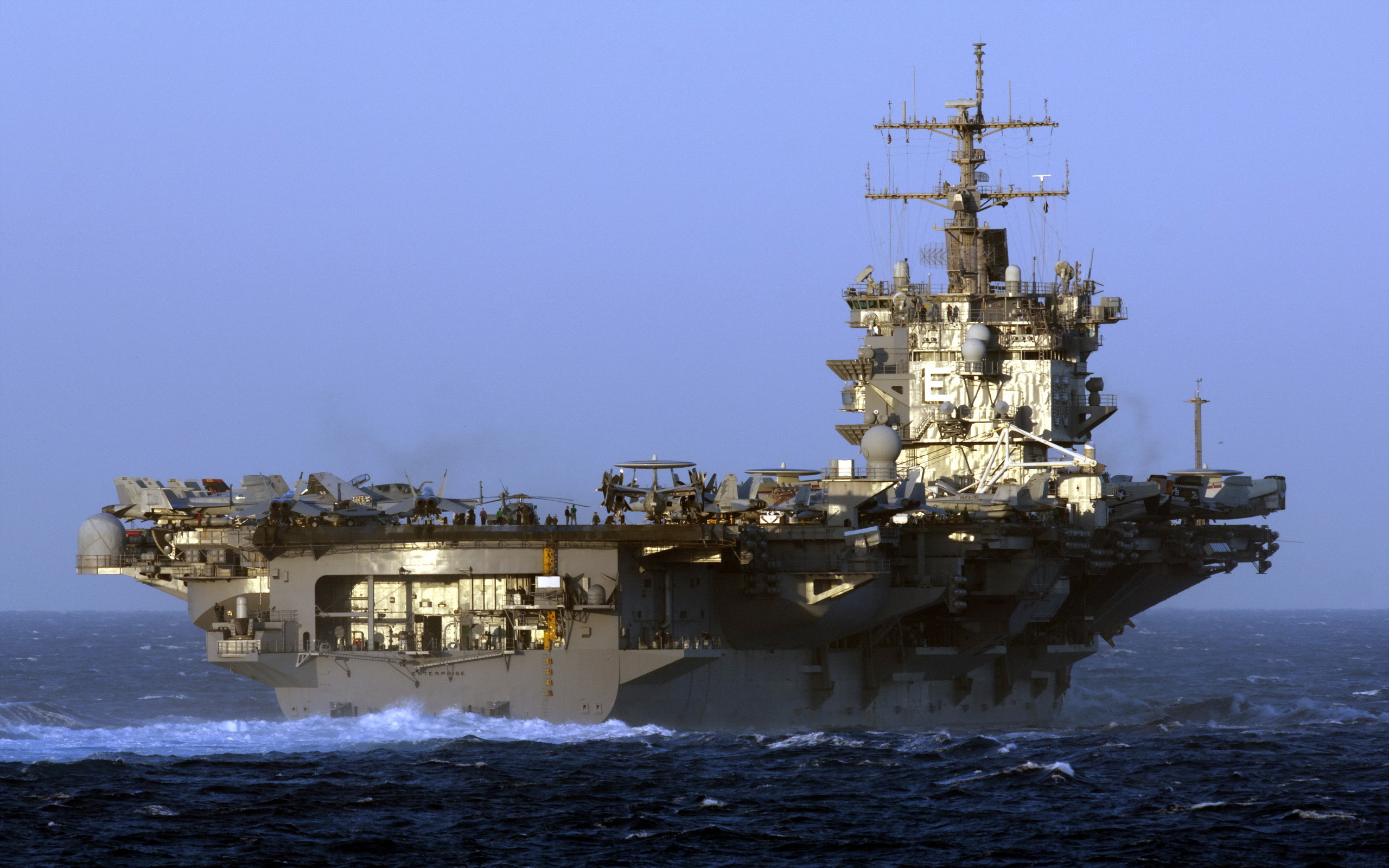
Key Points and Summary – As the legendary USS Enterprise (CVN-65) is dismantled, its legacy—including two near-catastrophic grounding incidents—serves as a cautionary tale.
-While the “Big E” was nearly lost to internal and navigational failures, the next generation of carriers faces a far deadlier external threat environment.
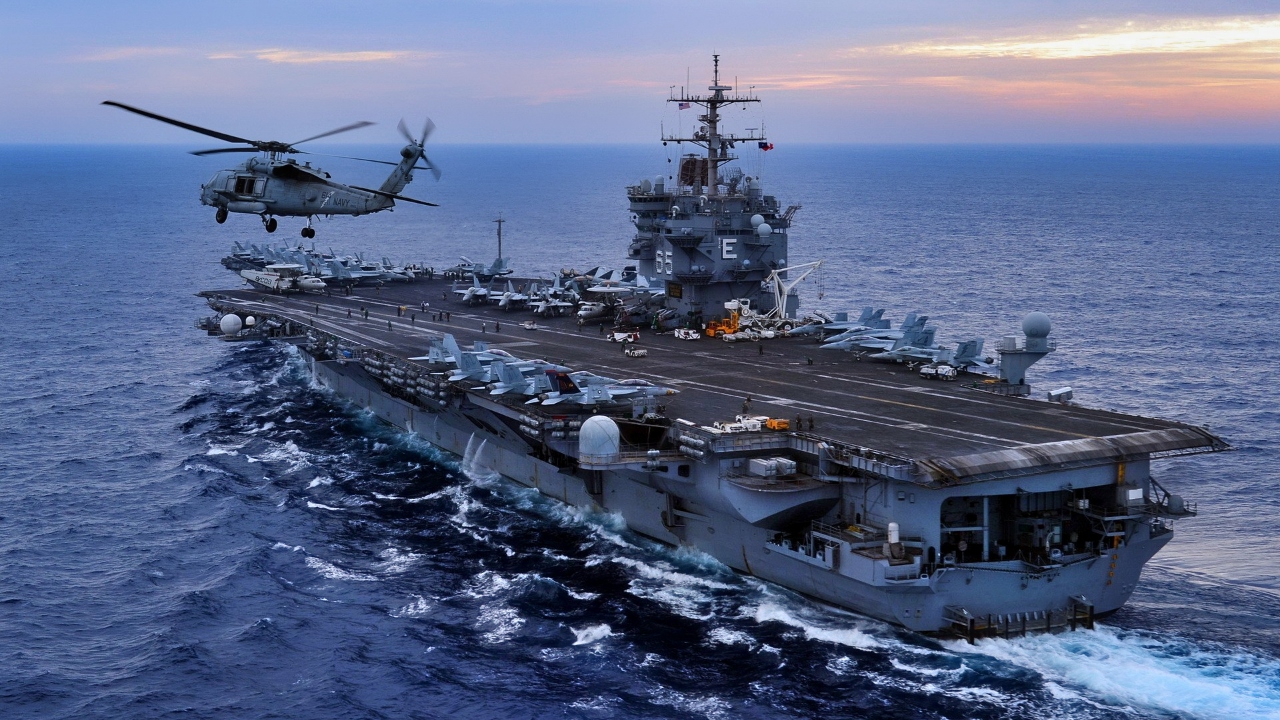
USS Enterprise. Image Credit: Creative Commons.
-Modern “carrier-killer” missiles, hypersonic weapons, and drone swarms mean that these new, multi-billion-dollar supercarriers are now high-value targets.
-This has forced the U.S. Navy to a crossroads, debating whether the aircraft carrier, a long-time symbol of American power, has finally become obsolete in the modern age.
USS Enterprise Survived It All
In June 2025, the U.S. Navy awarded a $536.5 million contract to dismantle the nuclear-powered aircraft carrier USS Enterprise (CVN-65).
Once the centerpiece of U.S. naval power, the “Big E,” as it is colloquially known, will soon be little more than a relic of old naval power.
But new carriers are coming, and with them come new threats.
From missiles and drones to advanced new submarines, the U.S. and other great naval forces face evolving threats, and much can be learned from the submarines that are now reaching the end of their service lives.
When the USS Enterprise Nearly Went Under
During her decades of service, the Enterprise encountered two near-catastrophic incidents that could have destroyed her legacy and ended her service.
In 1983, the carrier ran aground only yards from her home port after a steering failure caused by a malfunctioning starboard propeller, reducing her maneuverability.
A flotilla of nine tugboats spent six hours freeing her from the sandbar as she listed ten degrees to port.
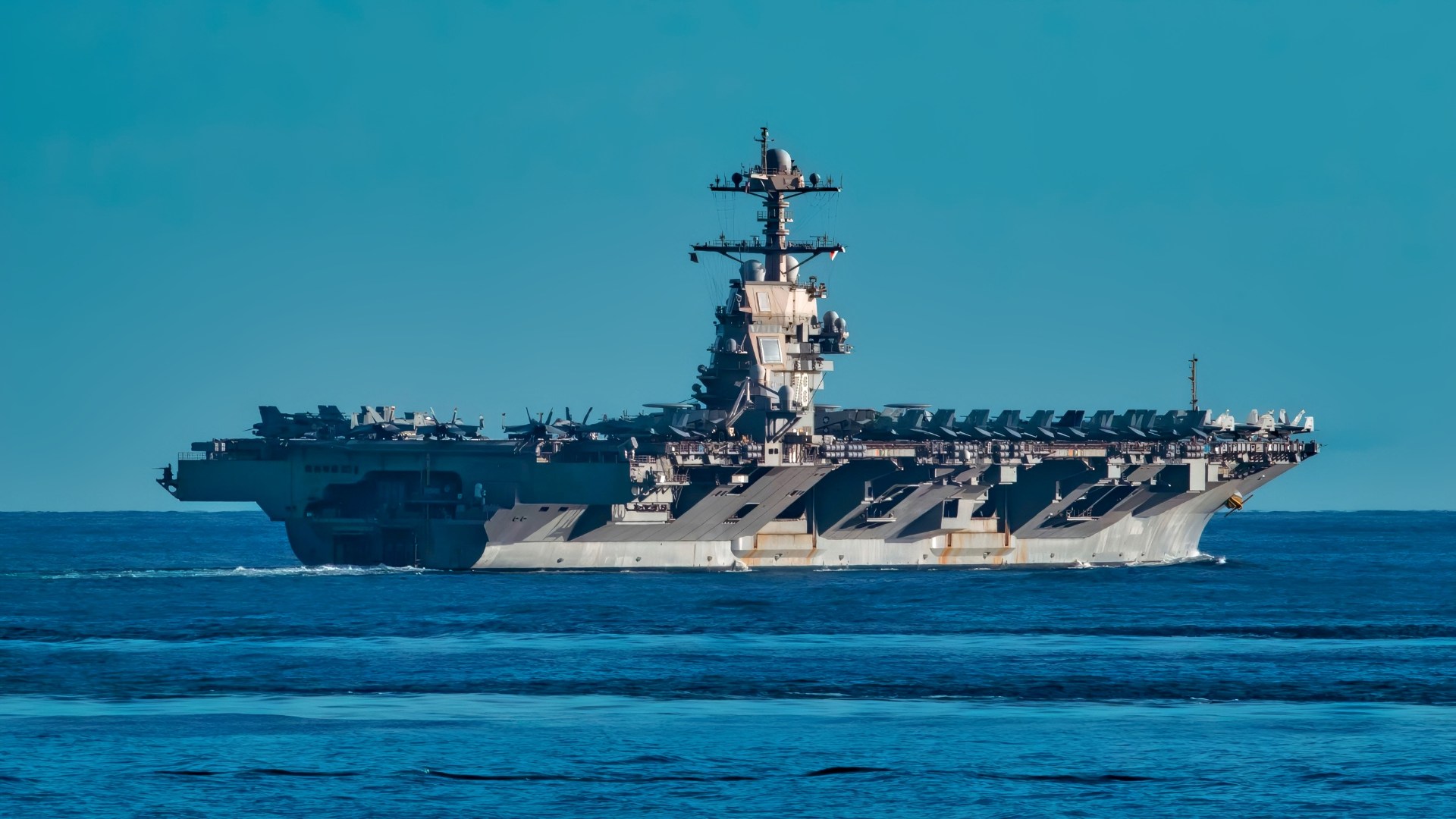
The Arleigh Burke-class guided-missile destroyer USS Winston S. Churchill (DDG 81) sails alongside the world’s largest aircraft carrier the USS Gerald R. Ford (CVN 78), Sep. 24, 2025. Winston S. Churchill, as part of Carrier Strike Group 12, is on a scheduled deployment in the U.S. 6th Fleet area of operation to support the warfighting effectiveness, lethality and readiness of U.S. Naval Forces, Europe-Africa, and defend U.S. Allied and partner interest in the region. (U.S. Navy photo by Mass Communication Specialist Seaman Hector Rodriguez)
Just two years later, in 1985, she struck land again – hitting Bishop Rock off the California coast.
The incident tore a sixty-foot gash in her hull, destroying three of her four giant propellers and even ripping out her port keel – a moment that could have easily spelled the end for the vessel if it wasn’t quite so enormous and capable.
What saved her was not just her design but also her incredible seamanship and good crisis response capability.
These incidents are interesting stories, but they also serve as a lesson and cautionary tale: if a ship as advanced as the Enterprise (for her era) could almost be lost to a mechanical failure, could it happen to the next generation of carriers that will replace her? And what does the new overall threat environment look like?
Growing External Dangers for Aircraft Carriers
The threats faced by the Enterprise in the 1980s were navigational and internal, as evidenced by the two aforementioned incidents.
They were also external, of course – but the ship sailed at a time when the United States was unquestionably the world’s greatest superpower.
And while that may technically be true today, near-peer adversaries have never been closer to matching the United States Navy’s capacity and capability. With that in mind, it’s essential to consider the kind of missiles the next generation of carriers will face.
From modern anti-ship ballistic missiles and unmanned aerial swarms to hypersonic technology and ultra-stealthy submarines, carriers now have more threats than ever before.
Those threats don’t even need to be in proximity to the ship, either, with China and Russia both working on long-range anti-ship missiles, and analysts across the West warning that a pivot away from aircraft carriers could be necessary unless air defense technologies catch up.
Take, for example, China’s DF-21D and DF-26B missiles, which are explicitly designed to target carrier strike groups from beyond the first island chain.
A 2019 study noted that even if a carrier strike group operated 1,000 nautical miles from launch sites, missiles could exploit gaps between existing defense layers and threaten the ship.
Today, a giant floating platform that once operated with relative impunity might now be forced to retreat into safer waters or dramatically alter its air defense systems in such a way that it can better protect against long-range threats.
But even then, the threat is much larger, and with more advanced carriers on the open seas, there is undoubtedly more to lose, too.
So, are aircraft carriers becoming obsolete?
Possibly. It’s undoubtedly a lesson some believe we have learned in recent years, especially with the emergence of artificial intelligence, automation, long-range missiles, and swarming drones.
Some argue that these vessels, which cost tens of billions of dollars to design, manufacture, and deploy, are simply too valuable to risk in a major war.
Others, however, caution against declaring the carrier dead, noting that while tactical vulnerabilities exist, the carrier still retains significant strategic value. It’s also true that adversaries face similar risks themselves.
So, What Next?
The Enterprise’s successor, USS Enterprise (CVN-80), is now under construction and will be the most advanced U.S. carrier ever built.

(July 28, 2017) An F/A-18F Super Hornet assigned to Air Test and Evaluation Squadron (VX) 23 approaches the aircraft carrier USS Gerald R. Ford (CVN 78) for an arrested landing. The aircraft carrier is underway conducting test and evaluation operations.(U.S. Navy photo by Erik Hildebrandt/Released) 170728-N-UZ648-161
It will feature electromagnetic catapults (EMALS), a redesigned nuclear reactor, and integrated digital systems designed to reduce crew size and increase sortie rates.
Yet the fundamentals remain largely unchanged: the new vessel, named after its predecessor, will still be a massive, high-value target.
In contrast, Russia has focused on smaller, more flexible naval aviation assets, while China is following the same path as the U.S., developing its Type 003 Fujian carrier and preparing its nuclear-powered Type 004 – both aimed at rivaling U.S. supercarriers.
The competition, therefore, persists – but under entirely new conditions where survivability and not size determines the advantage a ship may have.
As anti-ship weapons, drones, and undersea threats evolve faster than the ships designed to counter them, the U.S now faces a crossroads.
About the Author:
Jack Buckby is a British author, counter-extremism researcher, and journalist based in New York. Reporting on the U.K., Europe, and the U.S., he works to analyze and understand left-wing and right-wing radicalization, and reports on Western governments’ approaches to the pressing issues of today. His books and research papers explore these themes and propose pragmatic solutions to our increasingly polarized society. His latest book is The Truth Teller: RFK Jr. and the Case for a Post-Partisan Presidency.
More Military
Forget the F-35 of F-47: A 7th Generation Fighter Is Possible
$500 Drones are Destroying $10,000,000 NATO Tanks in Ukraine War
The Mach 2.2 F-4 Phantom II Fighter Has a Message for Every Air Force on Earth
China’s White Emperor ‘NGAD’ Stealth Fighter Summed Up in 2 Words


