


Key Points and Summary: Russia’s apparent retirement of Admiral Kuznetsov caps a century in which Moscow didn’t build the foundations of aircraft carrier power: warm-water access, catapult technology, industrial base, logistics, and deck-ops culture.
-Soviet doctrine prioritized submarines and shore-based air; post-1991 budgets and sanctions gutted shipyards and supply chains; STOBAR constraints denied organic AEW and heavy tanking; thin training pipelines and low at-sea time limited sortie rates and safety margins.
-By contrast, the U.S. has a mature carrier ecosystem and China is rapidly building one.
-The outcome is not an accident: Russia repeatedly chose other tools over carriers, and Kuznetsov’s end simply makes that choice visible.
Russia’s Aircraft Carrier Mistake Just Can’t Be Fixed?
Russia’s lone carrier, Admiral Kuznetsov, has become a punchline—dry-dock accidents, fires, endless refits, and long stretches pier-side.
Whether it formally retires tomorrow or simply fades into ceremonial status, the reality is the same: Moscow never fielded a capable, repeatable aircraft carrier force.
That isn’t about one unlucky ship. It’s about a century of geography, doctrine, industry, economics, and training that pushed first the Soviet Union and then Russia to invest everywhere except in the hard, boring, expensive work of carrier aviation at scale. The result is a “fleet” of one, limping toward the history books, while the United States runs global airpower from the sea and China rapidly learns the trade.
Geography: Bad Water, Worse Chokepoints
Aircraft carriers live where water and politics let them. The Soviet—and later Russian—Navy draws from fractured seas: the Arctic, Baltic, Black Sea, and Far East. Each basin is fenced by chokepoints controlled or surveilled by rivals (GIUK Gap in the North Atlantic; Turkish Straits from the Black Sea; narrow exits from the Baltic; long stretches past Japan to reach blue water). Winter ice and brutal weather complicate the Northern Fleet’s life; the Pacific Fleet faces long supply lines and limited friendly ports. A global carrier strategy needs reliable warm-water access and allied hubs. Moscow never had the right map.
Doctrine: Submarines First, Shore-Based Air Always
Soviet naval thought became pragmatic early: if you can’t easily operate big decks far from home, deny the enemy’s. That birthed a fleet biased toward submarines, missile cruisers, coastal aviation, and layered shore-based defenses. The “bastion” strategy concentrated on protecting ballistic-missile subs under the Northern ice and in the Far East, not on escorting task forces across oceans. Carriers, when considered at all, were tools to cover the fleet’s own missile shooters, not expeditionary airfields for distant crises. You can see that in the ship classes that actually got built: lots of submarines, lots of missile tubes, fewer true sea-control assets.

Admiral Kuznetsov back in 2011. Image Credit: Royal Navy.

Admiral Kuznetsov. Image Credit: Creative Commons.
Workarounds, Not Aircraft Carriers: The “Aviation Cruiser” Era
Unable to buy the full U.S. package—catapults, big deck cycles, fixed-wing early warning—the USSR tried hybrids. The Kiev-class “aviation cruisers” mixed heavy missiles with Yak-38 VTOL jets. They looked innovative and were operationally underwhelming.
The airwing lacked legs, payload, and rough-sea performance. The Yak-141 promised more, but the program died with the budget collapse. All of this reflects a habit: when you won’t or can’t build a proper CATOBAR carrier (catapults and arresting gear), you end up with compromises that fly—but rarely fight the way you need when the weather turns and the deck pitches.
The Kuznetsov Compromise: STOBAR’s Glass Ceiling
Admiral Kuznetsov, launched at the end of the Soviet era, is a STOBAR ship—ski-jump launches, arrestor-wire recoveries, no catapults.
That matters. Without cats you can’t routinely launch heavy, high-drag aircraft, especially fixed-wing airborne early warning (AEW) platforms that make a carrier air wing truly dangerous. You’re stuck with helicopters for AEW and tanking, and fighters must trade fuel and weapons to make the ramp. Survivable deck cycles demand sortie volume, airborne radar at altitude, and organic tanking; STOBAR constrains all three. The ship’s notorious reliability problems make headlines, but the structural limit is the air plan. Even healthy, Kuznetsov can’t do what U.S. carriers do every day.
The Air Wing That Never Grew Up
A carrier without a coherent, modern air wing is just a target with a nice kitchen. Russia’s deck inventory has long rested on Su-33s and a thin cadre of MiG-29K/KUBs.
Both can fight; neither is paired with a fixed-wing AEW jet or a robust organic tanker. That absence turns every long-range intercept or strike into a fuel math puzzle and hands the enemy the information high ground. Add limited pilot throughput, few at-sea flight hours, and a tiny training base, and you get crews who work hard—but a system that can’t sustain high-tempo, day-night, all-weather operations. The United States learned that grind over generations; China is learning it now. Russia never put in the reps.
A Lost Shipyard And An Anemic Ecosystem
Soviet aircraft carriers were built in Mykolaiv (now in Ukraine). The post-1991 breakup severed access to the yards, suppliers, and skill clusters that go with them. Reconstituting that capability at home would have required a national industrial program: giant dry docks, heavy lifts, specialized steels and composites, catapult R&D and test stands, and a work force trained generation over generation. Russia didn’t fund it.
Instead, it tried to maintain a single ship while everything around it aged. When the massive PD-50 floating dry dock sank and later shipyard mishaps stacked up, they weren’t one-offs; they were symptoms of a hollow industrial base.

Admiral Kuznetsov Russia Aircraft Carrier. Image Credit: Creative Commons.
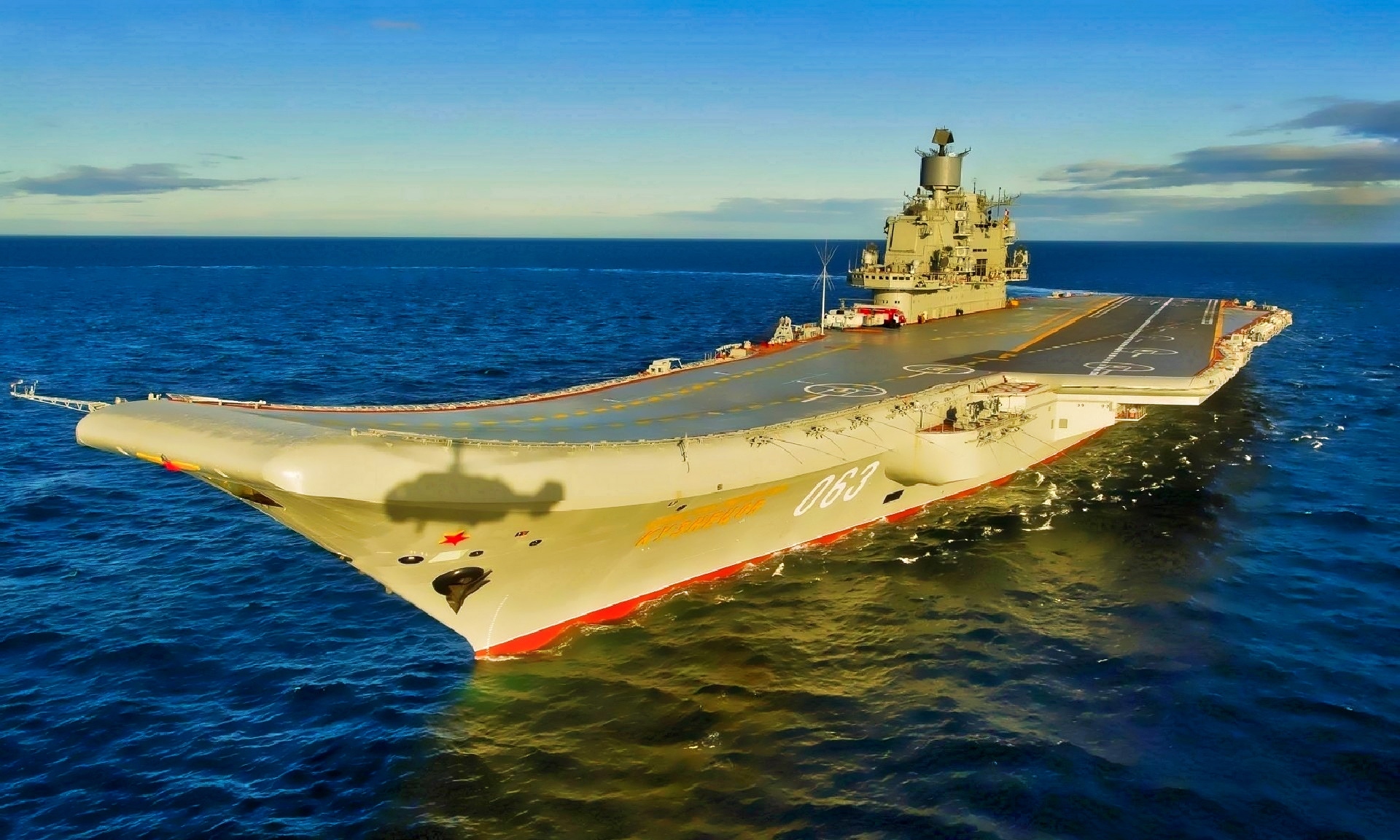
Admiral Kuznetsov Aircraft Carrier. Image Credit: Creative Commons.

Sukhoi Su-33 launching from the Admiral Kuznetsov.
The Catapult Problem: Physics And Money
Catapults are the quiet center of carrier airpower. Steam cats demand hulking, reliable boilers and exacting maintenance; electromagnetic cats demand power generation, power conditioning, and exquisite control electronics. Both demand a land-based test complex, years of reliability growth, and a domestic supply chain for big, unforgiving parts. Russia never fielded either at scale. Without cats, you can’t lift the aircraft that lift everyone—the E-2-style AEW, the big tanker, the heavy jammer. That single technology gap cascades into the entire air plan, clipping the wings of what your fighters can do.
The Logistics Bill: Escorted, Fueled, And Fed—Forever
An aircraft carrier strike group is a system of systems: escorts with layered air defense, submarines for screening, fast oilers and ammo ships, specialized tugs, and a shore network that moves parts where they’re needed. It’s also a training, certification, and maintenance treadmill. Keeping two or three groups ready at any given time requires five or six in some stage of workups, deployment, or overhaul.
That is a budget choice, an industrial policy, and an alliance structure. The United States built precisely that. China is building it. Russia, facing continental land wars, sanctions, and a smaller economy, has consistently chosen other priorities: nuclear forces, air defense, cruise and ballistic missiles, and ground modernization. The result isn’t mysterious; it’s arithmetic.
Budgets And Sanctions: Death By Deferred Maintenance
The 1990s crushed the Navy’s coffers; the 2000s and early 2010s prioritized other programs; post-2014 sanctions and then wartime strain magnified the squeeze. Carriers and carrier aviation are up-front expensive and back-end relentless: coatings, arresting gear rewires, catapult refurbishments, deck resurfacing, aviation life support, engines, spares.

Admiral Kuznetsov. Image Credit: Creative Commons.

Admiral Kuznetsov Aircraft Carrier from Russia. Image Credit: Creative Commons.
If you miss a funding window, you don’t just slip a schedule—you break a cycle. Admiral Kuznetsov spent more time out of service than learning the sea, and every missed cruise meant crews got rustier, suppliers got poorer, and skeptics got louder. That spiral is hard to reverse without a flood of money and a long calm period to fix the basics.
Aircraft Carrier Training And Culture: Deck Ops Are A Craft
Aircraft carrier aviation is a language learned by doing. Launch and recovery crews, air department sailors, maintainers, ordnance teams, meteorology, the handler in “Pri-Fly,” the paddles on the platform, the pilots shooting night traps in rough seas—all of it requires repetitions. That’s why the U.S. Navy’s value isn’t just ships; it’s people who have accumulated those reps across decades and passed them down. China has deliberately created that pipeline with dedicated training carriers and endless cycles. Russia’s small deck force never had the volume to build the deep culture that makes deck ops safe and efficient. A rare at-sea period becomes precious and brittle; any accident sets you back months.
A Tale Of Two “Varyags”
If you want one picture to explain the divergence, look at a single hull. The unfinished Varyag, a Kuznetsov-class sister ship, left Ukraine and became China’s Liaoning. Beijing used it as a training ship, learned the craft, then built Shandong, and now Fujian with catapults. China paired that progression with escorts, logistics, and aviation pipelines. Russia took Kuznetsov, never fully solved its integration and maintenance problems, and doubled down on other arms of naval power. One path produces a fleet that can deploy credible air wings; the other produces…a flagship for drydock stints.
“Why Not Just Build More?” Because Strategy Drives Structure
Russia’s admirals know how expensive aircraft carriers are—and how vulnerable prestige fleets look when a single mishap floods social media. They also know their main strategic tasks: deter NATO with nuclear forces, secure near seas with dense A2/AD, and project limited power where land-based aviation can reach.
Aircraft carriers don’t rank high on that list. When budgets tighten, you fund the submarine leg, air defenses, missiles, tactical aviation, and electronic warfare. In that sense, the “failure” to build carriers is simply consistency: the state bought the tools it uses most.
Why The U.S. And China Could—And Russia Didn’t
The U.S. Navy enjoys geography (two oceans, friendly chokepoints), a global alliance web of bases, and a century of learning carrier operations. Its industry turns out nuclear plants, massive hull sections, and high-reliability combat systems; its air wings fly with organic AEW, tanking, and jamming. China brings a different but equally decisive advantage: the world’s largest commercial shipbuilding base, a political system willing to sequence risk (train on Liaoning, improve on Shandong, leap with Fujian), and a budget that can underwrite mistakes while the workforce learns. Russia has neither the bases nor the budget nor the time to re-create those ecosystems while fighting land wars and navigating sanctions.

Norfolk Naval Shipyard welcomed USS George H.W. Bush (CVN 77) for a Planned Incremental Availability Jan. 11. In addition to equipment maintenance, this availability will improve ship safety along with communications and combat system upgrades.
Kuznetsov’s Symbolism: A Museum, Not A Model
The ship’s specific woes—fires, arresting gear failures, dry-dock disasters—matter less than what they symbolize: a Navy that never built the routines a carrier demands. When Admiral Kuznetsov did deploy to war, it lost aircraft to deck mishaps and demonstrated limited sortie rates. That isn’t a knock on the sailors; it’s an indictment of a system that put them on a ship with constrained air plan, thin logistics, and too few flight hours to iron out inevitable rough edges. In the end, Kuznetsov became a national metaphor—loud in parades, quiet when it counts.
Could Russia Pivot Now on Aircraft Carrier?
Technically, yes—given enough time, money, and political will, a state can build catapults, test ranges, hulls, air wings, and escorts.
Practically, no. The opportunity cost is enormous. The same rubles would buy submarines, missiles, drones, ISR, and EW that directly solve Russia’s near-term problems. And even if the money appeared, the people would take a decade or more to train—the deck crews, the maintainers, the pilots with thousands of night-trap cycles, the program managers who understand why a catapult fails on humid days and how to fix it before the next event. You cannot sprint a craft learned by generations.
The Bottom Line: Not An Accident—A Choice
Russia didn’t “fail” at aircraft carriers in the sense of tripping over an obvious path. It chose not to build the industrial, doctrinal, and training foundations that make carriers credible. Geography made the choice easier; budgets made it inevitable; a continental strategy made it sensible—at least from Moscow’s point of view. The United States and China, with different maps and different ambitions, chose the opposite.
If Kuznetsov finally exits the stage, it won’t close an era of Russian aircraft carrier power. It will simply mark the end of a long experiment that Moscow never truly resourced.
About the Author: Harry J. Kazianis
Harry J. Kazianis (@Grecianformula) is Editor-In-Chief and President of National Security Journal. He was the former Senior Director of National Security Affairs at the Center for the National Interest (CFTNI), a foreign policy think tank founded by Richard Nixon based in Washington, DC. Harry has over a decade of experience in think tanks and national security publishing. His ideas have been published in the NY Times, The Washington Post, The Wall Street Journal, CNN, and many other outlets worldwide. He has held positions at CSIS, the Heritage Foundation, the University of Nottingham, and several other institutions related to national security research and studies. He is the former Executive Editor of the National Interest and the Diplomat. He holds a Master’s degree focusing on international affairs from Harvard University.
More Military
The YF-23 Black Widow II: Better Than the F-22 Raptor?
The A-12 Avenger II Stealth Bomber: What Navy Aircraft Carriers Almost Had
America’s Big Boeing X-32 Stealth Fighter Mistake Still Stings
The B-52J Bomber Might Never Fly: Here’s Why
K3: The New Tank That Looks Like the B-21 Raider Stealth Bomber


