

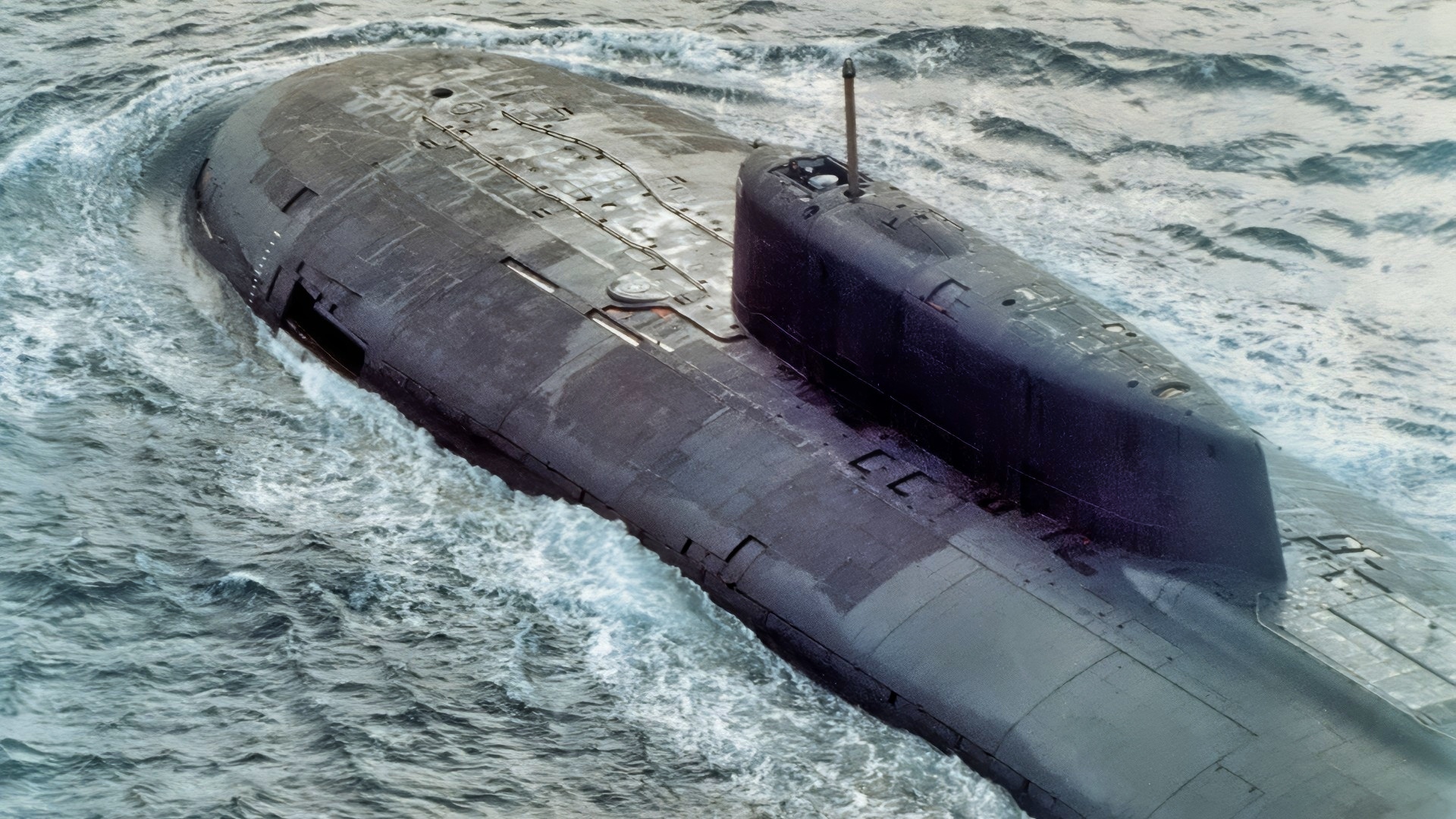
The Russian K-329 Belgorod nuclear-powered special operations submarine carries 6 Poseidon nuclear torpedoes. Each Russian Poseidon nuclear torpedo can carry up to a 100-megaton warhead. The Russian Poseidon is a 65-foot nuclear torpedo, officially known as the Status-6 Oceanic Multipurpose System. The Russian Poseidon is designed to be launched from thousands of miles away from a coastal target.
The Russian Navy Has a Submarine Like No Other
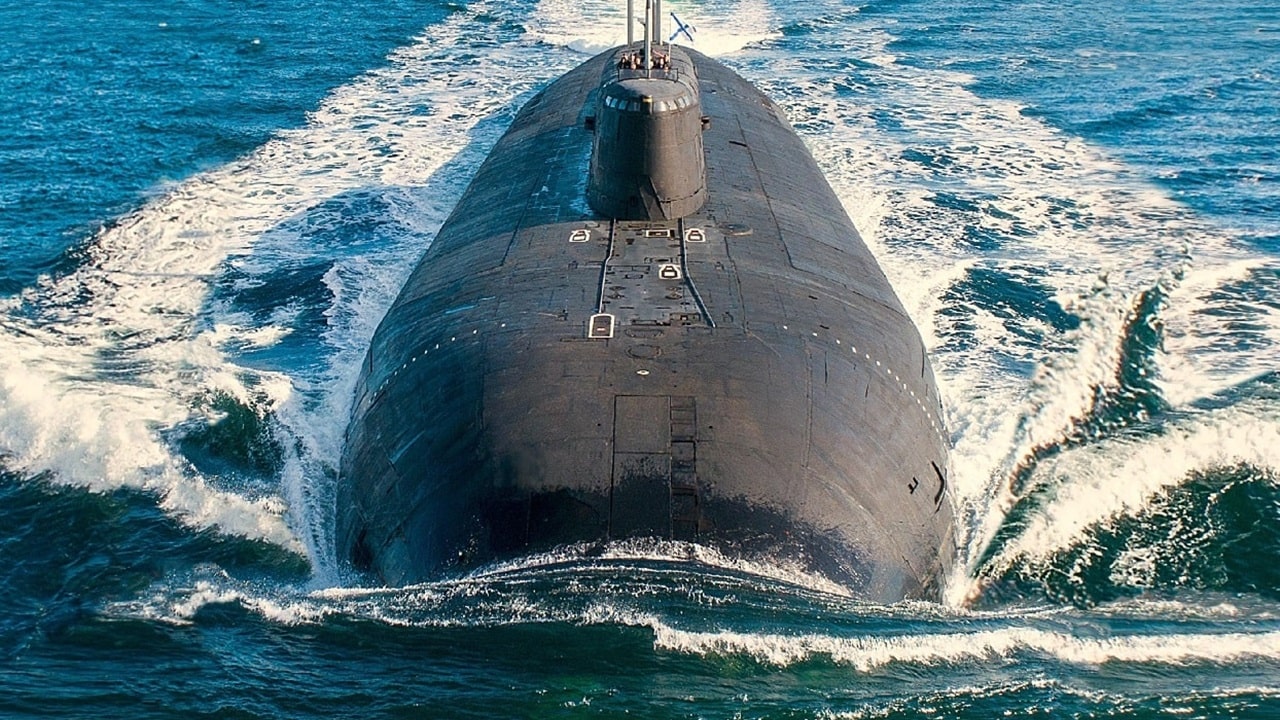
Oscar-Class Submarine. Image Credit: Creative Commons.
The K-329 Belgorod is a special operations and research submarine based on the Oscar II class submarines. It was built under Project 09852 for the Russian Navy. It was built by Sevmash, a shipbuilding company that is part of the Russian joint stock company United Shipbuilding (USC), and commissioned in July 2022.
The Belgorod is 184m long and 18.2m wide, with a displacement of more than 14,700 tons when surfaced and 24,000 tons when submerged.
The submarine can dive to a depth of 520m and remain underwater for approximately four months. It can carry an AS-15 deep-sea nuclear station.
Due to its immense size, it may be less silent and more easily tracked by US/NATO forces compared to smaller, modern attack submarines.
The K-329 Will Target Undersea Communication Cables
It can host deep-diving nuclear-powered midget submarines to conduct covert deep-sea operations beneath the ocean’s surface. Midget submarines can target subsea infrastructure, including sensor arrays, pipelines, and internet cables.
The submarine is propelled by two pressurized water reactors OK-650M.02, each with a capacity of 190MW, which drive two steam turbines and twin screws. It can travel at speeds of more than 32 knots.
The Belgorod also carries six enormous Poseidon torpedoes. The Poseidons are 65-foot nuclear torpedoes to be armed with up to a 100-megaton warhead that could be launched from thousands of miles away from a coastal target.
The explosion would “destroy important economic installations of the enemy in coastal areas and cause guaranteed devastating damage to the country’s territory by creating wide areas of radioactive contamination, rendering them unusable for military, economic or other activity for a long time,” according to a translation of a Russian presentation caught on camera by the BBC in 2015.

Russian Akula-Class Submarine X Screenshot Image.
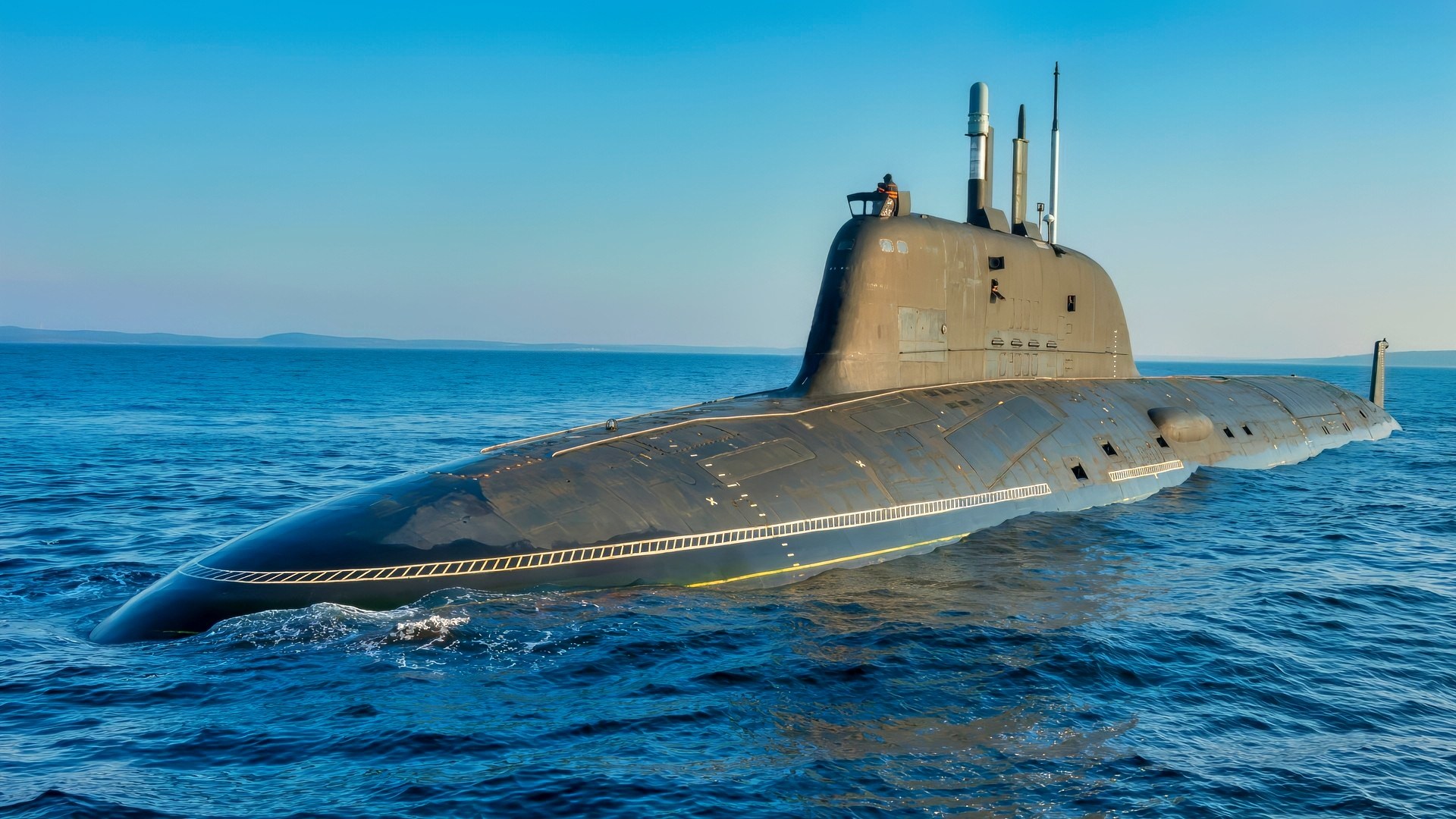
Yasen-Class Submarine. Image Credit: Russian Navy.

Russian Titanium Submarine. Image Credit: Creative Commons.
The Oscar II-class boats have suffered from a myriad of problems since their inception. Whether the Russians have addressed these issues is not known. However, they remain a significant and dangerous part of Russia’s fleet.
Meet The Poseidon Torpedo
Russia’s Poseidon torpedo, officially known as the Status-6 Oceanic Multipurpose System, is a nuclear-powered autonomous underwater vehicle (AUV) capable of delivering a nuclear warhead.
It’s designed to operate in the ocean and is believed capable of high speeds (54 knots) and deep dives, reaching a maximum depth of 1,000 meters (3,300 ft).
The Poseidon, previously known by the Russian codename Status-6, is a nuclear-powered and nuclear-armed unmanned underwater vehicle under development by Rubin Design Bureau, capable of delivering both conventional and nuclear payloads. The Poseidon is one of the six new Russian strategic weapons unveiled by Russian President Vladimir Putin on March 1, 2018.
The Poseidon is designed as an asymmetric counter to US missile defense systems, including anti-ballistic missiles, railguns, and laser weapons, thereby ensuring Russia’s ability to overcome them.
The Poseidon warhead can contaminate a large area with radiation. According to NukeMap simulations, the radioactive area will be approximately 1700 × 300 kilometers.
For this purpose, Poseidon is believed to be equipped with a toxic cobalt bomb containing cobalt-60.
Poseidon Was Designed To Counter US Capabilities
Nuclear scientists speculated that Poseidon was developed in response to advances in US ballistic missile defense capabilities. In March 2018, Russian President Putin stated that Poseidon and other advanced weapons were developed in response to the demise of the 1972 US-Soviet Anti-Ballistic Missile Treaty, which Putin described as “the cornerstone of the international security system.”
After the United States pulled out of the treaty in 2002 to build its new national missile defense system, Russia started working on improving its military equipment and weapons to maintain a strong nuclear deterrent capability against US assets.
After the Cold War, the US moved its defenses away from nuclear weapons, and Russia took the opposite track. Russia continued to rely greatly on nuclear weapons and even adopted a nuclear doctrine of “escalate to de-escalate,” which consists of using nuclear coercion and messaging tactics to achieve strategic goals.
The development and deployment of new nuclear weapons like the Poseidon are considered to contribute to Russia’s broader strategy of nuclear coercion.
The US Strategy Has Evolved Since The 1960s, Russia’s Has Not
However, in the early 1960s, during the height of the Cold War and the Cuban Missile Crisis, the United States had a very similar outlook.
“We may seek to terminate a war on favorable terms using our [remaining] forces as a bargaining weapon—by threatening further attack … our large reserve of … firepower would give an enemy an incentive to avoid our cities and to stop a war.”
This quote was from US Secretary of Defense Robert McNamara in 1962, explaining the US strategy to use limited nuclear strikes to de-escalate a conflict through “deliberate escalation,” specifically in situations where NATO non-nuclear forces could not successfully defend against a Soviet attack.
Is Poseidon A Retaliatory or First Strike Weapon?
While both US and Russian officials have described Poseidon as a new category of retaliatory weapon, capable of triggering radioactive ocean swells to render coastal cities uninhabitable under what could be a nuclear tsunami, but is it truly retaliatory, or could this be part of a first strike?
“The first set of Poseidons has been manufactured, and the Belgorod submarine will receive them in the near future,” TASS, a state news agency, quoted the source as saying.
TASS reported that the main components of Poseidon, including a nuclear reactor to provide the torpedo with its power source, had been completed. The crew of the Belgorod nuclear submarine has also completed torpedo model tests, TASS said.
Putin’s Fixation With Threatening To Nuke The West
According to TASS, the Russian Navy intends to purchase at least 30 Poseidon torpedoes and deploy them on four submarines.
Reuben F. Johnson noted: “The Kremlin today retains an even more pronounced and seemingly psychotic fixation with destroying American cities by showering them with radiation. It remains an obsession on the Russian leadership’s list of priorities to this day.
“Since Moscow’s invasion of Ukraine in February 2022, either Russian President Vladimir Putin (or one of his surrogates) has surfaced at regular intervals to warn the West of how he plans to use nuclear weapons against the West if he somehow feels appropriately threatened.”
“In the past few years, these threats have escalated as the development of platforms that could carry out this doomsday mission – once the preserve of the November subs – has been steadily feeding Putin’s diatribes about annihilating the West.”
Still, many nuclear scientists see Poseidon primarily as a psychological weapon intended for nuclear signaling rather than for its actual use.
Some even believe that Poseidon will remain at the prototype stage and serve mainly political objectives, such as renewed talks with the United States on ballistic missile defense systems. The weapon’s primary intent may be in the uncertainty, speculation, and fear it can provoke.
While that is certainly part of Putin’s constant threats, the US will surely plan its own defenses in light of its potential. Because the K-329, acting as a “mothership” for undersea sabotage and as a nuclear threat, is an asymmetric danger to the US and the Western nations.
About the Author: Steve Balestrieri
Steve Balestrieri is a National Security Columnist. He served as a US Army Special Forces NCO and Warrant Officer. In addition to writing on defense, he covers the NFL for PatsFans.com and is a member of the Pro Football Writers of America (PFWA). His work was regularly featured in many military publications.


