


Key Points and Summary – Officially retired in 2008, the F-117 Nighthawk still flies from Tonopah as a stealth “adversary” and technology testbed—work the Air Force plans to sustain through at least 2034.
-America’s first operational stealth jet pioneered low-observable tactics with faceted shaping, RAM coatings, and internal bays, striking high-value targets from Panama to Desert Storm.

F-117 Photo Taken at USAF Museum July 2025. Image Credit: National Security Journal.
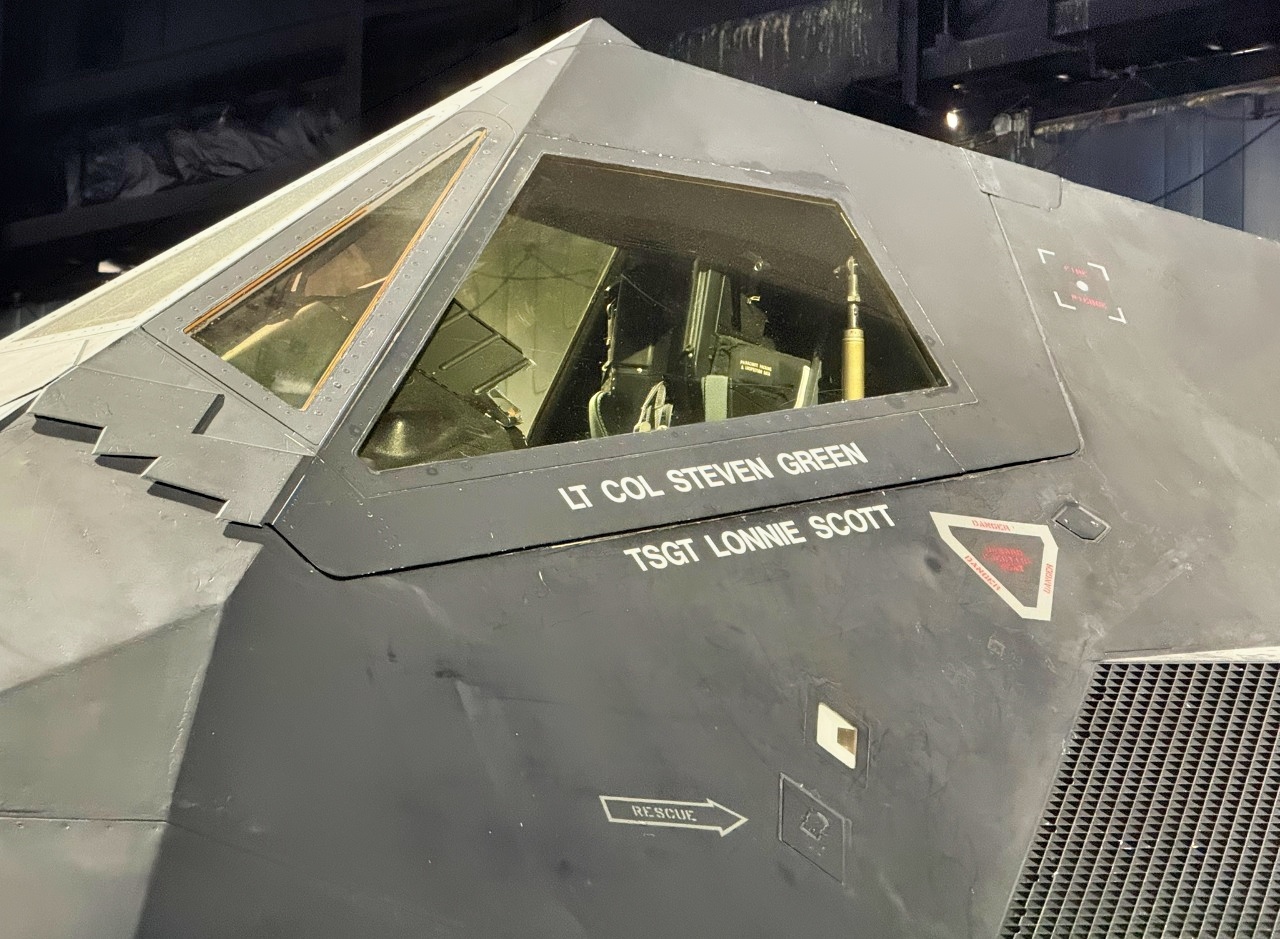
F-117 Up Close at USAF Museum. Image Credit: National Security Journal.
-Today, a handful of airworthy jets help validate sensors, IR tracking, coatings, and counter-stealth tactics at far less cost and risk than using F-22s or F-35s.
-Roughly 45 airframes remain in inventory; more will head to museums over time.
-Until then, the Nighthawk’s second act keeps shaping stealth warfare.
The F-117 Nighthawk Is Still Flying Even After Retirement
The Lockheed F-117 Nighthawk was the world’s first operational stealth aircraft. Developed in response to a need for an aircraft capable of attacking high-value targets without being detected by radar, it utilized a faceted design and radar-absorbent materials to minimize its radar cross-section.
The F-117 Nighthawk is still flying, even though it was officially retired from combat service in 2008.
A portion of the fleet remains airworthy and is used by the U.S. Air Force for testing new technologies and training, including acting as an adversary to simulate enemy stealth aircraft. The Air Force plans to continue these operations through at least 2034.
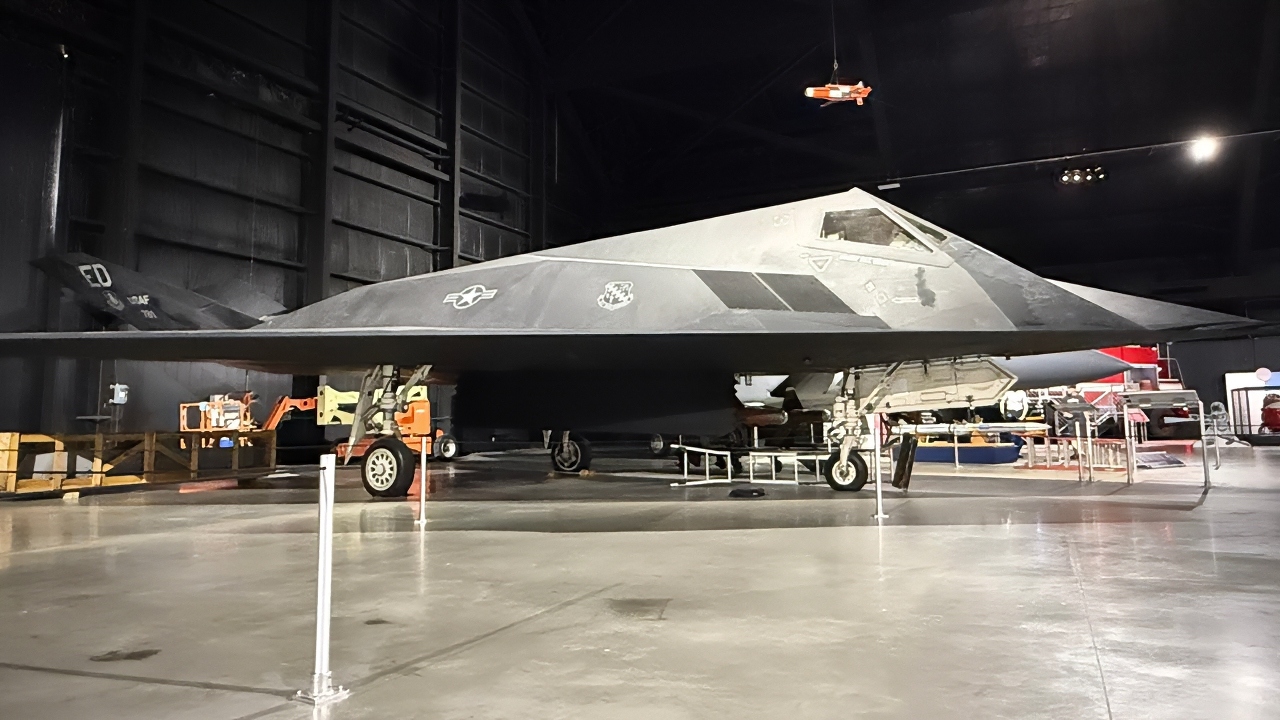
F-117 Nighthawk in the Air Force Museum. Image Credit: National Security Journal.

F-117 Stealth Fighter National Security Journal Photo. Image taken at U.S. Air Force Museum.
The Air Force keeps all the F-117s at the Tonopah Test Range Airport, which is located within the boundaries of the larger Nevada Test and Training Range (NTTR), which lies adjacent to Nellis Air Force Base.
The Aircraft Are Older Than Many Of The Pilots Who Fly Them
The F-117 first saw combat action during Operation Just Cause in 1989. It was retired by the U.S. Air Force in 2008, but remains an iconic example of stealth technology and a subject of public fascination.
Its small radar signature, Low Observable (LO Stealth) technologies, and advanced targeting system allowed the aircraft to penetrate dense threat environments and deliver precision weapons against heavily defended, high-value targets with pinpoint accuracy. Primary missions included precision attack, air interdiction, Suppression of Enemy Air Defenses (SEAD), and special operations.
But for all the hoopla generated around the aircraft, it wasn’t heavily armed.
Meet The F-117 Nighthawk
The F-117A’s story dates back to the 1970s, when the U.S. Air Force began to realize that increasingly sophisticated Soviet Air defense systems and radar, particularly surface-to-air missiles, were jeopardizing American air supremacy.
The Defense Research Projects Agency, more commonly known as DARPA, contracted with Lockheed’s fabled Skunk Works division to design and build the Have Blue stealth technology demonstrator, the similar-looking predecessor to the F-117A Nighthawk.
The turnaround time, from contract award to initial operating capability, was incredibly short, just seven years, which was a testament to the talented team at Lockheed’s Skunk Works. The first F-117As became operational in 1983. But the Air Force didn’t acknowledge its existence until 1988.

F-117A Up Close National Security Journal Image. Taken by Harry J. Kazianis on July 19, 2025.

F-117 at the US Air Force Museum July 2025. Image taken by National Security Journal.
During Desert Storm in 1991, the F-117 consisted of only 2 percent of the combat sorties but covered 40 percent of the targets.
The Nighthawk’s Stealth Technology
The F-117’s unique design incorporates flat, angled panels that scatter and reflect radar waves. Bolstered by an external coating of radar-absorbent materials, which reduces its radar signature, the aircraft was nearly invisible to radar.
The F-117’s design utilized flat, faceted panels to deflect radar waves away from the source, minimizing its radar cross-section. The aircraft was coated with RAM, further reducing its radar signature.
The radio-wave-absorbing materials covering the F-117 weighed almost one ton and were held in place by an adhesive. The gaps between the sheets are filled with a kind of putty material called “butter.”
The F-117 did not utilize radar for targeting; instead, it relied on infrared sensors and a laser designator. The F-117’s internal weapons bays further reduced its radar profile.
The Air Force only built 59 of the F-117s, but they punched above their weight, especially in Operation Desert Storm.
Technical Specifications :
Engines: Two General Electric F404-F1D2 engines, 9,040 lbf thrust each
Maximum speed: 684 mph (0.84 Mach)
Range: 1,070 miles (unlimited with aerial refueling)
Crew: 1
Length: 65 ft 11 in (20.09 m)
Wingspan: 43 ft 4 in (13.21 m)
Height: 12 ft 5 in (3.78 m)
Wing area: 780 sq ft (72 m2)
Empty weight: 29,500 lb (13,381 kg)
Max takeoff weight: 52,500 lb (23,814 kg)
The F-117s’ Armament Capability Wasn’t Big
The F-117 Nighthawk was designed as a stealth attack aircraft, primarily focused on delivering precision-guided munitions.
It carried its weapons internally in two bomb bays, and its arsenal mainly consisted of laser-guided bombs (LGBS) and GPS-guided bombs (JDAMs). The GBU-27 Paveway III was a key munition, designed to penetrate hardened targets.
The F-117’s stealth design required that all weapons be carried internally, limiting its payload capacity to two bombs.
The F-117 was equipped to deploy laser-guided bombs (LGBs) such as the GBU-12, GBU-16, GBU-10, and GBU-27, which were guided by the aircraft’s laser designator.
Later in its service, the F-117 also utilized GPS-guided bombs like the GBU-31 and GBU-38, providing an alternative to laser guidance.
The F-117 was designed solely for air-to-ground missions and lacked any air-to-air weapons or a gun for engaging enemy aircraft. It is curious that the Air Force used the designator as a fighter (F) instead of an attack aircraft (A) due to a combination of factors, including a desire to attract top pilots and potential security considerations.
While primarily a stealth attack aircraft, the “F” designation was seen as more appealing to fighter pilots, and may have also been used to obscure its true nature from potential adversaries.
Why Are The F-117s Still Flying?
The Nighthawks continue to fly for the Air Force despite being officially retired from the USAF in 2008, and they are still providing the service with several valuable tools. Why is the USAF still flying them?
The aircraft is used as a testbed for new technologies, such as radar systems, infrared tracking, and stealth-enhancing materials.
The Nighthawk serves as a valuable “red air” asset to train pilots on how to counter and defeat modern stealth aircraft from other nations.
Using the F-117 for these purposes is less risky and expensive than testing these systems on more modern, active-duty aircraft like the F-22 Raptor or F-35.
The F-117 can be used to simulate stealthy cruise missiles during large-scale exercises.
The F-117 Paved The Way For The Stealth Aircraft Of Today
The F-117’s development and operational use paved the way for other stealth aircraft, such as the B-2, F-22, and F-35. The Air Force still uses the F-117, and an official said, “On occasion, we fly certain [F-117A] aircraft to support limited research and training activities.”
F-117s have recently been involved with and supported several exercises in 2020, operating more frequently and openly alongside Aggressor aircraft at Nellis and MCAS Miramar.
In 2023, a USAF spokesperson said: “We have approximately 45 F-117s currently. As we demilitarize the aircraft, they will be made available to museums, if requested, or be disposed of.”
The number had reduced by six compared to the total given in 2019. Lockheed originally built five YF-117As and 59 production aircraft. Thirteen of these have been retired to museum or display use, and six were lost. This leaves 45 aircraft, of which at least five seem to be active.
Eventually, all of the 45 remaining aircraft will be retired. Then they’ll be scrapped or donated to museums. Currently, 10 are slated for museum duty.
About the Author: Steve Balestrieri
Steve Balestrieri is a National Security Columnist. He served as a US Army Special Forces NCO and Warrant Officer. In addition to writing on defense, he covers the NFL for PatsFans.com and is a member of the Pro Football Writers of America (PFWA). His work was regularly featured in many military publications.
More Military
China’s H-20 Stealth Bomber Has a Message for the U.S. Air Force
China’s New J-35 Stealth Fighter Has a Message for the U.S. Air Force
China Is Studying the Ukraine War to Become a Drone Superpower
The Road to a China-America Nuclear War
China Could Fire Mach 6 Hypersonic Missiles from Bombers to Sink Navy Aircraft Carriers


Bailey D Shaffer
October 31, 2025 at 3:04 pm
They should bring back the SR-71. That is still an awesome platform‼️