


Key Points and Summary – The F-117A Nighthawk was the Air Force’s answer to maturing Soviet air defenses: a low-observable, night precision-strike jet that could penetrate the hardest airspace and hit high-value targets.
-After a debut in Panama (1989), it became a precision workhorse in Desert Storm (1991), then returned for Allied Force (1999) and early phases of Afghanistan and Iraq.
-Retired from frontline service in 2008, the fleet didn’t vanish; many airframes remained airworthy as test and training assets, flying LO aggressor profiles and supporting sensor/coating trials.
-Expect them to keep flying into the 2030s, giving U.S. crews a live stealth problem while newer platforms take center stage.
–National Security Journal visited the F-117 at the U.S. Air Force Museum in Dayton, Ohio. All images and videos in this article were created from that visit and are entirely original.
F-117A Nighthawk: From Black Project To Quiet Teacher
By the mid-1970s, U.S. planners had a problem math couldn’t wish away: Soviet air defenses were maturing into dense, overlapping networks of search radars, fire-control sets, and surface-to-air missiles. Throwing more speed at the problem helped—until it didn’t. What the Air Force really needed was a way to skip the radar equation altogether: radically cut an aircraft’s signature so it could slip through the web, hit key nodes, and leave before the enemy figured out what had happened. That idea—stealth before “stealth” was a household word—became the F-117A Nighthawk.
Conceived as a night, precision strike aircraft, the Nighthawk was never a dogfighter despite the “stealth fighter” nickname. Its angular, faceted shape, internal weapon bay, and careful management of heat and radio emissions were all in service of one mission: penetrate the hardest airspace on earth and drop laser-guided weapons exactly where commanders needed them. The first unit achieved initial operating capability in 1983, and the airplane’s very existence remained a closely held secret until 1988. For a generation raised on runway fly-bys and air-show formation passes, the F-117A was a different animal—built to be seen only when it wanted to be.

F-117 Stealth Fighter in Museum Hanger. Image Credit: National Security Journal.
First Combat: Learning In The Shadows
The Nighthawk’s first combat missions were in Panama in December 1989, where it struck select military targets during the opening of Operation Just Cause. The larger lesson wasn’t spectacle; it was precision. In a dense urban environment where collateral damage could change the politics of a campaign overnight, a jet that could put a guided bomb on a specific aimpoint at night—without alerting every radar within a hundred miles—was suddenly more than a technology demo. It was a policy tool.
Desert Storm: Precision At Scale
In 1991 over Iraq, the F-117A moved from boutique to backbone. On the opening night, Nighthawks led deep strikes on hardened command bunkers, air-defense nodes, and leadership targets in downtown Baghdad—places no conventional jet wanted to be on Night One. Over the campaign, they settled into a ruthless rhythm: launch at night, slip across the border, strike two targets from the internal bay, and ghost home. The airplane’s kill chain—low observable airframe, stable attack platform, laser-guided weapons, and crews drilled to a metronome—delivered what the joint force needed most: reliable, repeatable first-round hits on the targets that unlock a modern air war.

F-117 National Security Journal Photo Taken at U.S. Air Force Museum.
Two features stood out. First, concentration of effect: a small force of jets could dismantle critical infrastructure without massing hundreds of aircraft. Second, confidence: air battle managers and strike planners learned that when a Nighthawk was on a fragged target, it would be hit, even under weather and in the teeth of the densest defenses. That trust changed the way opening-night target sets were built in every major campaign that followed.
Between Wars: From Black To Gray
After Desert Storm, the F-117A shed a bit of its cloak. It was still a night specialist, still a precision instrument, but it began to train more openly and integrate with a wider set of joint and coalition partners. The airplane refined its tactics for urban strike, aimpoint mensuration, and post-strike assessment—skills that would be needed again, and soon.
Allied Force: Tough Air Defenses And A Hard Lesson
When NATO intervened over Yugoslavia in 1999, the Nighthawk again led early strikes against defended, politically sensitive targets. The campaign also delivered the F-117’s most famous scar: the shoot-down of a Nighthawk by a vintage, but cleverly operated, SA-3. The pilot survived; the community absorbed the lesson.
Stealth reduces risk; it doesn’t erase it. Predictable routes and timing, even for a low-observable aircraft, create patterns adversaries can exploit. The fix was the same as ever in air warfare: more variety, more deception, tighter suppression of enemy air defenses, and sharper crew discipline. The F-117 returned to the fight and continued to strike through the remainder of the campaign.
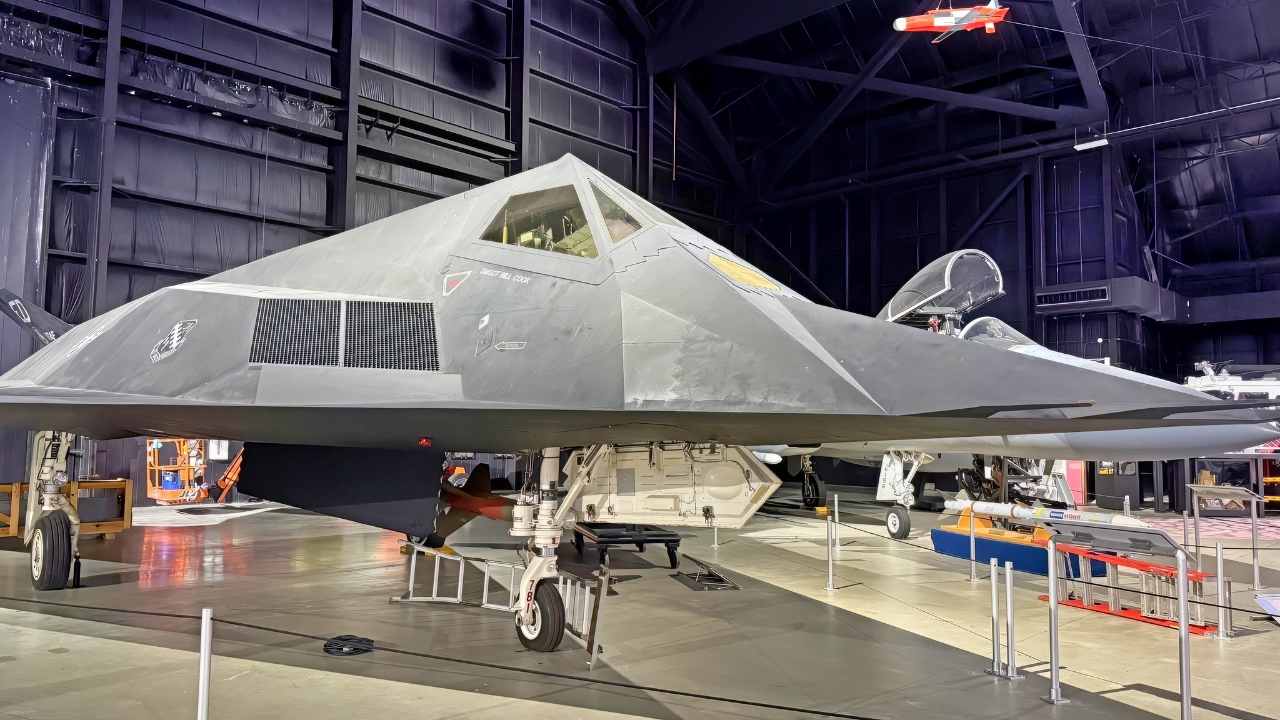
F-117 Nighthawk July 2025 National Security Journal Image HD. Photo by Harry J. Kazianis.
Afghanistan: Precision Without Runways Or Roads
In the early phases of Operation Enduring Freedom (2001), the Nighthawk helped dismantle Taliban target sets under darkness, hitting fixed facilities and defended sites in regions where weather, terrain, and distance turned logistics into guesswork. The airplane’s familiar strengths—night penetration and precise LGB delivery—let planners hold high-value aimpoints at risk without stacking large packages of non-stealth jets over limited tanker orbits. In a theater with few friendly runways and many political constraints, that mattered.
Iraq 2003: Opening Doors, Then Handing Off
When the United States returned to Iraq in 2003, the F-117 was once again part of the opening choreography. It attacked hardened and time-sensitive targets in and around Baghdad, helped crack open key defenses, and then, as the fight shifted to a broader, sustained campaign, handed off many missions to multirole platforms that could carry larger mixed loads and stay aloft longer over evolving battles. That hand-off foreshadowed the airplane’s sunset: the Nighthawk pioneered a way of war that newer aircraft could now execute more efficiently, with lower maintenance costs and greater versatility.
Why It Retired—And Why It Never Quite Went Away
In 2008, the Air Force retired the F-117A from frontline service. The reasons were straightforward. The aircraft’s faceted stealth demanded labor-intensive upkeep. Avionics, cooling, and power margins were aging out just as newer, more flexible platforms—F-22, then F-35, and the B-2—were picking up stealthy precision strike with better range, sensors, and survivability across a wider set of missions.
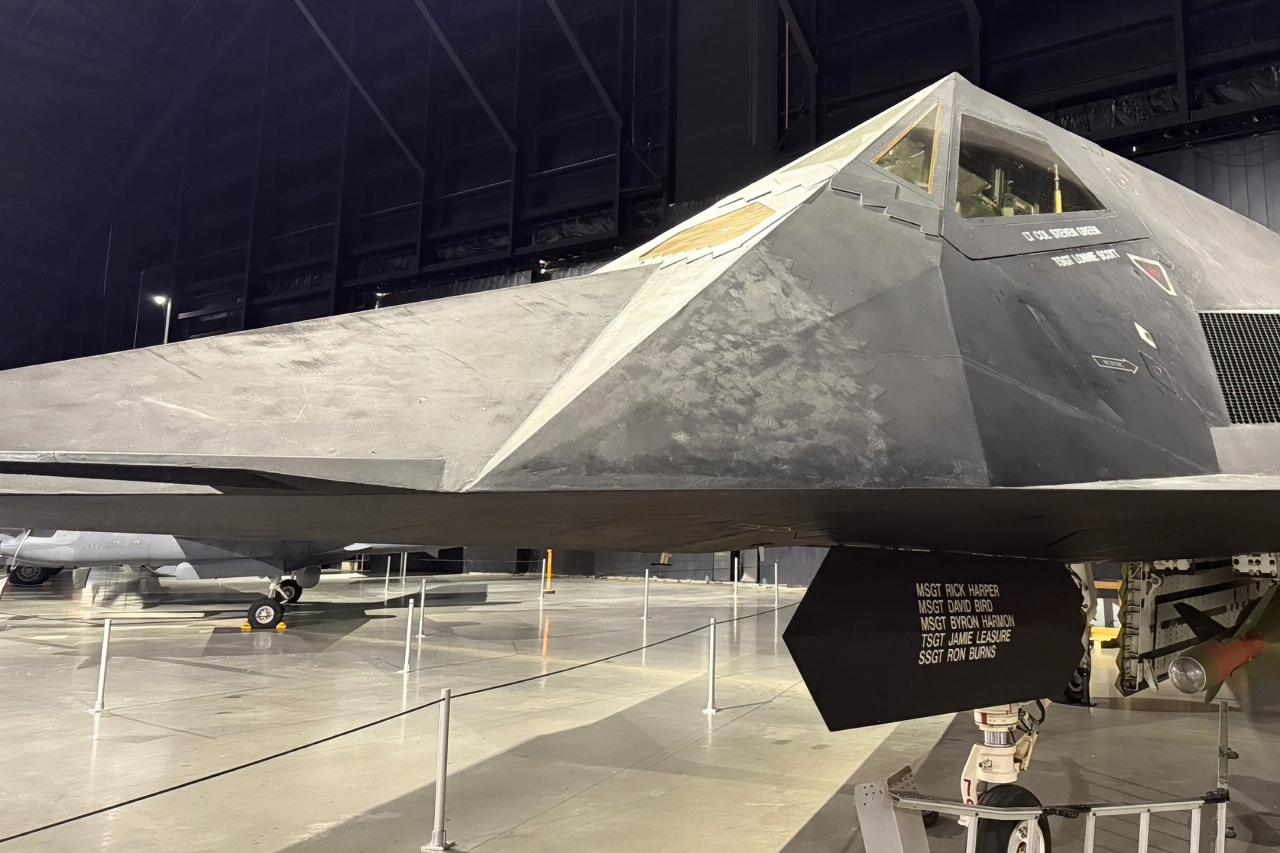
F-117 As Close As We Can Get. National Security Journal Original Photo.
But the Nighthawk didn’t go to the boneyard like other fleets. Most airframes went into flyable storage, and a subset stayed airworthy. The community’s logic was as pragmatic as it was secretive: an aircraft that can present a genuine low-observable problem is a priceless tool for test and training. Need to evaluate a new radar mode, infrared search-and-track concept, datalink tactic, or weapon seeker against a real stealthy target? Put a black jet in the air at the right time and place and find out.
The “Retired” Years: A Quiet Second Career
Over the last decade, the F-117A has reappeared regularly—never as a front-line striker, always as a surrogate and sparring partner. Nighthawks have flown adversary profiles for fighter squadrons and integrated exercises, stress-tested air-defense sensors, rehearsed long-range maritime targeting problems, and supported developmental testing for sensors and coatings. The airplane’s signature and handling are unique enough to teach valuable lessons yet familiar enough for crews and maintainers to keep safe.
That second career is likely to extend into the 2030s. As China and Russia field their own stealthy aircraft and low-observable cruise missiles, U.S. forces need live, repeatable LO presentations to keep tactics honest. The Nighthawk can impersonate pieces of those problems without revealing anything sensitive about current stealth designs.
It’s a useful decoy, a stubborn teacher, and a reliable test article.

F-117A Up Close National Security Journal Image. Taken by Harry J. Kazianis on July 19, 2025.
What The F-117A Nighthawk Changed—Technically And Culturally
Technically, the F-117A proved that geometry and discipline—planform shaping, edge alignment, careful materials, and emission control—could beat radar equations that once looked unassailable. It turned night precision into a standard expectation, not a boutique capability. It also taught engineers and crews to think of stealth as a system, not a paint job: route planning, radio procedures, formation spacing, and even tanker timing are part of the signature.
Culturally, the jet altered how America fights night one. Instead of massing hundreds of aircraft to batter down a door, the Air Force could use a handful of stealth platforms to remove key locks and hinges, then let larger forces flow through. That change rippled across doctrine, diplomacy, and industry—because once decision-makers believe night-one strikes can be both precise and survivable, they plan differently.
Why The F-117 Still Matters In An Era Of New Stealth
It’s fair to ask: with F-35s in squadron service and the B-21 beginning to arrive, what’s the point of a 1980s stealth jet? The answer is honest training and rapid testing. Not every unit can or should use front-line stealth assets for every experiment or exercise vignette.
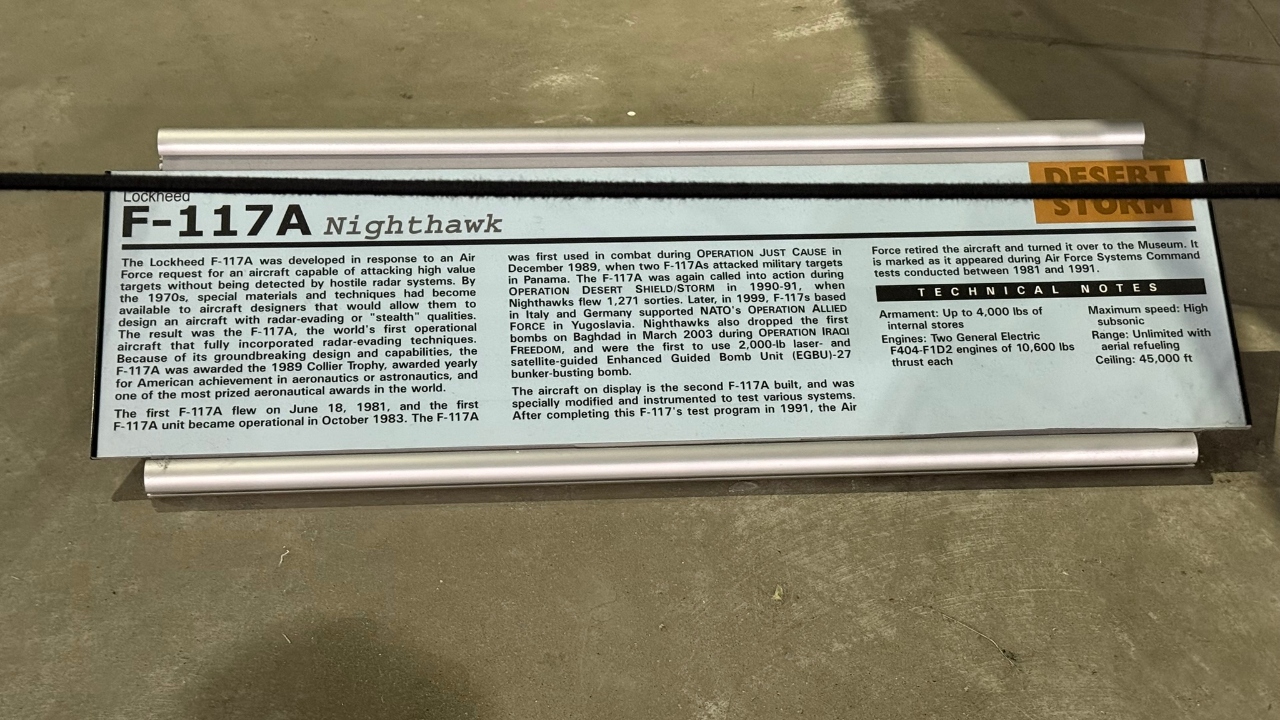
F-117A Nighthawk Sign Image Taken at USAF Museum. Image Credit: National Security Journal.
The Nighthawk fills that gap. It can stress a data chain without compromising a newer jet’s tactics, fly a red-air LO profile to force blue units to solve a real detection problem, and support coating and materials trials without touching a production fleet. In other words, the F-117 is the wind tunnel that flies, a controllable variable for a military that expects to fight in the shadows as much as in the daylight.
A Museum Piece That Still Teaches
Stand near a Nighthawk at the National Museum of the U.S. Air Force like I did, and the shape still looks like a secret.
The facets that once baffled radars also turn a hangar’s spotlights into shards of gray. It’s a reminder that the airplane wasn’t just an engineering feat—it was a concept proven in combat.
From Panama’s first nights to Baghdad’s most defended intersections, and later over the Balkans and the early days in Afghanistan and Iraq, the F-117 did exactly what it was built to do: go where others couldn’t, hit what others couldn’t, and come home unseen.
Verdict on the F-117A
The F-117A Nighthawk began as a bet—that the right mix of geometry, materials, sensors, and crew discipline could make a combat jet that radars would struggle to find. It paid off in the 1990s, reshaped night-one strategy for a generation, and retired when newer aircraft could carry the idea further.
Today it lives on as a flying problem set for America’s test ranges and training airspace, a practical way to prepare for the stealthy threats U.S. forces will face from Russia and China. For an airplane designed not to be seen, that may be the most fitting legacy: still shaping how others fight, long after the headlines moved on.
About the Author: Harry J. Kazianis
Harry J. Kazianis (@Grecianformula) is Editor-In-Chief and President of National Security Journal. He was the former Senior Director of National Security Affairs at the Center for the National Interest (CFTNI), a foreign policy think tank founded by Richard Nixon based in Washington, DC. Harry has over a decade of experience in think tanks and national security publishing. His ideas have been published in the NY Times, The Washington Post, The Wall Street Journal, CNN, and many other outlets worldwide. He has held positions at CSIS, the Heritage Foundation, the University of Nottingham, and several other institutions related to national security research and studies. He is the former Executive Editor of the National Interest and the Diplomat. He holds a Master’s degree focusing on international affairs from Harvard University.
More Military
The B-1B Lancer Bomber: The Air Force’s Best Bomber Ever?
MBT-70: The Super Tank Built to Fight WWIII Against Russia
The M48 Tank Has a Message for the U.S. Army


