

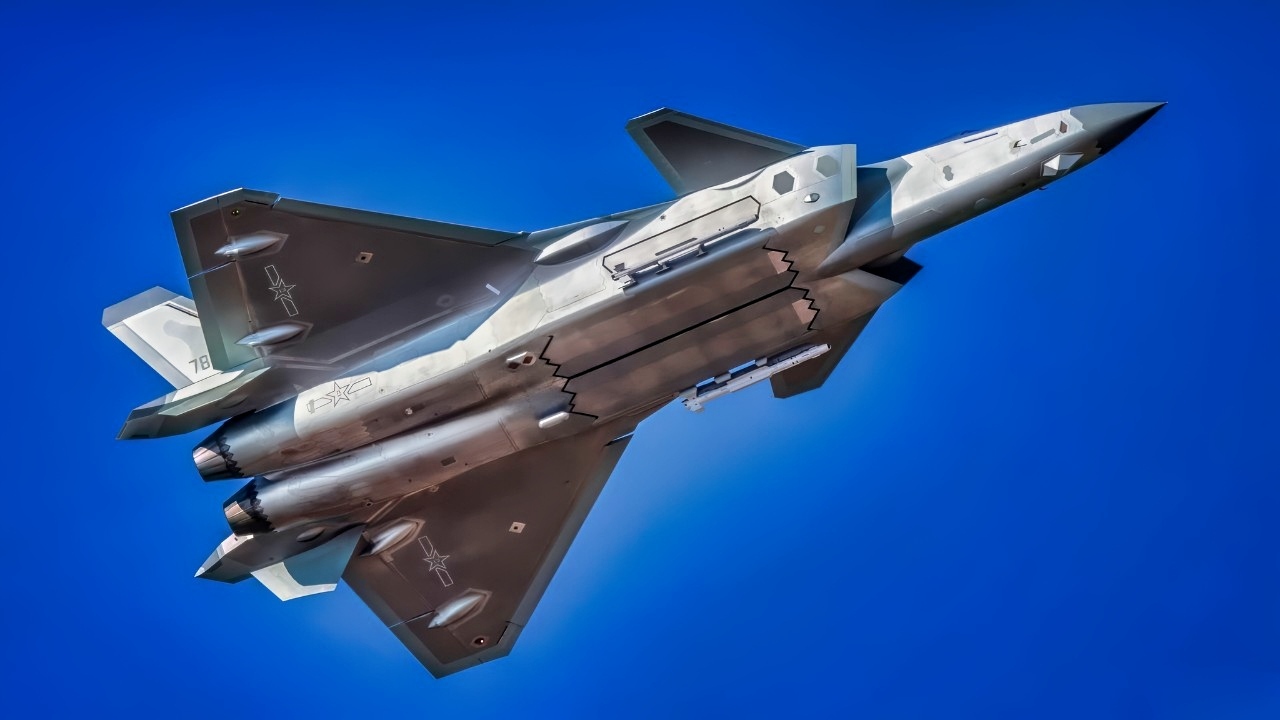
Key Points and Summary – China’s massive military parade this week showcased an impressive air force, with around 100 fighters, including five 5th-generation stealth models.
-While Beijing promotes these as domestic triumphs, this analysis argues that China’s entire modern combat aviation industry is built upon a Russian technological foundation.
-The pivotal moment was the Soviet Union’s 1990 sale of its top-tier Su-27 fighter, a deal that “broke the seal” on technology transfers.
-Decades later, every advanced Chinese jet on display is a direct result of that initial cooperation, a fact that underpins China’s current airpower.
China Showed Off 100 ‘Chinese’ Jets. They All Have a Russian Secret
Kielce, Poland – Wednesday’s parade in Beijing that celebrated 80 years since the surrender of Japan in WWII—and for the Chinese, the final end of the war—featured, among other displays, scores of weapon systems, some 100 different fighter aircraft of the People’s Liberation Army Air Force (PLAAF) and the People’s Liberation Army Navy (PLAN).
While they are always labelled by the People’s Republic of China (PRC) officialdom as “Chinese,” it only takes a short walk down memory lane to realize where the technique, engineering skill, and overall inspiration for those designs come from.
The Su-27 Flanker Deal
The story begins in 1988, when an activity was taking place inside the PLAAF under the classified codename “Project 906.” This was in the waning days of the Soviet Union, and the project was for the purchase of the PRC’s first batch of Sukhoi Su-27s. The deal was finally done in 1990, with Beijing acquiring 24 of the then-Soviet Union’s most powerful air superiority fighters.
The PRC went down in history as the only nation to ever be approved for an export purchase of the Su-27 by the former Soviet Union.
Later, multiple purchases of the aircraft, or its upgraded derivative, the Su-30, would end up being concluded by the largest successor state of the USSR, the Russian Federation, with sales to Malaysia, India, Algeria, Venezuela, and Vietnam.
But the sale to the PRC “broke the seal,” so to speak. Before 1990, the USSR had adhered to a time-honoured principle that certain, upper-tier weapons would be for domestic use only and not sold for export, with the Su-27 having been one of those.
A Hundred Flowers
That principle went by the wayside long ago in Russia, with the most sophisticated hardware going to major client states – the PRC and India being some of the biggest buyers. In the case of Beijing, the Su-27s created an industry that fulfilled a long-time slogan of Mao Zedong of “let a hundred flowers bloom.”
The PLAAF—albeit decades after Mao’s departure—turned the Su-27 and all of the Russian aerospace technology that the PRC acquired later into the bedrock that their combat aviation industry is built on. The “100 flowers” were all on full display this week, which major state-controlled press outlets in the PRC were only too happy to crow about.
At the top of the list were several types of 5th-generation combat aircraft that are in active duty with the PLA, all of which were seen together for the first time at this grand parade on Wednesday. Chinese media quoted Western experts who said this parade of advanced designs was “intended to show its world-class air prowess.”
All of the five 5th-generation models – these being the four different PLAAF aircraft: Chengdu J-20, J-20A, J-20S and the Shenyang J-35A and the PLAN Navy’s J-35B – flew over the parade route and past the center VIP reviewing box where Chinese Communist Party General Secretary Xi Jinping, Russian President Vladimir Putin and Democratic People’s Republic of Korea (DPRK) leade Kim Jong Un were overseeing the display. The entire parade lasted some 70 minutes, but in a demonstration of how important China’s communist rulers viewed the event, rehearsals for the spectacle had been underway for weeks.
Unprecedented Unveiling
Wang Yanan, who is the chief editor of the PRC’s Aerospace Knowledge magazine, told the state publication China Daily that this is the first time in the history of the PRC that so much new hardware has participated in a parade.
“What we have seen is an unprecedented unveiling of China’s domestically developed weaponry such as those new aircraft. All of these previously unseen weapons have state-of-the-art designs and superior capabilities and have tremendously enhanced the Chinese armed forces’ overall strength,” he said.
“Specifically speaking, the appearance of the J-20 and J-35 families on a considerable scale means that the Air Force and Navy are in the middle of a systemic transformation that highlights the core role of fifth-generation types, namely these stealth jets,” he added.
In his estimation, the PLA is ahead of other militaries around the globe in its development of comprehensive 5th-generation air combat systems.
According to a statement by the “air boss” of the parade – a temporary-in-command officer in charge of all the aircraft to be flown in the parade – the new fighters “have been deployed to handle high-intensity warfare”. At the same time, their appearance was meant to “reflect the PLA’s strength to deter adversaries and safeguard China’s airspace.”
It is PRC air power at its apex, but all made possible by the decades of cooperation with the Russian aerospace industry.
About the Author: Reuben F. Johnson
Reuben F. Johnson has thirty-six years of experience analyzing and reporting on foreign weapons systems, defense technologies, and international arms export policy. Johnson is the Director of Research at the Casimir Pulaski Foundation. He is also a survivor of the Russian invasion of Ukraine in February 2022. He worked for years in the American defense industry as a foreign technology analyst and later as a consultant for the U.S. Department of Defense, the Departments of the Navy and Air Force, and the governments of the United Kingdom and Australia. In 2022-2023, he won two awards in a row for his defense reporting. He holds a bachelor’s degree from DePauw University and a master’s degree from Miami University in Ohio, specializing in Soviet and Russian studies. He lives in Warsaw.
More Military
SR-72 Darkstar Might Never Fly
The U.S. Navy’s ‘Achilles Heel’: China’s Underwater Drones
The F-35 Has a ‘5-Year Late’ Problem


