

Moscow’s Ministry of Defense said on Friday that Ukraine launched a major overnight attack on a dozen regions across Russia. The strikes are once again among the largest launched throughout the entire campaign and brought Kyiv closer to its goal of isolating Crimea from the Russian mainland.
What Just Happened
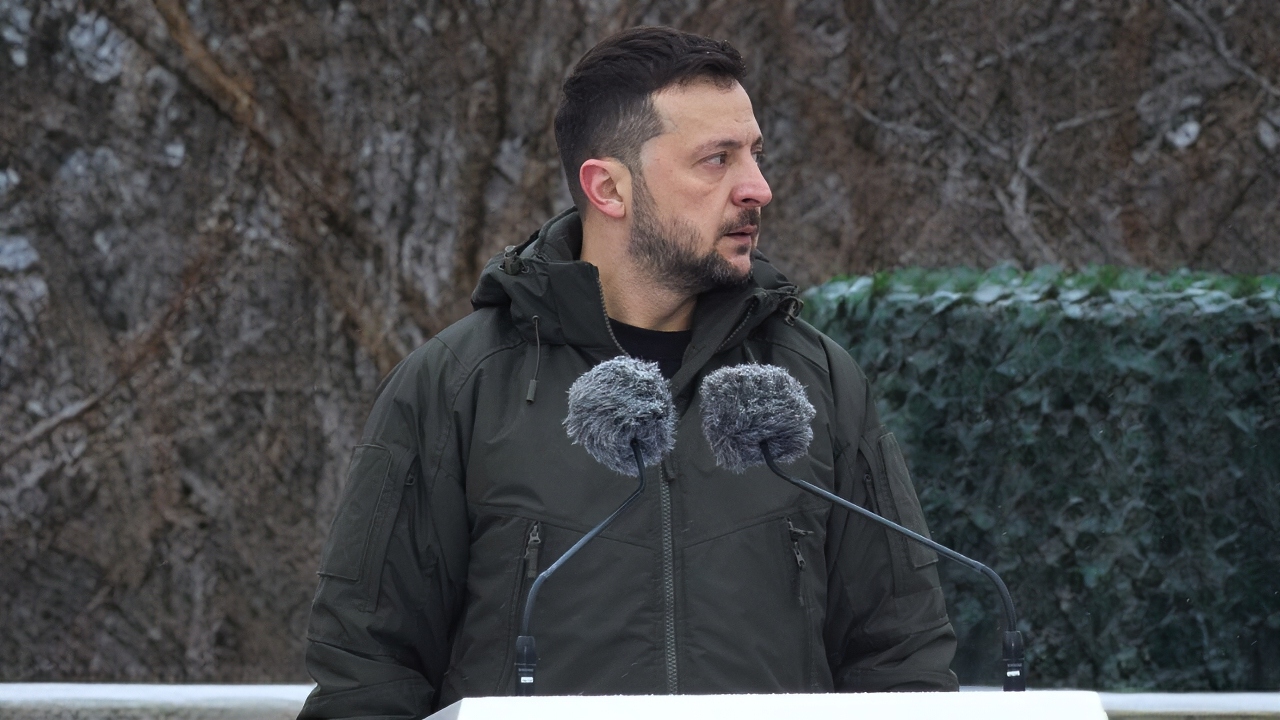
Image Credit: Office the the President, Ukraine.
The Russian Defense Ministry confirmed that it had intercepted 660 Ukrainian drones.
It is substantially bigger than the previous largest attack by the Ukrainians over the past year, which took place on May 17 and saw 556 drones flown at Russian targets.
The official statement described a dispersed Ukrainian assault targeting “Belgorod, Bryansk, Kursk, Kaluga, Rostov, Voronezh, Tula, and Ryazan regions, as well as the Moscow region.”
Russia appeared to be prepared for the assaults, too. Earlier on the same day, Ukrainian President Volodymyr Zelenskyy warned Russia that he had approved a 40-day-long campaign to put pressure on Moscow to end the war.
That 40-day period began with what looks to be the most severe strike of the war. Kyiv has yet to release all details about the strike in any public statement.
What We Know So Far
Reports from Novomoskovsk in the Tula region describe how explosions began after 2 am local time. Videos circulating on social media appear to show large fires at the Azot chemical plant, one of Russia’s largest producers of industrial chemicals used in explosives and military manufacturing.
Local media also reported a fire at the nearby Novomoskovsk hydroelectric plant, though Russian authorities have not released a full assessment of the damage.
Crimea was also hit particularly hard, with Ukrainian forces continuing a military campaign that now risks isolating the valuable territory from mainland Russia.
Ukraine’s Security Service (SBU) said that its drones struck Russian naval vessels and air defense radar systems positioned around Kerch – one of the most strategically important logistics hubs for Russia.
The attacks followed previous strikes that forced the temporary closure of the Kerch Bridge. Local media reports and Telegram posts also reported explosions throughout the city in the early hours of the morning.
Later in the day, open source intelligence showed a 20-mile-long traffic jam as Russians attempted to flee Crimea over the Kerch bridge.
In a statement issued on social media, the Ukrainian Ministry of Defense insisted there is “no safe harbor in occupied Crimea.”
“@ServiceSsu drones hit the Zaliv shipyard in Kerch: two military cable ships, a near-complete ferry, and an S-400 radar covering the strait.
The cable ships alone are worth hundreds of millions of dollars each. Crimea is no logistics hub. Ukraine’s defense forces will keep proving it,” the statement continued.
The Strikes Reached Moscow
Moscow endured yet more strikes overnight, with Mayor Sergei Sobyanin describing how 47 drones were intercepted approaching the capital city.
Sobyanin said emergency services had been dispatched to locations where debris fell from the interceptions, but no casualties or significant damage were recorded in the city this time.
Airports in and around the capital city also introduced temporary flight restrictions.
Dmitry Milyaev, the regional governor of Tula, described the strikes as a “massive” drone attack and confirmed that a residential building in the Shchekino district had been damaged. One injury was also reported.
Zelenskyy’s 40-Day Push
It’s a big start for what is set to be a brutal and punishing 40 days for Russia.
Speaking during his evening address on Thursday, the Ukrainian president confirmed that he had met with the nation’s top military leaders and intelligence chiefs to review plans for the next phase of Ukrainian operations.
He described how Ukraine had identified particularly sensitive targets inside Russia and had approved a new, sustained pressure campaign that will last 40 days.
The objective, he said, is to force Moscow back to the negotiating table by raising the cost of continuing the war.
“I approved a 40-day influence operation for the Service against the aggressor state aimed at compelling it to end the war,” Zelenskyy also said in a statement issued on social media.
“Importantly, for several months in a row, the SSU has demonstrated the highest performance in defending Ukraine’s positions on the front lines through the use of various types of drones.
The Center of Special Operations “Alpha” leads in terms of the occupier’s personnel and equipment neutralized,” it continued.
The Ukrainian president once again referred to the latest long-range strike campaign as a form of “long-range sanctions” designed to undermine Russia’s ability to finance and sustain the invasion rather than simply fighting shell-for-shell on the battlefield.
He described how missiles and drones will target Russian logistics, military facilities, and other enterprises, which he said must feel that the war has consequences.
Russia is preparing for the strikes.
Reports this week revealed that Pantsir air defense systems were being moved to the nation’s capital, while Zelenskyy also reported that “hundreds” of systems were being moved to protect major Russian cities.
About the Author: Jack Buckby
Jack Buckby is a British researcher and analyst specializing in defense and national security, based in New York. His work focuses on military capability, procurement, and strategic competition, producing and editing analysis for policy and defense audiences. He brings extensive editorial experience, with a career output spanning over 1,000 articles at 19FortyFive and National Security Journal, and has previously authored books and papers on extremism and deradicalization.


