


The U.S. Navy plans to spend $17 billion on the first Trump-class BBG(X) nuclear-powered guided-missile battleship, with the first three hulls estimated at $43 billion and the full fleet potentially reaching $700 billion across its lifetime. The ship will displace 30,000 to 40,000 tons — closer in size to Russia’s Admiral Nakhimov nuclear battlecruiser than to a U.S. destroyer — and carry hypersonic weapons, Conventional Prompt Strike missiles, directed-energy lasers, and potentially nuclear cruise missiles. The Pentagon is designing the BBG(X) around the U.S. defense industrial base’s inability to build mass, rather than around the distributed warfare China’s PLA Navy is preparing for.
The Trump-Class Battleship Mistake
America’s empire continues its terminal decline as its Navy is now directed by the ruling class to build nuclear-powered battleships.
Massive, floating targets, like the HMS Hood or the Bismarck from the Second World War, the imperial capital has become so disconnected from reality that it is quite literally building expensive nuclear battleships that will simply be converted into coral reefs lining the seafloor of places like the South China Sea or Taiwan Strait.
Enter the Trump-Class BBG(X)
Known as the Trump-class battleship, this new capital ship is turning out to be one of the most controversial procurements since the USS Gerald R. Ford.
Unlike the Ford, though, the Trump-class battleship is something that few in the Navy (or anywhere else for that matter) ever wanted. If the Ford was impractical, the Trump-class BBG(X) is an extravagant absurdity.

Iowa-Class Sideview. Image taken by the National Security Journal at USS Iowa Battleship. Taken August, 2025.
Still, the Trump administration has attempted to justify this boondoggle.
Some have loosely referred to the BBG(X) as an “arsenal ship” that is optimized for long-range strike warfare against peer rivals, like the People’s Republic of China. Technically, this ship is less of a battleship and more of a battlecruiser, like Russia’s equally monstrous Admiral Nakhimov.
Although officially the Navy describes the BBG(X) as a guided-missile battleship.
A Nuclear-Powered Missile Fortress
She’ll displace between 30,000 and 40,000 tons. That’s far larger than today’s destroyers and approaching smaller aircraft carrier sizes.
The White House claims this leviathan will be essentially a floating missile fortress capable of saturating enemy defenses with massive missile salvos while surviving in contested waters.
It’s directly aimed at waging war against China in the Indo-Pacific.
By placing massive missile magazines, the potential for hypersonic weapon launch capability, Conventional Prompt Strike (CPS) missiles, directed-energy laser defenses, potential railguns, heavy air and missile defense systems, artificial intelligence-enabled combat management, and the potential for nuclear cruise missile capability–all powered by a nuclear reactor–President Trump believes he’s delivering the ace-in-the-hole that the Navy needs against China.
China’s Industrial Rise–and America’s Decline
To be fair, even though this is clearly an obscene vanity project for the forty-seventh president, the Navy is facing a real problem when it comes to China.
Today, China’s navy is growing at a staggering pace. The People’s Liberation Army Navy (PLAN) has the world’s largest navy (by hull count) and an enormous missile inventory.
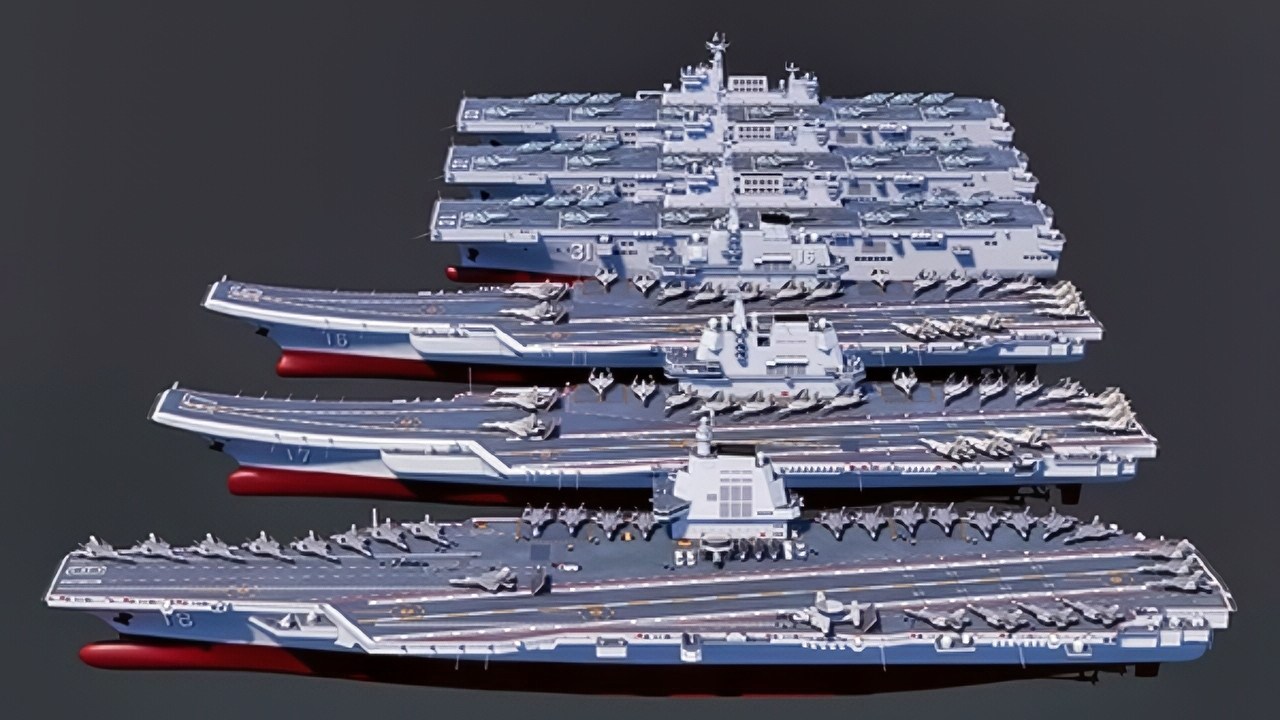
China Aircraft Carriers In Focus. Image Credit: X Screenshot.

China New Carrier Type 003 CCTV Screencap Photo.
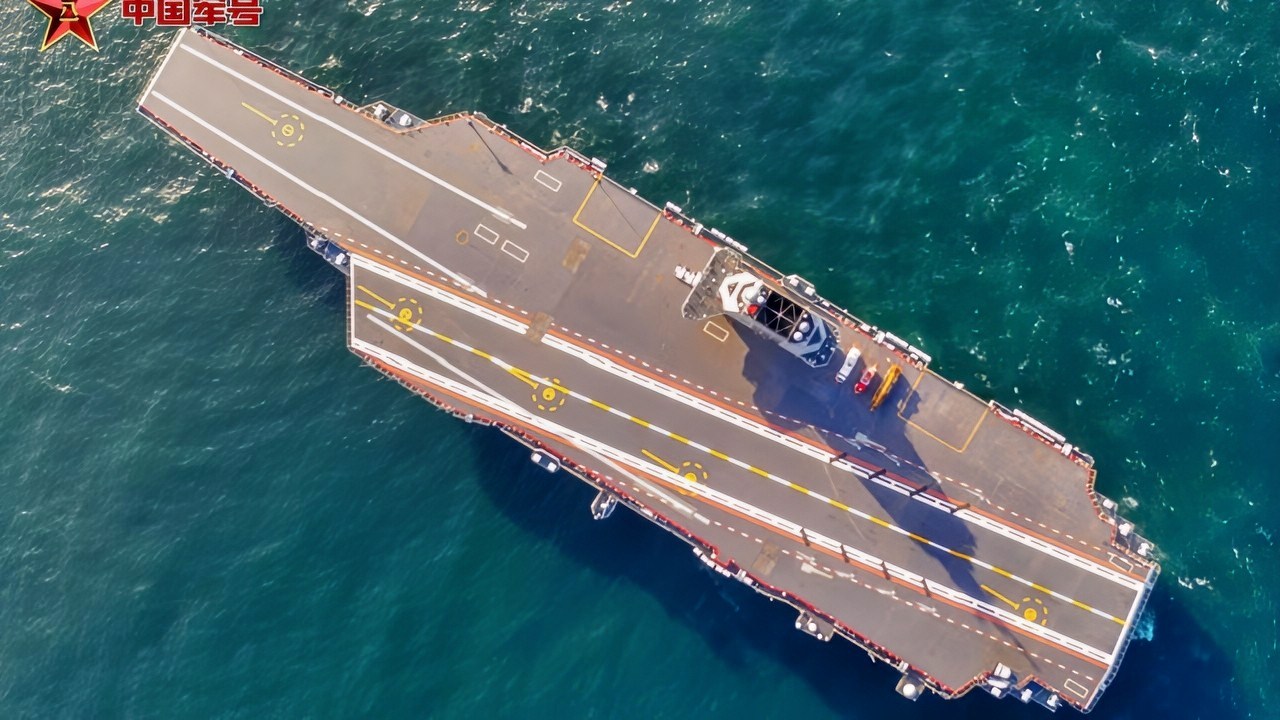
CV-18 Fujian aircraft carrier from China. Image Credit: Creative Commons.
These capabilities are the result of decades of hard-nosed Chinese leaders’ fixation on scaling industrial capacity.
There’s a direct link between China’s impressive industrial capacity today and the deindustrialization craze that dominated the United States from the 1970s onward. America dismantled the productive capabilities that made it the “Arsenal of Democracy” in the Second World War and sold them to China. Beijing dutifully absorbed those capabilities and used them as the spark that lit the fire of China’s growth.
Now, America’s industrial capacity is tiny compared to that which China can achieve. To ameliorate this obvious imbalance, Washington is focused on concentrating enormous offensive and defensive capabilities into fewer, survivable platforms.
But the cost of the BBG(X) is exploding. The Pentagon’s own projections now estimate that the United States will pay $17 billion for the first ship and more than $43 billion for the first three (potentially hundreds of billions across the full planned fleet).
Some projections estimate that the fleet could cost around $700 billion once maintenance, infrastructure, nuclear support, escorts, and sustainment are included. That would rival or exceed some Cold War-era strategic modernization programs.

Trump-Class Battleship. Image Credit: White House.
A Dinosaur Built for the Wrong Era
The fundamental flaw in the Trump-class, though, isn’t the cost. That’s an outgrowth of the fundamental problem the BBG(X) faces. In an age of distributed warfare, where mass and quantity are preferable to smaller, more complex systems, the Trump-class is a dinosaur.
Pentagon planners are designing the BBG(X) not based on strategic needs but on the very serious limitations of America’s ailing defense industrial base and naval shipyards.
That’s a recipe for disaster.
Why build a $17 billion floating target?
Because, clearly, the US defense industrial base is broken, the Pentagon’s acquisition people are out of ideas, and the president who ordered it wants a vanity project.
But when it comes time to build this boondoggle, if it ever gets built, the chances are great that this ship gets destroyed in the opening salvos of any real engagement with a peer competitor.
About the Author: Brandon J. Weichert
Brandon J. Weichert is the Senior National Security Editor at 19FortyFive.com. Recently, Weichert became the editor of the “NatSec Guy” section at Emerald. TV. He was previously the senior national security editor at The National Interest. Weichert hosts The National Security Hour on iHeartRadio, where he discusses national security policy every Wednesday at 8 p.m. Eastern. He hosts a companion show on Rumble entitled “National Security Talk.” Weichert consults regularly with various government institutions and private organizations on geopolitical issues. His writings have appeared in numerous publications, among them Popular Mechanics, National Review, MSN, and The American Spectator. And his books include Winning Space: How America Remains a Superpower, Biohacked: China’s Race to Control Life, and The Shadow War: Iran’s Quest for Supremacy. Weichert’s newest book, A Disaster of Our Own Making: How the West Lost Ukraine, is available for purchase at any bookstore. Follow him via Twitter/X @WeTheBrandon.


