


The Kitty Hawk-class — the USS Kitty Hawk, USS Constellation, and USS America — were America’s last great conventionally powered supercarriers. Each ship displaced about 84,000 tons fully loaded, exceeded 32 knots on eight boilers and four Westinghouse steam turbines, and carried up to 90 aircraft ranging from the F-14 Tomcat and F/A-18 Hornet to the E-2 Hawkeye and EA-6B Prowler. The class anchored U.S. naval aviation through Vietnam, the Cold War, the Gulf, and the Global War on Terror. The USS Kitty Hawk earned a Presidential Unit Citation during the Tet Offensive. The USS America was deliberately sunk during live-fire survivability testing — it took weeks.
The Kitty Hawk-Class Aircraft Carriers Were Unsinkable
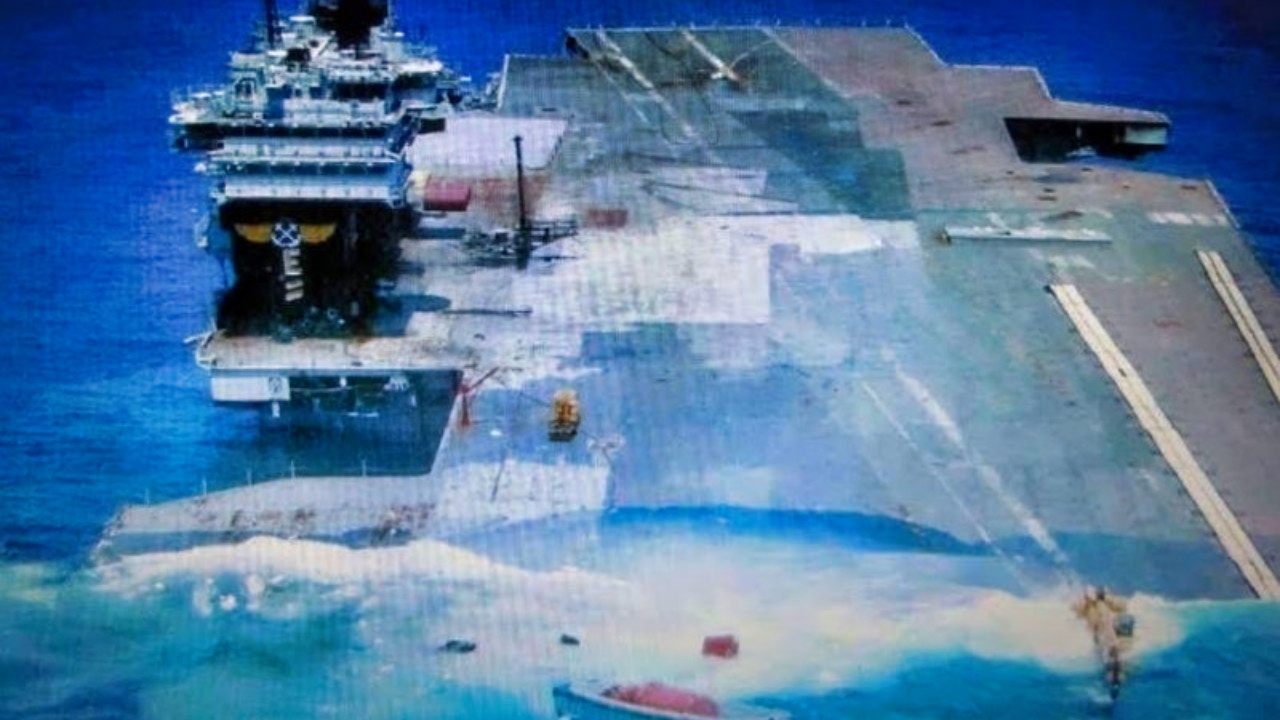
Navy Aircraft Carrier USS America sinking in a controlled detonation. Image Credit: U.S. Navy.
The United States Navy is known for its nuclear-powered aircraft carrier force. From the original nuclear-powered USS Enterprise (CVN-65) to the enduring Nimitz-class, to today’s still developing Gerald R. Ford-class aircraft carriers, the Navy is in the business of building and maintaining nuclear-powered aircraft carriers. But the Navy’s aircraft carrier force wasn’t always nuclear-powered.
Indeed, the greatest aircraft carrier classes in the Navy’s history were conventionally powered systems. For example, the Essex-class aircraft carriers of the Second World War played a key role in America’s victory at sea against the Empire of Japan.
But the postwar, Cold War-era Kitty Hawk-class aircraft carrier represented the high watermark of America’s conventionally powered supercarrier era. Built as an evolutionary step of the earlier Forrestal-class carriers, the Kitty Hawk-class combined massive striking power, improved flight deck efficiency, and decades of combat endurance into what many naval historians consider some of the finest non-nuclear aircraft carriers ever built.
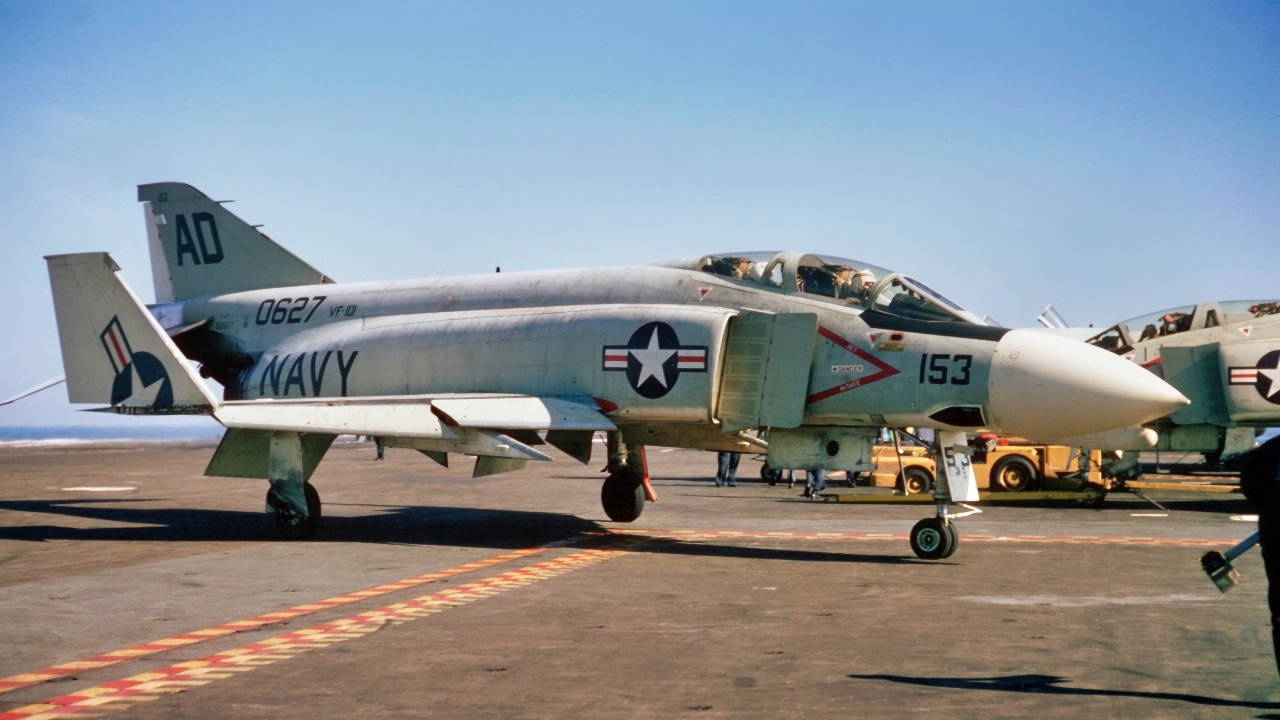
A Fighter Squadron 101 (VF-101) F-4J Phantom II aircraft taxis on the flight deck of the attack aircraft carrier USS AMERICA (CVA 66).
The Kitty Hawk-Class Was Designed to Fix the Forrestal’s Problems
When the Navy created the Kitty Hawk-class during the Cold War, naval aviation was becoming the centerpiece of naval power projection. The earlier Forrestal-class had proven revolutionary, but the Navy wanted better aircraft flow on the flight deck and more efficient sortie generation.
In fact, one of the biggest improvements the Kitty Hawk-class made over the Forrestal-class was its elevator placement. You see, on the Forrestals, one elevator interfered with landing operations and catapult launches. The Kitty Hawks moved elevators to more practical positions, allowing aircraft to be moved around the deck faster and more safely. That change dramatically improved operational tempo.
Only three true Kitty Hawk-class ships were completed. CV-63, the USS Kitty Hawk (and namesake of the class), USS Constellation (CVA-64), and USS America (CV-66). A fourth vessel, USS John F. Kennedy (CV-67), evolved sufficiently during construction to become its own subclass.
The Last Great Conventional Supercarriers
These carriers became known as the last great conventionally powered supercarriers in America’s fleet. Unlike the Nimitz-class and later Ford-class aircraft carriers, the Kitty Hawks relied upon enormous steam plants instead of nuclear reactors. Even though they lacked the efficiency of nuclear propulsion, these carriers delivered tremendous performance, iconic even, for the US Navy throughout the Cold War (and beyond).
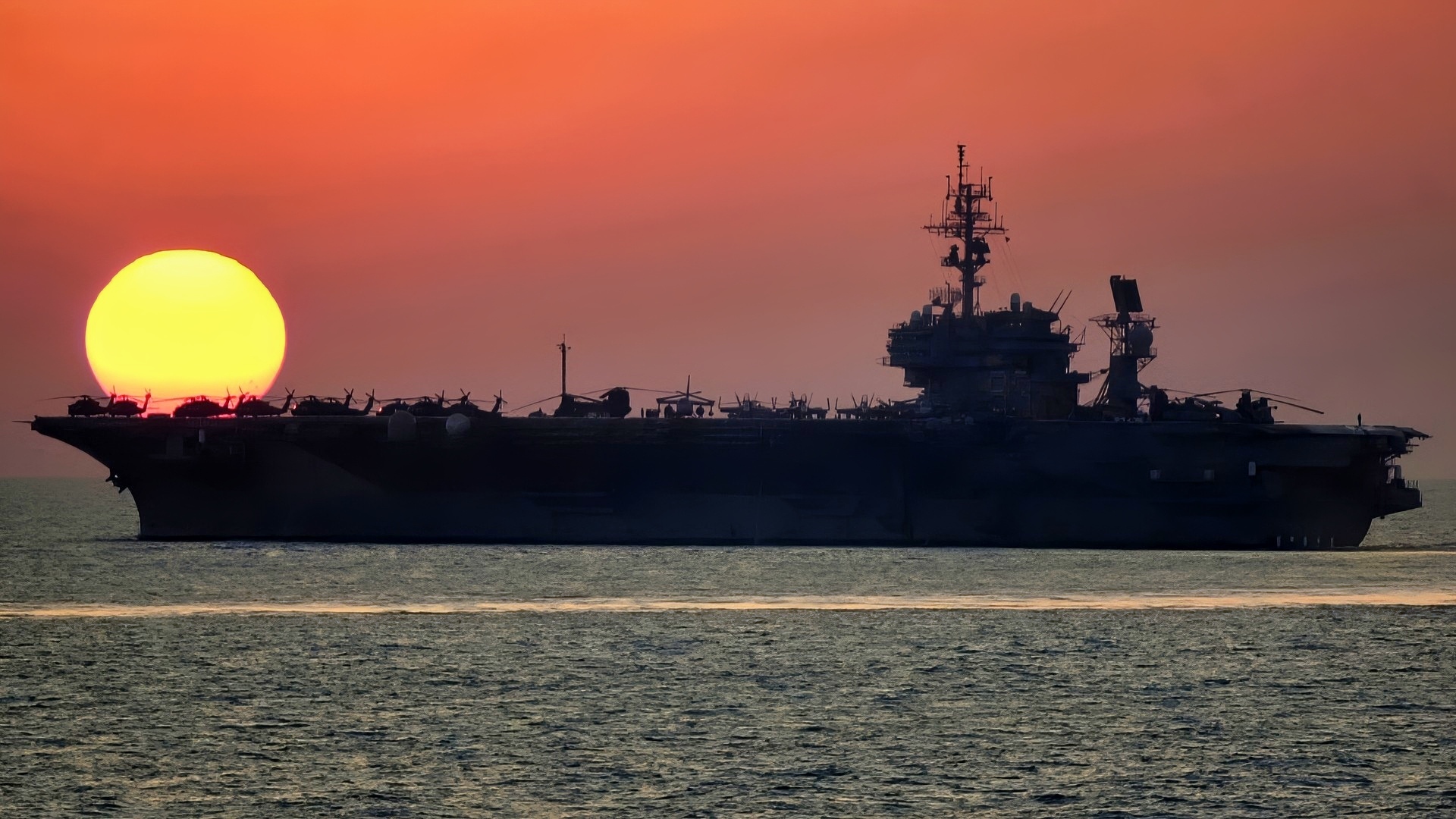
USS Kitty Hawk of Kitty-Hawk-Class. Image Credit: Creative Commons.
Kitty Hawk-class carriers achieved speeds above 32 knots, could carry an air wing of up to 90 aircraft, and displaced around 84,000 tons when fully loaded. Interestingly, these non-nuclear carriers formed the strategic backbone of US naval aviation across the Vietnam War, Cold War, operations in the Middle East, and various post-Cold War interventions.
Vietnam War
USS Kitty Hawk earned a Presidential Unit Citation during the Tet Offensive of the Vietnam War. Carrier aviation from these ships endlessly attacked North Vietnamese targets while sustaining operations in the Gulf of Tonkin. People forget when studying the Vietnam War that, while it was primarily a ground war, the Navy played a critical role.
Carriers took up station in the Gulf of Tonkin off the coast of Vietnam and spent months conducting combat air operations from those positions.
Cold War Era Power Projection
These carriers also became symbols of American maritime dominance during the Cold War. They routinely prowled the Pacific, Mediterranean, and Persian Gulf, conducting deterrence patrols. Kitty Hawks also carried advanced aircraft.
Everything from Grumman F-14 Tomcats to McDonnell Douglas F/A-18 Hornets, Northrop Grumman E-2 Hawkeyes, and Grumman EA-6B Prowlers formed the fixed-wing components of the airwings for these legendary carriers.
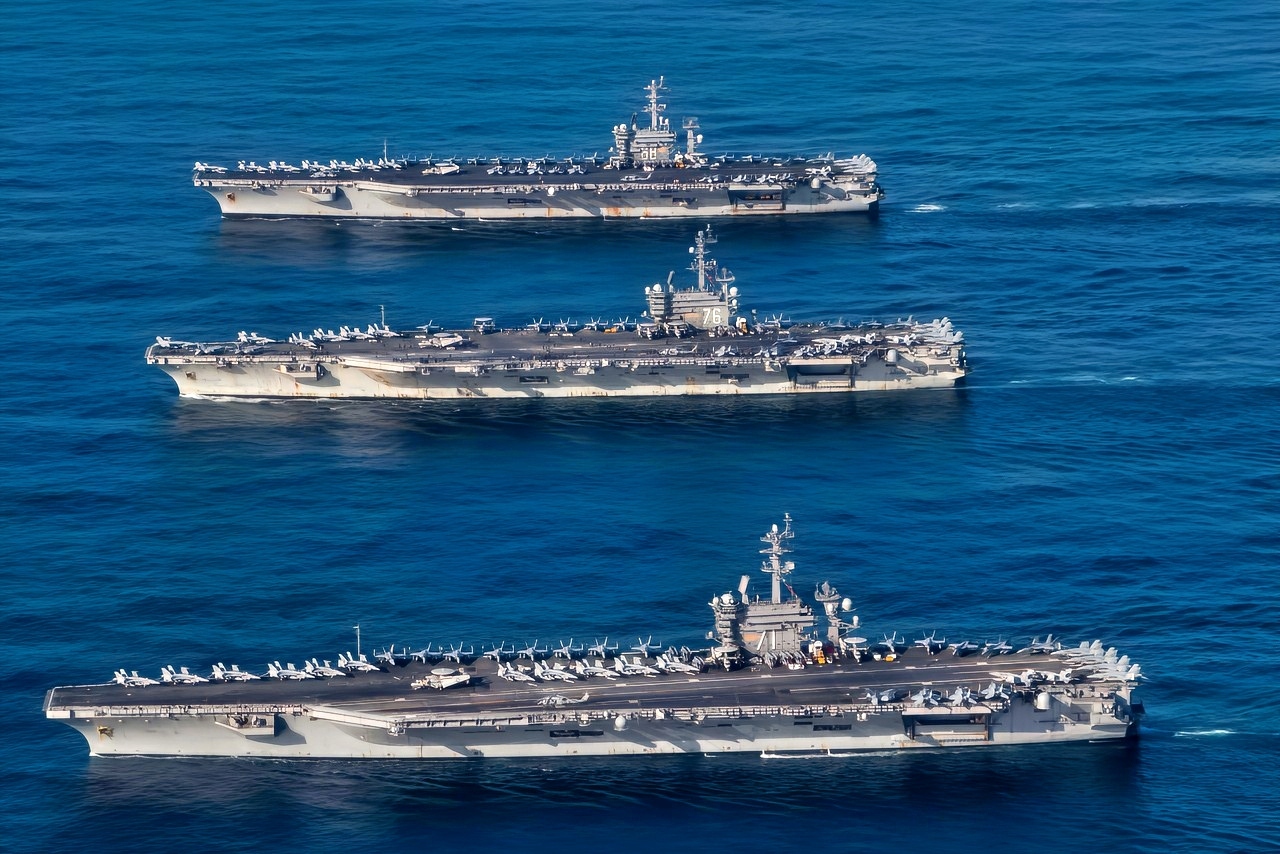
The U.S. Navy aircraft carriers USS Nimitz (CVN-68), USS Theodore Roosevelt (CVN-71) and USS Ronald Reagan (CVN-76) underway in the Western Pacific on 12 November 2017. The strike groups were underway and conducting operations in international waters as part of a three-carrier strike force exercise. This was the first time since August 2007 that three U.S. Navy carriers operated together. In 2007, USS Kitty Hawk (CV-63), USS Nimitz (CVN-68) and USS John C. Stennis (CVN-74) participated in exercise “Valiant Shield”.
What’s more, the Kitty Hawk-class served as a critical linkage between the conventionally powered carriers of the US Navy in the 1960s and the modern digital, nuclear-powered strike groups of the twenty-first century.
Why Sailors Loved Them
The Kitty Hawk-class developed a reputation as a reliable workhorse for the fleet. Unlike some modern carrier programs, such as the Ford-class (which routinely veers into boondoggle territory), the Kitty Hawk-class was a mature design that evolved gradually. The Navy poured huge sums into Service Life Extension Programs (SLEP) during the late Cold War, too.
USS Kitty Hawk received around $785 million in upgrades, while the USS Constellation received around $800 million. The USS John F. Kennedy, a subclass variant of the Kitty Hawk-class, later received its own overhauls. But these upgrades extended the operational life of the carriers for decades.
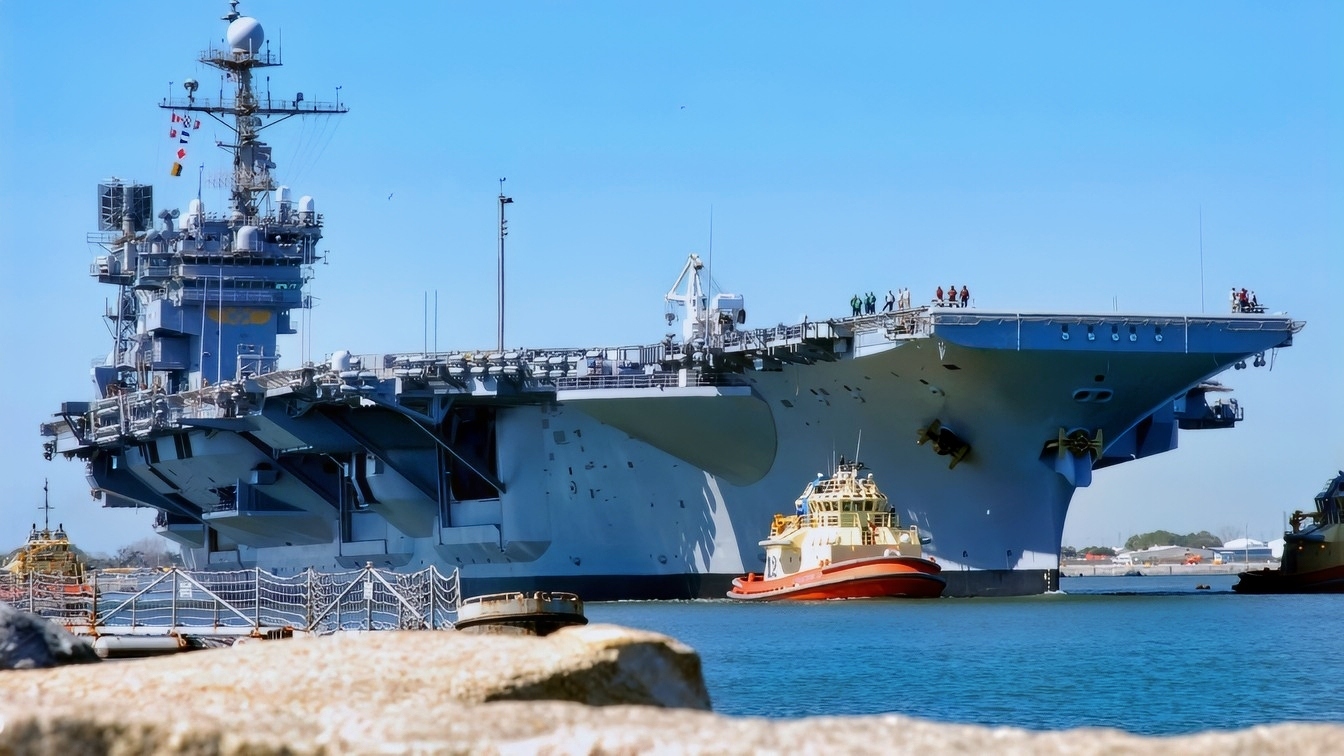
070220-N-1550W-001 Mayport, Fla (Feb. 20, 2007)
USS John F. Kennedy (CV 67) departs Naval Station Mayport for the last underway period before its decommission in March. U.S. Navy photo by Mass Communication Specialist 2nd Class Elizabeth Williams (RELEASE).
What’s more, these ships were seen as more “user-friendly” than the complex nuclear-powered carriers that define America’s fleet today.
Kitty Hawk-Class Specifications
With a range of around 12,000 nautical miles, the Kitty Hawk-class was designed for blue-water naval operations, even though it lacked nuclear power. The crew size hovered around 5,000 on these ships (including airwing personnel). As for its steam-powered propulsion system, there were eight boilers and four Westinghouse steam turbines, giving the ship around 280,000 shp.
The main defensive systems on board the ships consisted of Sea Sparrows, RAM Missiles, and the always useful Phalanx Close-In Weapon System (CIWS).
The last ship of the class, retired in 2009, was, ironically, the first to be decommissioned. The USS Kitty Hawk. Interestingly, the Kitty Hawk’s story did not end with the Cold War. It continued serving, as noted until 2009, running combat operations in America’s Global War on Terror.
Also, though, there was an infamous encounter with a Chinese People’s Liberation Army Navy (PLAN) Song-class diesel-electric that surfaced within torpedo range of the Kitty Hawk without ever being detected. That incident, which occurred in 2007, should have been a wake-up call for Americans about both China’s growing undersea warfare capabilities and the vulnerability of American carriers in the new century.
Sadly, that realization never happened.
USS America’s Violent End
One of the most fascinating stories from the class involved USS America (CV-66). Rather than preserve the carrier as a museum, the Navy deliberately sank her during live-fire survivability testing.
The tests were designed to understand how modern supercarriers absorb battle damage. According to naval observers, the Navy spent weeks attempting to sink the ship. The exercise demonstrated just how extraordinarily durable these carriers were.
That event became symbolic of the class itself: massive, resilient, and extraordinarily hard to kill.
The Final Voyage of USS Kitty Hawk
The end of the class was deeply emotional for naval aviation enthusiasts.
After years in reserve, USS Kitty Hawk (CV-63) made her final voyage to the scrapyard in 2022. For many sailors and observers, it marked the end of America’s conventionally powered supercarrier era.
The ship had served as the Navy’s forward-deployed carrier in Japan before being replaced by the nuclear-powered USS George Washington (CVN-73).
The Message the Kitty Hawks Leave Behind
The core argument from recent retrospectives is simple: the Kitty Hawk-class embodied a balance the modern Navy increasingly struggles to maintain.
These ships were powerful without being overly experimental, upgradeable across decades, operationally resilient, easier to maintain than some modern systems-heavy successors, and extremely effective at sustained deployments.
That is the “message” many analysts believe the class leaves behind for today’s Navy. In an age when the service struggles with carrier maintenance delays, rising procurement costs, and questions about the survivability of massive capital ships in missile-heavy warfare, the Kitty Hawks are increasingly remembered as dependable Cold War workhorses that simply did their jobs for half a century.
With the Navy’s continued, seemingly unbreakable commitment to aircraft carriers as the primary vessels for power projection, perhaps the Pentagon would consider building smaller, conventionally powered aircraft carriers that are cheaper than today’s nuclear-powered monstrosities (and easier to replace if lost in combat).
MORE – China Has Thousands of Missiles to Point at Navy Aircraft Carriers
MORE – Canada’s F-35 Purchase Could Get Squashed
About the Author: Brandon J. Weichert
Brandon J. Weichert is a Senior National Security Editor. Recently, Weichert became the editor of the “NatSec Guy” section at Emerald. TV. He was previously the senior national security editor at The National Interest. Weichert hosts The National Security Hour on iHeartRadio, where he discusses national security policy every Wednesday at 8 p.m. Eastern. He hosts a companion show on Rumble entitled “National Security Talk.” Weichert consults regularly with various government institutions and private organizations on geopolitical issues. His writings have appeared in numerous publications, among them Popular Mechanics, National Review, MSN, and The American Spectator. And his books include Winning Space: How America Remains a Superpower, Biohacked: China’s Race to Control Life, and The Shadow War: Iran’s Quest for Supremacy. Weichert’s newest book, A Disaster of Our Own Making: How the West Lost Ukraine, is available for purchase at any bookstore. Follow him via Twitter/X @WeTheBrandon.


