


Key Points and Summary: The F/A-18E/F Super Hornet was born from urgency: replace aging Navy jets, fly from tight decks, and do everything reasonably well.
-It delivered—bigger lungs, tougher bones, and easier upkeep than the original Hornet, plus modern sensors and standoff weapons.

An F/A-18 Super Hornet from Naval Air Station Oceana, Virginia, performs an aerial demonstration over Rickenbacker International Airport, Ohio, June 16, 2024, as part of the Columbus Air Show. This year’s event featured more than 20 military and civilian planes, including a KC-135 Stratotanker from the 121st Air Refueling Wing, which served as the base of operations for military aircraft participating in the show. (U.S. Air National Guard photo by Senior Airman Ivy Thomas)
-Two decades later, it’s still the backbone of the carrier air wing, now upgraded to Block III with fresher avionics and longer life.
-But the world shifted. Stealth is table stakes, ranges are growing, and the Pacific is a big ocean to cross on tanker gas.
-The Super Hornet remains essential—just not immortal. The job now is to use it smarter while building what’s next.
From Hornet To F/A-18 E/F Super Hornet: An Evolution Written On The Flight Deck
If the original F/A-18 Hornet was a scrappy utility player, the Super Hornet is the reliable power hitter—longer reach, more endurance, and calmer in rough seas.
The jump wasn’t cosmetic. After the Cold War, the Navy needed a jet that could absorb roles once split between the F-14 Tomcat and the A-6 Intruder, but still live happily on a pitching carrier deck.
The answer was a clean-sheet remake: about a quarter larger than the Hornet, with stronger landing gear, beefier wings, and General Electric F414 engines that offered more thrust with better reliability.
Just as important, the Super Hornet was designed to be maintained by real sailors in real weather. Panels open easily. Parts are modular. The jet forgives long deployments and the unglamorous grind of corrosion control. That’s why it stuck: commanders could plan around it, and maintainers could keep it flying without heroic measures.

An F/A-18C Hornet, assigned to the “Stingers” of Strike Fighter Squadron 113, transits over the haze of southern Afghanistan. VFA 113, part of Carrier Air Wing 14 aboard the aircraft carrier USS Ronald Reagan is supporting Operation Enduring Freedom. The mission of CVW 14 is to protect the people of Afghanistan and to support coalition forces. Ronald Reagan is currently deployed to the U.S. 5th Fleet area of operations. Operations in the U.S. 5th Fleet area of operations are focused on reassuring regional partners of the United States’ commitment to security, which promotes stability and global prosperity.
What Makes The Super Hornet Special, Even Now
Start with the basics a carrier cares about: bring-back, sortie rate, and mission flexibility. Bring-back is the weight a jet can safely land with—fuel and unused weapons—so pilots don’t have to jettison expensive stores to trap on deck. Sortie rate is how many times per day the air wing can launch, recover, and turn jets.
Mission flexibility is whether the same airplane can pivot from defensive counter-air in the morning to maritime strike at dusk. The Super Hornet checks all three.
Its radar—an active electronically scanned array—can track multiple threats while remaining harder to jam. Its “eyes without shouting,” the infrared search-and-track sensor, lets crews passively find warm targets without broadcasting their position.
And its wiring and software backbone grew up with modern weapons and networks, which is why the jet can sling long-range anti-ship missiles one day and act as a refueler the next. When the Navy needed an interim tanker before its new refueling drone arrives, the Super Hornet wore the “buddy” tank and kept the air wing moving.
Is it the stealthiest airplane afloat? No. But it’s the one the Navy can turn, day after day, in weather, with the magazines we actually have.
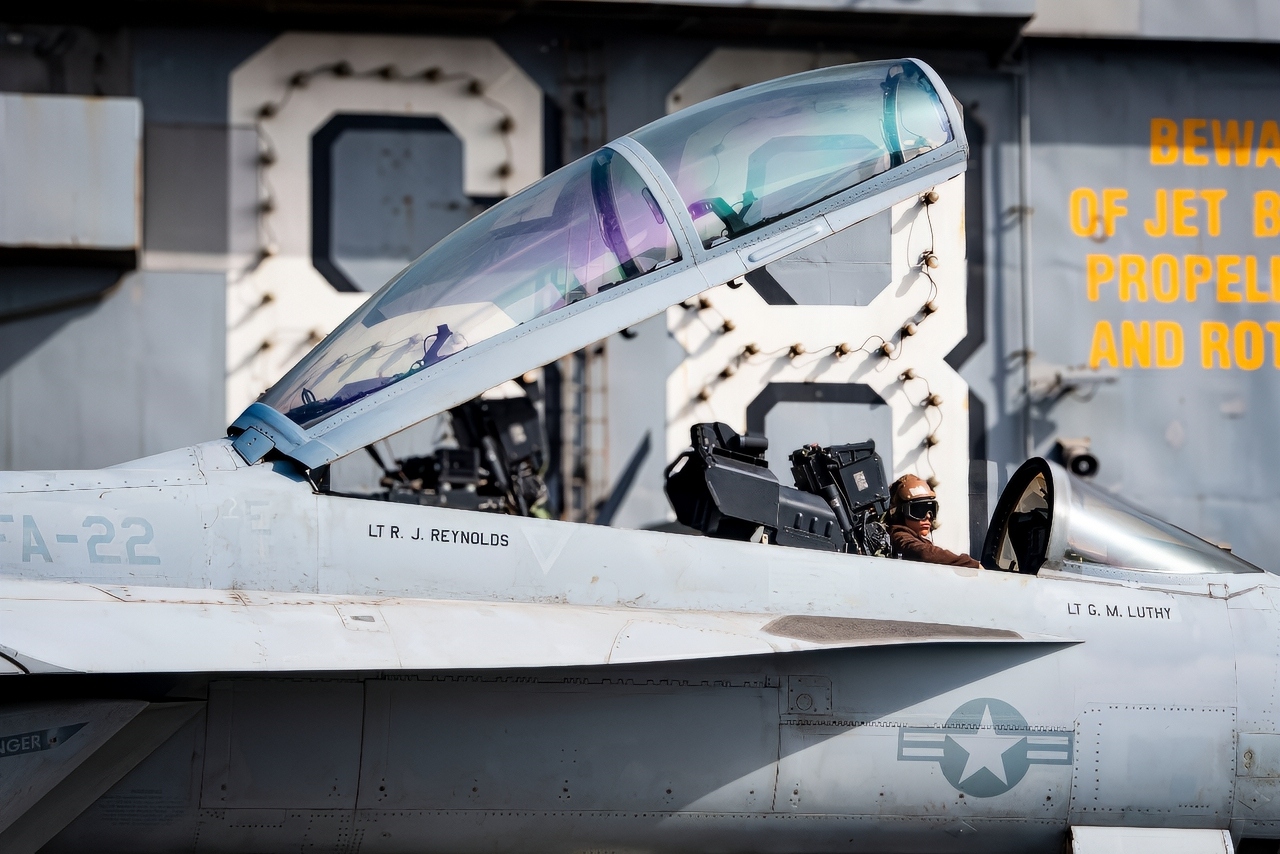
U.S. CENTRAL COMMAND AREA OF RESPONSIBILITY (July 22, 2025) An F/A-18F Super Hornet, attached to Strike Fighter Squadron (VFA) 22, taxis across the flight deck of the Nimitz-class aircraft carrier USS Nimitz (CVN 68) in the U.S. Central Command area of responsibility. (Official U.S. Navy photo)
The Block III Bridge: A Bigger Brain And A Longer Life
To keep the jet relevant, the Navy pushed through a deep refresh known as Block III. Think less paint job, more organ transplant. The cockpit becomes a single, large-area touchscreen display that shows a fused picture; the computing power and datalinks get a big lift; the structure is rated for a longer life. There are quite tweaks to signature reduction and provisions for future pods and weapons.
It’s still a Super Hornet, but with a brain and backbone tuned for the 2030s.
One much-discussed idea—conformal fuel tanks that hug the fuselage to extend range—has bobbed in and out of the plan. The Navy has moved cautiously here, prioritizing reliability and sustainment over a quick range boost.
That tells you something about Block III’s purpose: not to turn the jet into something it isn’t, but to stretch its usefulness while the future force takes shape.
The Hard Part: Range, Survivability, And A Bigger Pacific
Here’s the truth the flight deck already knows. The Western Pacific is huge. China has built layered defenses that push U.S. aircraft farther out, and the targets that matter—ships, airfields, sensors—won’t sit still and wait.
When every mission starts with a long drag to the fight, the jet that can do more miles without a gas stop has leverage. That’s where the Super Hornet shows its age.
It can absolutely fight: with high off-boresight short-range missiles, the latest versions of the AMRAAM air-to-air missile, and very capable precision weapons. It can absolutely kill ships: the long-range anti-ship missile gives it serious bite from well beyond the horizon. But it is not a stealth platform, and the more the Navy expects it to waltz inside the densest air defenses, the more we ask it to do a job it wasn’t shaped to do.

(Jan 31, 2009) An F/A-18 Super Hornet assigned to the “Tomcatters” of Strike Fighter Squadron (VFA) 31 launches from the flight deck of USS Theodore Roosevelt (CVN 71). The Nimitz-class aircraft carrier and embarked Carrier Air Wing (CVW) 8 are operating in the 5th Fleet area of responsibility and are focused on reassuring regional partners of the United States’ commitment to security, which promotes stability and global prosperity (U.S. Navy photo by Mass Communication Specialist 3rd Class Jonathan Snyder/Released)
The answer is not to pretend the airframe grew a cloak overnight. It’s to change how we use it.
Using An Aging Thoroughbred The Smart Way
In modern naval air warfare, information is ammunition. The F-35C—America’s carrier-based stealth fighter—often plays quarterback, sneaking forward to build the picture with passive sensors and then handing off targets. The Super Hornet plays the finisher: carrying larger loads of standoff weapons, protecting high-value aircraft like airborne warning planes and tankers, and surging in numbers when the deck cycle demands mass.
Extending that role requires range. The Navy’s coming refueling drone will matter more than any single pylon weapon because it buys time and angles—jets can launch farther from danger and still show up ready to fight. Pair that with electronic warfare from the Growler variant, a library of decoys and jammers, and the Super Hornet remains a problem for any opponent, stealth label or not.
The “Old” Label Isn’t An Insult—It’s A Design Brief
Calling the Super Hornet “old” can miss the point. It’s old in the sense that it was conceived before stealth became the price of admission to the world’s most defended airspace. It’s mature in the sense that the Navy knows exactly what it can do, how often it can do it, and what it needs on the pier to keep doing it. That reliability is not a consolation prize; it’s combat power.
But maturity is not an excuse to stop evolving. The Navy is already moving to longer-range air-to-air and anti-ship weapons, smarter targeting pods, and tactics that keep emissions quiet until the last moment. Block III brings the avionics ceiling high enough to accept those updates without ripping out the jet’s wiring every few years. That’s how you make a platform with miles on the odometer still matter when the stakes climb.
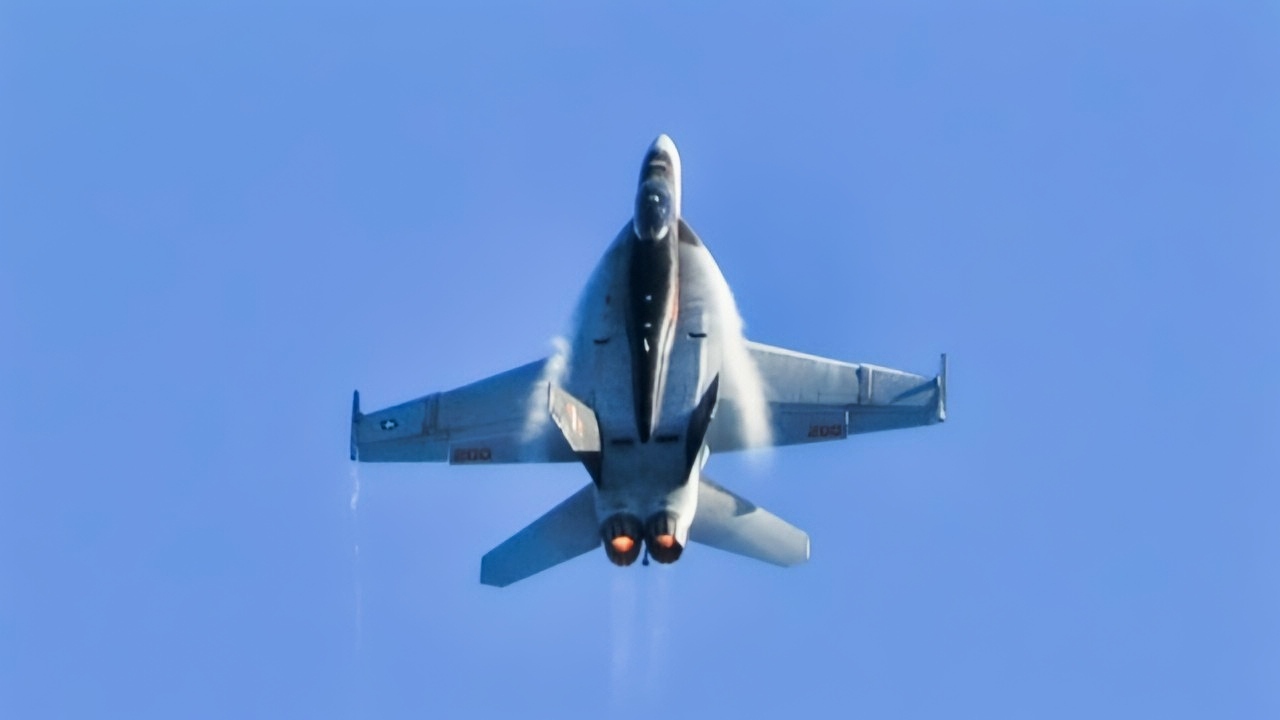
A U.S. Navy F/A-18E Super Hornet aircraft assigned to Strike Fighter Squadron (VFA) 147 performs maneuvers above the aircraft carrier USS Nimitz (CVN 68) during the departure of Carrier Air Wing (CVW) 11 Dec. 10, 2013, in the Pacific Ocean. CVW-11 fixed wing aircraft flew off the Nimitz to return home after being deployed to the U.S. 5th, 6th and 7th Fleet areas of responsibility. (U.S. Navy photo by Mass Communication Specialist Seaman Apprentice Kelly M. Agee/Released)
What The Future Looks Like—And Where The Super Hornet Fits
The Navy’s next new fighter—often referred to as the F/A-XX, the first of a new “sixth generation”—is meant to pair very low observability with range, sensors, and a team of uncrewed wingmen. That’s the direction every serious air arm is heading.
The trick will be getting from here to there without a gap the size of the Philippine Sea.
For the next decade, that bridge is the Super Hornet. Boeing’s line will wind down after the final Navy buys, but service life extensions and Block III conversions will keep airplanes on the roster.

F/A-XX Fighter from Boeing. Image Credit: Boeing.
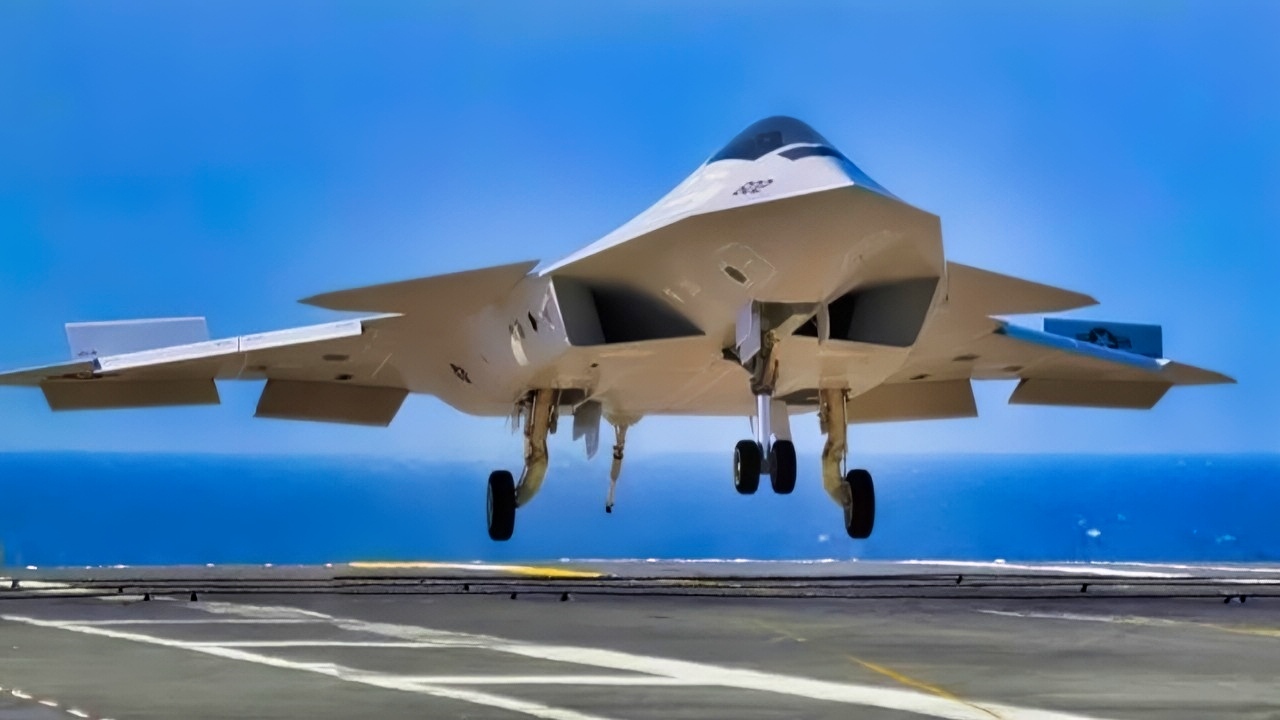
F/A-XX Fighter. Image Credit: Creative Commons.
As uncrewed aircraft arrive—refuelers first, then escorts and sensor carriers—the Super Hornet will fight as part of packages, not as lonely knights. In that world, what matters is whether the air wing can generate enough clean shots, not whether one jet can do every task alone.
A Clear-Eyed Bottom Line
The Super Hornet doesn’t need defending; it needs context.
It was the right airplane for the era that birthed it: big enough, tough enough, adaptable enough, with systems that grew into the 21st century. That era is passing. The next one prizes stealth, range, and the ability to choreograph humans and machines across a wide, contested ocean.
So use the jet accordingly. Let it bring the mass, the magazines, and the muscle memory of two decades on the roof. Let newer airplanes and uncrewed partners bring the sneaking and the scouting. And keep investing—not to make the Super Hornet something it’s not, but to ensure it stays lethal in the roles it owns until something truly new rolls to the catapult.
If we do that, the Navy’s workhorse gets the second act it deserves—and the fleet gets the breathing room it needs to build the future.
About the Author: Harry J. Kazianis
Harry J. Kazianis (@Grecianformula) is Editor-In-Chief and President of National Security Journal. He was the former Senior Director of National Security Affairs at the Center for the National Interest (CFTNI), a foreign policy think tank founded by Richard Nixon based in Washington, DC. Harry has over a decade of experience in think tanks and national security publishing. His ideas have been published in the NY Times, The Washington Post, The Wall Street Journal, CNN, and many other outlets worldwide. He has held positions at CSIS, the Heritage Foundation, the University of Nottingham, and several other institutions related to national security research and studies. He is the former Executive Editor of the National Interest and the Diplomat. He holds a Master’s degree focusing on international affairs from Harvard University. Email Harry: [email protected].
More Military
China’s ‘Thousands of Missiles’ Have a Message for U.S. Navy Aircraft Carriers
Japan’s ‘Big Whale’ Taigei-Class AIP Submarine Has A Warning for China
China’s New J-35A Air Force Stealth Fighter Summed Up in 2 Words
The Mach 9.6 X-43A ‘Hypersonic Scramjet’ Has a Message for the U.S. Air Force
China’s Plan To Sink Navy Aircraft Carriers Comes Down to 2 Words


Krystal cane
October 26, 2025 at 10:49 pm
Who writes this stuff.its sounds like something a drunken faux news host would write.