


In a 2012 Red Flag exercise at Eielson Air Force Base in Alaska, two German Eurofighter Typhoons claimed notional “kills” against U.S. Air Force F-22 Raptors in within-visual-range dogfights — a story still recycled in social media circles as evidence the Raptor isn’t all it’s cracked up to be. The full context tells a different story: the F-22s were flying with external fuel tanks that compromised their stealth, the engagement parameters were rigidly constrained to close-range dogfighting, and the F-22 unit completed 80 missions at the same event with what the Air Force described as “a very high mission success rate.” German Major Marco Gumbrecht — one of the pilots who scored the “kills” — admitted afterward that his Typhoons couldn’t get within 20 miles of an F-22 in realistic combat parameters; his colleague Col. Andreas Pfeiffer called the F-22’s long-range capabilities “overwhelming.”
Eurofighter Typhoon vs. F-22 Raptor: Who Really Won?

Eurofighter Typhoon Upgrade. Image Credit: Creative Commons.
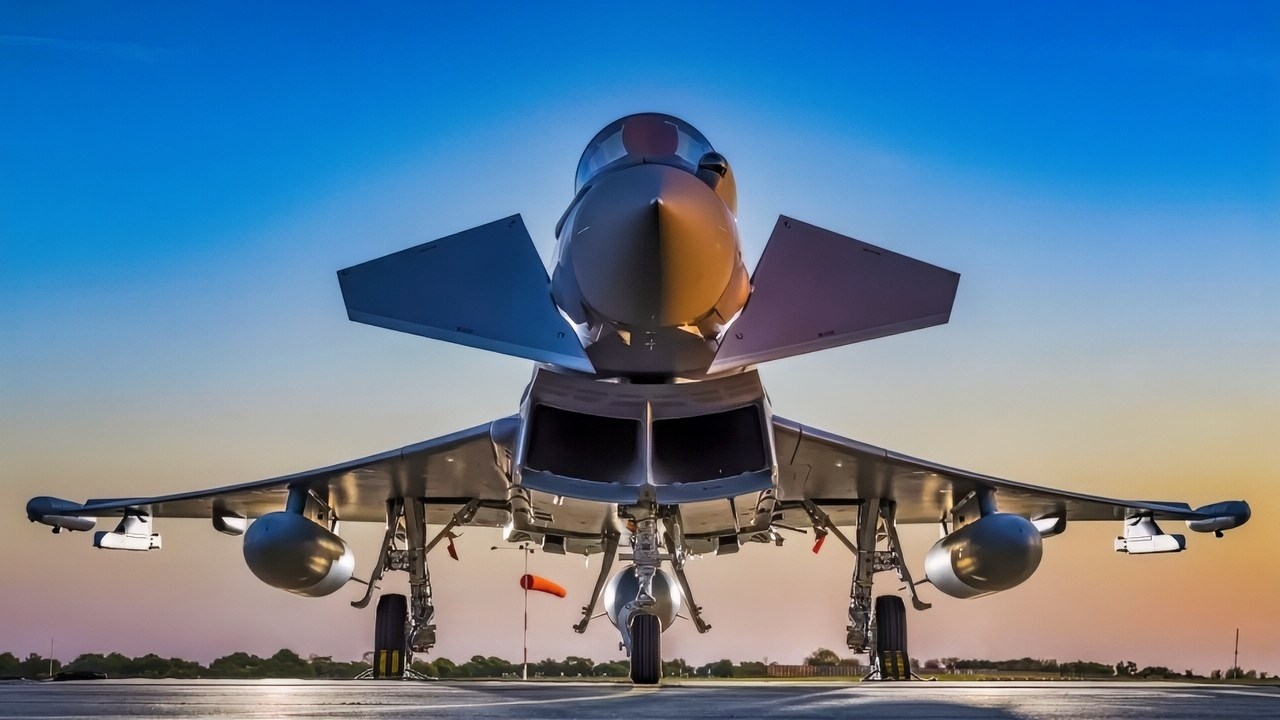
Eurofighter Typhoon on the Runway. Image Credit: Creative Commons.

Eurofighter Typhoon Fighter Training. Image Credit: Creative Commons.
In another story that just won’t die in social media circles, back in 2012, two German Eurofighter Typhoons “shot down” US F-22 Raptors in a Red Flag exercise in Alaska.
Of course, the press had a field day with it. ABC News reported that the F-22 Raptor may “own the skies at modern long-range air combat, it is ‘evenly matched’ with cheaper, foreign jets when it comes to old-school dogfighting.”
The Red Flag Exercise is a premier, realistic aerial combat training exercise held multiple times annually at Nellis Air Force Base, Nevada, and Eielson AFB, Alaska.
Established in 1975, it prepares aircrews from the U.S. and allied nations for combat by simulating the most dangerous missions of modern warfare, with a focus on high-end, multi-domain warfighting.
And in exercises where the parameters are often rigidly set, “notional shootdowns” will occur.
The F-22 has notionally been shot down by F-16s in the past, as well as an EA-18G Growler during a training exercise, with photographic evidence appearing in 2009 showing a Growler with an F-22 kill mark, demonstrating the Growler’s advanced electronic warfare capabilities.

The F-22 Raptor performs a demonstration at the Mather Airshow in Sacramento, California, Sept. 23, 2018. The P-38 is a World War I-era fighter aircraft that was developed for the Army Air Corps. (U.S. Air Force photo by Senior Airman Lauren Parsons/Released)

An Air Force F-22 Raptor executes a supersonic fly by over the flight deck of the aircraft carrier USS John C. Stennis. John C. Stennis is participating in Northern Edge 2009, a joint exercise focusing on detecting and tracking units at sea, in the air and on land.
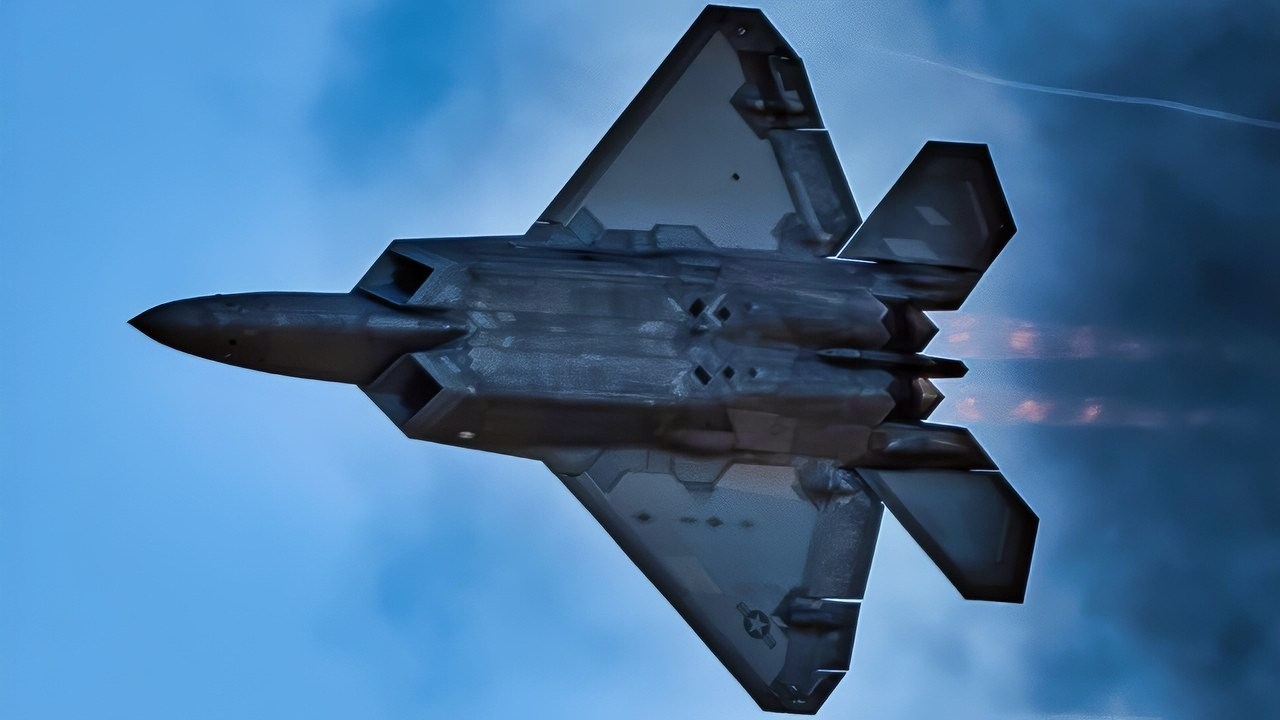
U.S. Air Force Lt. Col. Paul Lopez, F-22 Demo Team commander, flies through smoke during the Thunder over South Georgia Air Show at Moody Air Force Base, Ga., Nov. 2, 2019. Founded in 2007, the F-22 Raptor Demonstration Team showcases the unique capabilities of the world’s premier 5th-generation fighter aircraft. (U.S. Air Force photo by 2nd Lt. Sam Eckholm)
The German Pilots Milked It For All It Was Worth
The German pilots also sported Raptor “kill” decals on their Typhoons. “Gott im Himmel, das ist ‘n Wunder.” Yawn.
The Germans claimed that the notional “kills” proved that they had “Raptor salad for lunch.”
It sounds like they were quite impressed with themselves.
Two German officers, Col. Andreas Pfeiffer and Maj. Marco Gumbrecht, noted in an after-action report that the F-22’s capabilities are “overwhelming” when it comes to modern, long-range combat as the stealth fighter is designed to engage multiple enemies well-beyond the pilot’s natural field of vision – mostly while the F-22 is still out of the other plane’s range.
Grumbrecht said that even if his planes did everything right, they couldn’t get within 20 miles of the next-generation jets before being targeted.
“But as soon as you get to the merge…” Pfeiffer said, referring to the point at which fighters engage in close-up dogfighting, “in that area, at least, the Typhoon doesn’t necessarily have to fear the F-22 in all aspects… In the dogfight, the Eurofighter is at least as capable as the F-22, with advantages in some aspects.”
The E/A-18 Growler story was revealed by Stephen Trimble of Flight Global, who told aviationgeekclub.com how he learned about it.
But What About the Parameters Of This Exercise:
Alex Hollings of Air Power wrote that, “After the exercises were over, Germany’s Eurofighter pilots arrived at 2012’s Farnborough International Air Show, where they were quick to discuss their victories over the F-22.
“According to David Cenciotti’s coverage for The Aviationist, Germany’s Typhoon pilots explained that when the F-22 was flying with external fuel tanks attached and fighting within visual range, Typhoons were often able to outclass the Raptor.
“The Raptor pilots, flying within visual range, probably spotted the Eurofighter first, but for some reason did not engage its Sidewinders,” Dr. Brent Eastwood wrote. Things that make you go hmm.
Also lost in the hoopla of the ABC News story was the Air Force’s statement that the Raptors flew 80 missions during the event “with a very high mission success rate.”
The F-22 Raptor Is “Still The One”:
The US F-22 Raptor has been the standard against which all fighter aircraft have been measured for more than 21 years. Yet it still sits at the top of the mountain in terms of dogfighting ability, stealth, supercruise ability, maneuverability, and integrated avionics.
What makes the F-22 great in a dogfight is the aircraft’s thrust vectoring capabilities.
Its two engines have specially designed nozzles at their ends that can move on a vertical plane to vector the aircraft’s 70,000 pounds of thrust in one direction even if the aircraft is heading in another, thus allowing the F-22 to do some impressive acrobatics, as well as leverage a highly high angle of attack during a within-visual-range engagement.
The Raptor’s top speed is Mach 2.25 or 1,500 mph, powered by the Pratt & Whitney F119 turbofan engines.
The USAF currently has approximately 175 combat-ready F-22s in its inventory.
“When you’re flying the Raptor, you’re not thinking about flying the Raptor,” explained F-22 pilot Randy Gordon in a lecture he gave at MIT, “You’re thinking about employing the Raptor. Flying is secondary.”
“Raptor has vector thrust: Typhoon doesn’t,” RAF Typhoon pilot and squadron commander Rich Wells told Breaking Defense in 2013. “What the aircraft can do is incredible. The Typhoon just doesn’t do that.”
While rare, this “shootdown” of a stealth fighter is hardly a singular event. Whenever the situation or training scenario is constrained, it undermines the stealth fighter’s advantages.
However, it doesn’t mean that the Growler is equal to the Raptor, nor does it mean that the Typhoon is the F-22’s equal. It was simply a matter of cherry-picking some exercises that were stacked in one side’s favor.
Recent headlines from China featured statements from Chinese computer programmers who claimed that the J-20 would win engagements 95 percent of the time against the F-22.
However, that is if the J-20s had two “loyal wingmen.” The US is also developing the same program.
The Collaborative Combat Aircraft (CCA) program is a US Air Force initiative to develop a new type of uncrewed, jet-powered aircraft that will operate alongside and collaborate with crewed fighter jets. These are already flying and being tested.
However, in the same computer simulations conducted by Chinese programmers, it was reported that a single J-20 equipped with eight medium-range air-to-air missiles had less than a 10 percent chance of defeating an F-22 equipped with six AIM-120C missiles.
This is one of those neat, “let’s talk smack in the O’Club” stories. But ask those same German pilots if they’d rather have a Typhoon or a Raptor.
About the Author: Steve Balestrieri
Steve Balestrieri is a National Security Columnist. He served as a US Army Special Forces NCO and Warrant Officer. In addition to writing on defense, he covers the NFL for PatsFans.com and is a member of the Pro Football Writers of America (PFWA). His work was regularly featured in many military publications.


Craig
May 11, 2026 at 6:08 am
Every word out of a Chinese mouth is a lie
Garrett
May 14, 2026 at 2:40 pm
One photo used of an “F-22” is actually an F-35. Please correct or remove the image associated with the following caption:
The F-22 Raptor performs a demonstration at the Mather Airshow in Sacramento, California, Sept. 23, 2018. The P-38 is a World War I-era fighter aircraft that was developed for the Army Air Corps. (U.S. Air Force photo by Senior Airman Lauren Parsons/Released)
Dan
May 16, 2026 at 6:42 am
No one should take your opinion seriously when the first image of the “F-22” in your article is an F-35. What an embarrassment. Although somewhat typical for a US serviceman – a pedigree for incompetence.
Nathan
May 16, 2026 at 12:43 pm
One photo used was an F35 not an F22.
Martineering
May 17, 2026 at 9:19 am
Every European skilled pilot is a mile better than the US pilot.
Dassault Rafale, Typhoon they’re a mile better machines than the USA bubble.