


Key Points and Summary – The Su-35 Flanker-E is Sukhoi’s 4.5-generation evolution of the Su-27, pairing AL-41F1S thrust-vectoring engines with upgraded avionics and a powerful PESA radar to push high-alpha agility and long-range targeting.
-A single-seat air-superiority multirole, it carries roughly 8,000 kg of weapons from R-77/R-37 air-to-air missiles to Kh-31 and precision-guided bombs, and reaches about Mach 2.2 with limited supercruise.
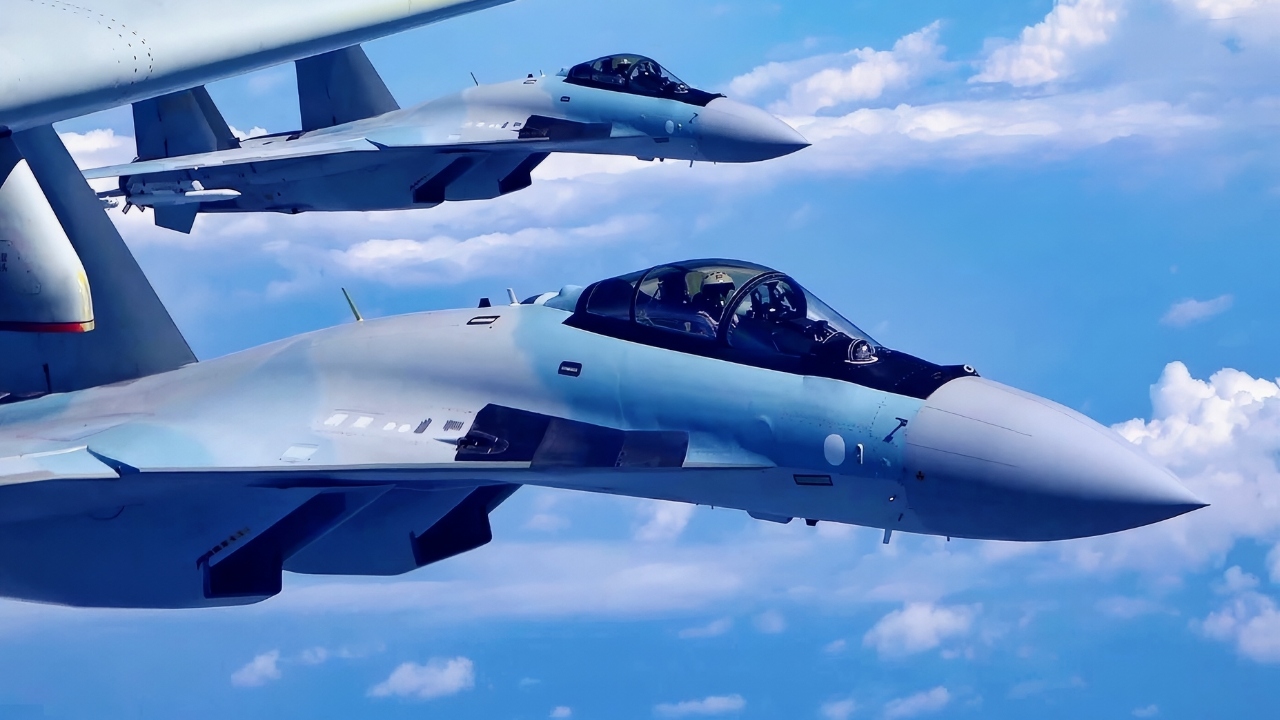
Su-35 from China. Image Credit: Chinese Air Force PLAAF.

Sukhoi Su-35 Fighter. Image Credit: Creative Commons.
-Entering Russian service in 2014, the jet was first combat-deployed over Syria and now flies extensively in the Ukraine war, where it has notched kills but also suffered losses. Exports—most notably to China—underline its status as Russia’s most capable non-stealth fighter to date.
Russia’s Su-35 Flanker-E/M Primer
In American football, the term “flanker” refers to a wide receiver who typically lines up on the line of scrimmage, just outside the offensive tackles, positioned on the “flanks” of the offensive formation (hence the name). In rugby, flankers are “the versatile workhorses” who are responsible for a wide range of tasks, including tackling, rucking, ball-carrying, and disrupting the opposition’s attack.
In military aviation parlance, the label “Flanker” (capitalized as a proper noun this time) applies to flying and fighting mechanical workhorses (or warbirds, if you prefer): the NATO codename for a series of Russian 4th- and 4.5th-generation jet fighters designed by the Sukhoi Design Bureau (headquartered in Moscow).
Today, National Security Journal provides a primer on the latest iteration, the Su-35 “Flanker-E/M” (also known as the “Super Flanker”), which some pundits argue is the Russian Federation’s best fighter, or at the very least, the Russians’ best non-stealth fighter.
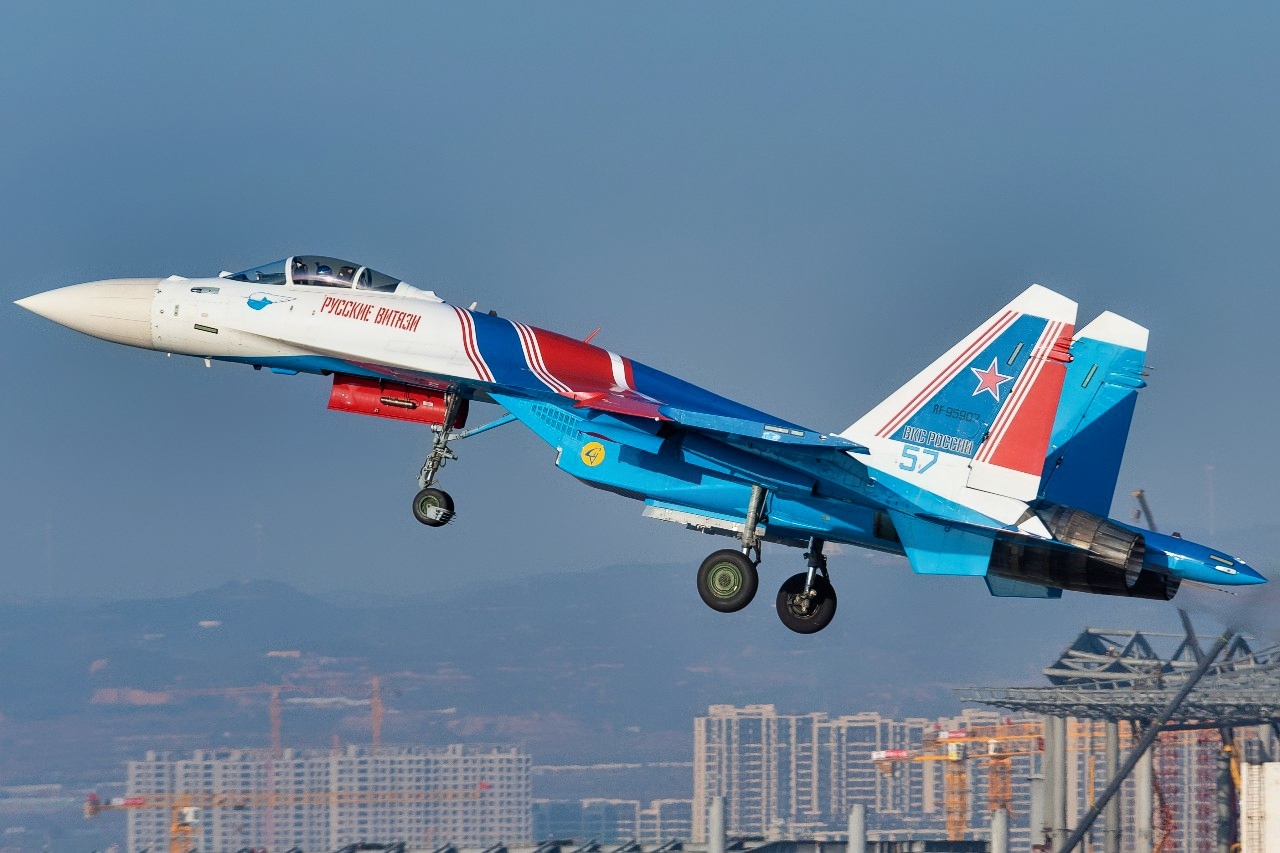
Su-35. Image Credit: Creative Commons.

Su-35 Fighter. Image Credit: Creative Commons.

Su-35 Fighter from Russia. Image Credit: Creative Commons.
Su-35E “Super Flanker” Initial History (and Differences from Older Flankers)
There are eight different Russian and Chinese fighter planes (five made by Sukhoi and three made by Shenyang) officially bestowed with the NATO reporting name of “Flanker.” So what differentiates the Su-35E from the rest (besides being the newest of the bunch, that is)? After all, as Juliet said to Romeo, “A rose by any other name would smell as sweet” (though granted, jet fuel doesn’t smell so sweet in a literal sense).
The original fighter to earn the Flanker moniker, the Su-27, made its maiden flight on May 20, 1977, and entered operational service with the Soviet Air Forces on June 22, 1985. As for the so-called “Super Flanker”, it made its maiden flight on February 19, 2008, and entered into official service with the post-Cold War Russian Aerospace Forces (Vozdushno-Kosmicheskiye Seely; VKS) in February 2014.
The AeroCorner website provides a detailed description of the differences between the standard Flanker and the Su-35. The newest version of the warbird has received comprehensive modernization upgrades, such as:
-Advanced thrust-vectoring engines for increased maneuverability
-Improved avionics suite
–Passive electronically scanned array (PESA) radar systemDrastically reduced infrared (IR) signature due to the use of advanced materials in the manufacturing design process
Su-35 Technical Specs and Vital Stats Part I
-Crew: 1 (pilot)
-Fuselage Length: 21.9 meters (71.85 feet)
-Wingspan: 15.3 meters (50.2 feet)
-Height: 5.9 meters (19.36 feet)
-Empty Weight: 19,000 kilograms (41,888 pounds)
-Max Takeoff Weight: 34,500 kilograms (76,059 pounds)
–Powerplant: 2x Saturn AL-41F1S afterburning turbofan generating 32,000 pound-force (142.2 kilonewtons) in emergency power
-Ferry Range: 4,445 kilometers (2,400 nautical miles)
-Combat Range: 1,600 kilometers (860 nautical miles)
-Thrust-to-Weight Ratio: 1.3
-Service Ceiling: 60,000 feet (18,228 meters)
-Estimated Number of Airframes Built: 158; 114 with Russia. 24 with the Chinese People’s Liberation Army Air Force (PLAAF), and 20 ordered by the Algerian Air Force (Kawat al-juwiya al-jazairia; Forces aériennes algériennes).
Su-35 Technical Specs and Vital Stats Part Deux: Speed and Weaponry
These categories merit their own separate subheading.
“Speed is life,” quoth the one fighter pilot motto, and though the Super Flanker isn’t the fastest currently operational jet fighter in the world (that distinction belongs to another Russian war machine, the MiG-31 “Foxhound”), is certainly no slouch in that department, topping off at a highly respectable max airspeed of Mach 2.18 (1,458 knots; 2,700 km/h, Mach 2.18); the plane can also supercruise at Mach 1.1 (630 knots; 1,170 km/h; 730 mph).

Su-35. Image Credit: Creative Commons.

Su-35. Image Credit: Creative Commons.
Now that we’ve covered the “Speed is life” aspect, what about the Flanker-E/M’s methods for dealing with death? To quote the famous dictum from early 20th-century airpower theorist General Giulio Douhet (May 30, 1869 – February 15, 1930), “Flexibility is the key to airpower.” Going hand-in-hand with flexibility is the concept of versatility, and the Su-35 is quite versatile in the amount and different types of ordnance it can carry, with a carrying capacity of 8,000 kg (17,630 lb):
Guns:
1 × internal 30 mm Gryazev-Shipunov GSh-30-1 autocannon with 150 rounds
Rockets:
S-25 266mm air-ground rocket (quantity uncertain)
Bombs:
8 × KAB-500KR TV-guided bombs
8 × KAB-500L precision-guided bombs
8 × KAB-500OD guided bombs
8 × KAB-500S-E satellite-guided bombs
3 × KAB-1500KR TV-guided bombs
3 × KAB-1500L precision-guided bombs
Air-to-Air Missiles:
8 × R-27ER/ET/EA
6 × R-73E/M
12 × R-77M/P/T/-1
6 × R-74
2 x R-37
Air-to-Surface Missiles:
6 × Kh-29L/TE
3 × 3M-14AE
Anti-Ship Missiles:
5 x Kh-59 MK2 Ovod cruise missile
3 × 3M-54AE1
6 × Kh-31A/AD
1 × P-800 Oniks
Kh-35U (quantity uncertain)
Anti-Radiation Missiles:
6 × Kh-31P/PD
5 × Kh-58UShE
The Su-35 was first “blooded” in combat in January 2016 in the skies over Syria, when four of the planes were sent to that war-torn Arab country. Reportedly, the Flanker-Es participated in the initial stages of air-to-ground strikes against various Western, Turkish, and Qatari-backed Islamist insurgent groups.
Unlike the more hyped-up Su-57 “Felon” 5th-generation stealth fighter, the Su-35 has seen extensive combat usage during the seemingly never-ending Russo-Ukrainian War. Vladimir Putin’s Su-35 jockeys have thus far claimed at least seven air-to-air victories against Ukrainian fixed-wing fighters plus one additional kill against a Ukrainian Naval Aviation Mi-14 utility helicopter.
In return, at least five and perhaps as many as eight Su-35s have been destroyed in the campaign, whether due to friendly fire, mechanical failure, or getting shot down by Ukrainian forces.
About the Author: Christian D. Orr, Defense Expert
Christian D. Orr is a Senior Defense Editor. He is a former Air Force Security Forces officer, Federal law enforcement officer, and private military contractor (with assignments worked in Iraq, the United Arab Emirates, Kosovo, Japan, Germany, and the Pentagon). Chris holds a B.A. in International Relations from the University of Southern California (USC) and an M.A. in Intelligence Studies (concentration in Terrorism Studies) from American Military University (AMU). He is also the author of the newly published book “Five Decades of a Fabulous Firearm: Celebrating the 50th Anniversary of the Beretta 92 Pistol Series.”
More Military
Russia’s Mach 2 Su-30SM Fighter Has A Message for Any Air Force on Earth
The Mach 2.2 B-1A Bomber Has A Message for the U.S. Air Force
The Mach 2.35 ‘Super’ Eurofighter Typhoon Fighter Has a Message for Any Air Force On Earth
Canada’s CF-18 Hornet Fighter Crisis
Forget NGAD or the J-20: A 7th Generation Fighter Could Hit Mach 5


