

Key Points and Summary – China’s navy is rapidly expanding its carrier fleet—with three carriers now operational and a fourth Ford-class-like supercarrier on the way—but it faces a “massive disadvantage” that negates its numerical progress: a “100-year” experience gap with the U.S. Navy.
-While China’s Fujian now has electromagnetic catapults, U.S. pilots have generations of “irreplaceable” combat experience and benefit from advanced landing software like “magic carpet” and “Delta Flight Path.”
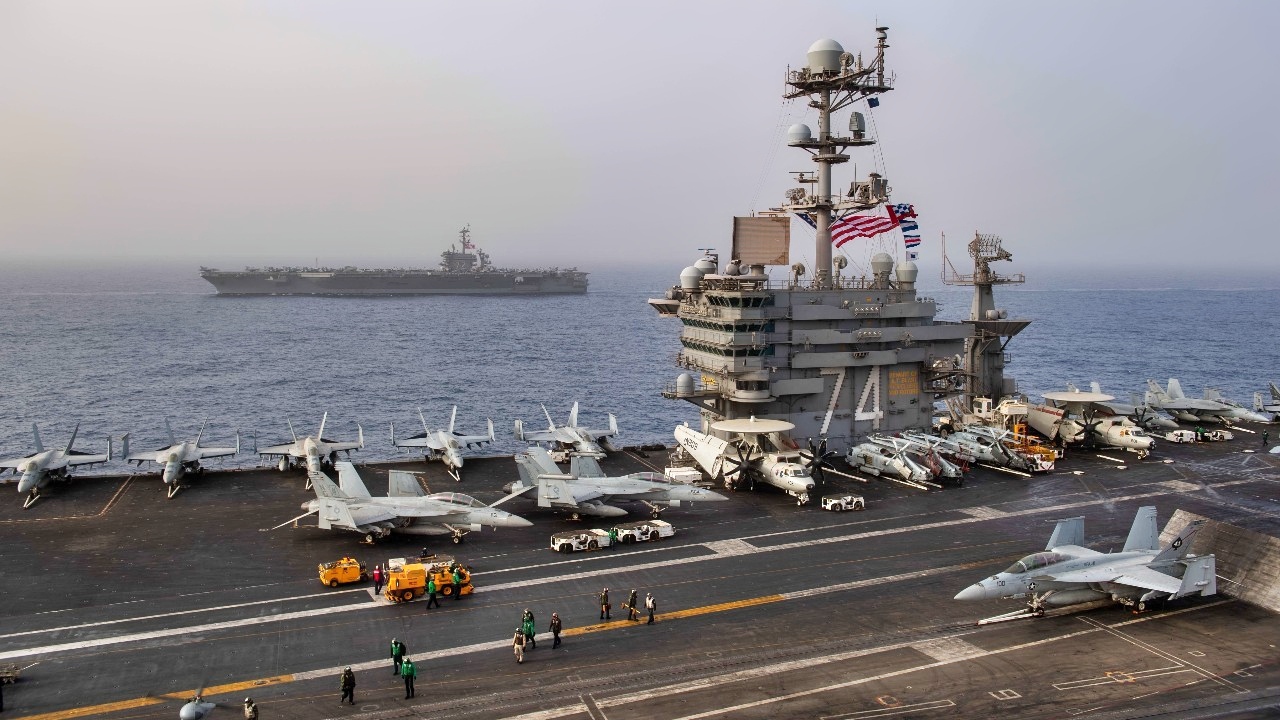
The aircraft carrier USS Abraham Lincoln (CVN 72), back, steams alongside the aircraft carrier USS John C. Stennis (CVN 74) in the Mediterranean Sea, April 24, 2019. The John C. Stennis Carrier Strike Group (CSG) 3 and Abraham Lincoln Carrier Strike Group (CSG) 12 are conducting dual carrier operations, providing opportunity for two strike groups to work together alongside key allies and partners in the U.S. 6th Fleet area of operations. John C. Stennis is underway in the Mediterranean Sea as part of the John C. Stennis Carrier Strike Group (JCSCSG) deployment in support of maritime security cooperation efforts in the U.S. 6th Fleet area of responsibility. (U.S. Navy photo by Mass Communication Specialist 3rd Class Grant G. Grady)
-This vast gap in training, operational knowledge, and real-world combat lessons means China’s carrier force, while growing, cannot yet truly rival U.S. dominance.
The U.S. Navy Years of Operations and Experience Aren’t Something China Can ‘Build’
Even a cursory look at China’s fast-growing fleet of aircraft carriers would suggest the People’s Liberation Army Navy (PLAN) poses a serious threat to the United States and its allies.
Furthering the case, the PLAN has already shown it can operate three carriers at sea at the same time.
Meanwhile, its Fujian carrier surges toward operational service.
The concern doesn’t end there. The PLAN is making progress on engineering a fourth carrier—a supercarrier that appears heavily modeled on the U.S. Navy’s Ford-class.
Sea Trial Prowess
As part of its sea trials, the Fujian operated at sea simultaneously with China’s first two carriers: the Liaoning, which was retrofitted from a Russia-purchased carrier, and the indigenously built Shandong.
The Fujian operates with a Ford-class-like electromagnetic catapult, and the PLAN also mirrored the U.S. Navy’s maritime tactics by conducting dual-carrier war preparation drills at sea.
The pace of China’s carrier construction, expedited by its policy of civil-military fusion, leads many observers to anticipate that Chinese carriers will soon enough truly rival the U.S. Navy.
Training & Experience Deficit
However, any advantage China may derive from its ability to build carriers quickly is powerfully mitigated by the U.S. Navy’s decades of experience operating carriers at sea.
The Navy has operated aircraft carriers since World War I—the service thus has more than 100 years of operational experience with floating runways and maritime air attack.
In the modern era, the Navy has operated a fleet of at least 10 carriers for decades and used them with great success in a wide range of conflicts, including World War II, the Gulf War, and Operation Iraqi Freedom, among others.
Coordinating at-sea take-offs and landings and, in addition, operating a massive air attack campaign with an integrated carrier air wing, clearly introduces warfighting complexities not easily replicated in exercises by the PLAN.
Even the fundamental task of landing a fighter jet on a carrier deck is challenging; pilots must account for wind, sea state, and aircraft op-tempo to descend and land on a carrier with a safe, effective glide slope.
The U.S. Navy holds a significant advantage due to its long history of conducting these operations, and it now operates F/A-18E/Fs and F-35Cs with advanced software that assists pilots with smooth, successful landings.
Pilots follow a light called the fresnel lens to align their aircraft properly for a carrier deck landing, and pilot experience is now supplemented on F/A-18s with a glide-slope-enhancing and stabilizing software known as “magic carpet.”
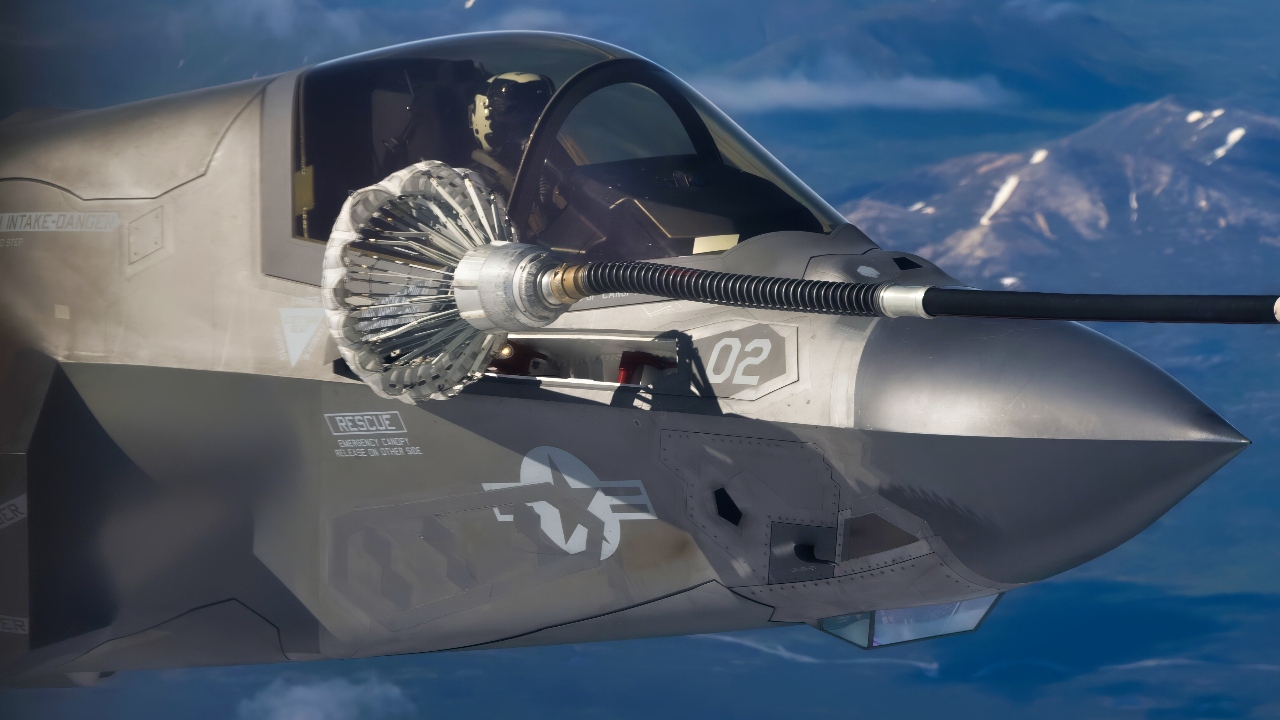
A U.S. Marine Corps KC-130J Super Hercules aircraft with Marine Aerial Refueler Transport Squadron (VMGR) 152 refuels an F-35B Lightning II aircraft with Marine Fighter Attack Squadron (VMFA) 121, both assigned to Marine Aircraft Group 12, 1st Marine Aircraft Wing, during exercise Red-Flag Alaska 25, at Joint Base Elmendorf-Richardson, Alaska, July 21, 2025. VMGR-152 partnered with the U.S. Air Force during Red Flag Alaska to enhance aerial refueling and assault support capabilities. Training in Alaska’s harsh environment sharpened the squadron’s combat readiness and lethality. (U.S. Marine Corps photo Lance Cpl. Cecilia Campbell)
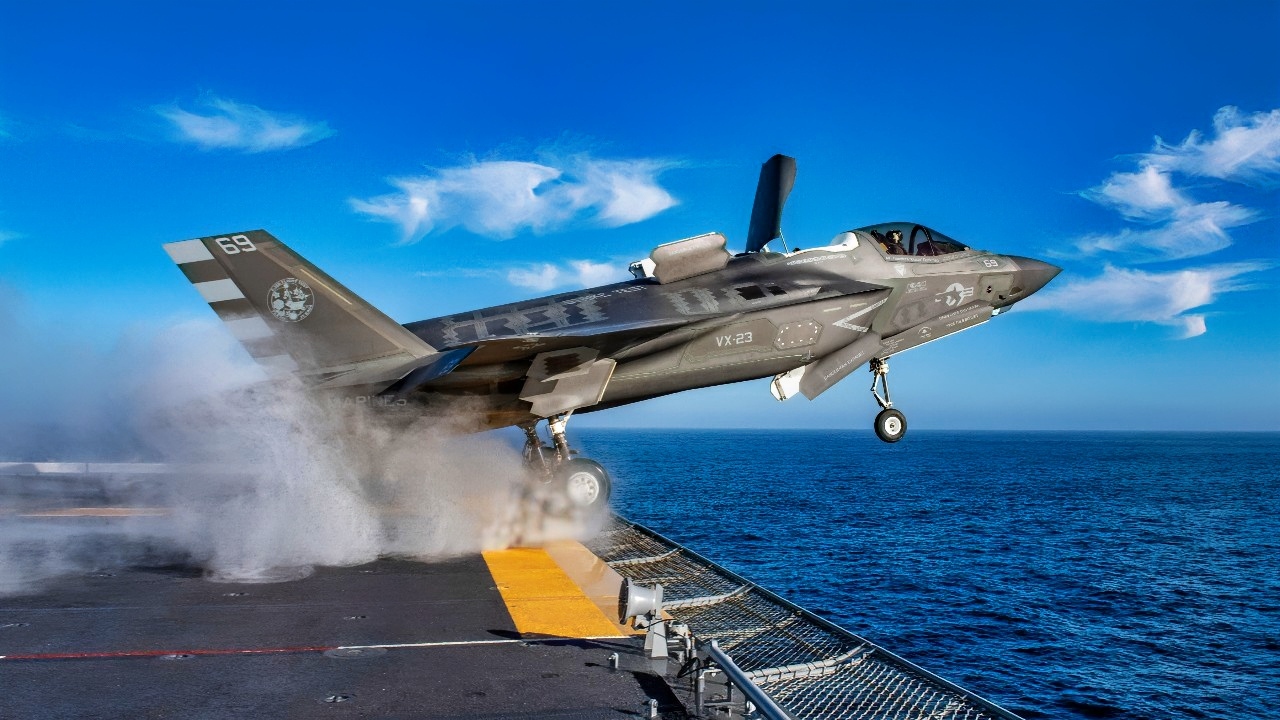
A joint team consisting of F-35 Patuxent River Integrated Test Force flight test members, U.S. Sailors and Marines, and the crew of the Japan Maritime Self-Defense Force Izumo-class multi-functional destroyer JS Kaga (DDH-184) are executing developmental sea trials in the eastern Pacific Ocean to gather the necessary data to certify F-35B Lightning II short takeoff and vertical landing aircraft operations. While aboard the MSDF’s largest ship, the Pax ITF flight test team has been gathering compatibility data for analysis in order to make recommendations for future F-35B operational envelopes, further enhancing the Japanese navy’s capabilities. The results of the testing will contribute to improved interoperability between Japan and the United States, strengthening the deterrence and response capabilities of the Japan-U.S. alliance and contributing to peace and stability in the Indo-Pacific region. Japan is an F-35 Joint Program Office foreign military sales customer planning to purchase 42 F-35Bs. The F-35 Joint Program Office continues to develop, produce, and sustain the F-35 Air System to fulfill its mandate to deliver a capable, available, and affordable air system with fifth-generation capabilities.
In a related capacity, the U.S. Navy’s F-35Cs and Marine Corps’ F-35Bs now operate with Delta Flight Path, a software program designed to help automate and assist carrier landings.
Perhaps most important of all is the irreplaceable value of operational war experience, which the PLAN lacks.
The Navy now operates with generations of lessons learned during real-life carrier-based warfare.
It has become highly adept at networking Carrier Strike Groups, coordinating weapons and sortie rates, and sustaining air operations under attack or in adverse conditions.
Therefore, not only does the PLAN continue to experience a significant carrier deficit compared to the U.S. Navy, but it also operates with a massive disadvantage in training and war experience.
About the Author: Kris Osborn
Kris Osborn is the President of Warrior Maven – Center for Military Modernization. Osborn previously served at the Pentagon as a highly qualified expert in the Office of the Assistant Secretary of the Army—Acquisition, Logistics & Technology. Osborn has also worked as an anchor and on-air military specialist at national TV networks. He has appeared as a guest military expert on Fox News, MSNBC, The Military Channel, and The History Channel. He also has a Masters Degree in Comparative Literature from Columbia University.
China Has the Missiles to Sink U.S. Navy Aircraft Carriers, But Questions Remain
The P-51 Mustang Was the Best WWII Fighter
The U.S. Navy’s Great Aircraft Carrier Shortage of 2025 Won’t End
The Navy Isn’t Prepared For What’s Coming
Not Made in USA: The Vanguard-Class Missile Submarine Has Just 1 Mission


