


Article Summary – The F-35 program’s lifetime cost is now projected at roughly $2 trillion when you add acquisition and decades of sustainment.
-That sticker shock fuels endless criticism. But there are concrete reasons the price is so high: the F-35 is replacing multiple fighter types at once, it was built as three jets in one program, it is a stealth sensor platform first and a “traditional fighter” second, its sustainment tail stretches to the 2080s, and it underpins a massive allied industrial network.

A U.S. Air Force F-35A Lightning II, from the 421st Expeditionary Fighter Squadron, deployed to Kadena Air Base, taxis after a training mission at Kadena Air Base, Japan, July 11, 2025. The F-35 is an agile, versatile, high-performance, multirole fighter that combines stealth, sensor fusion and unprecedented situational awareness to overcome adversarial and situational challenges. (U.S. Air Force photo by Airman Nathaniel Jackson)
-Put simply, the F-35 is expensive because it does more, for more countries, over a much longer time.
The $2 Trillion F-35 Question
Every time the Pentagon or a watchdog drops a fresh F-35 cost estimate, you can almost hear the collective gasp.
The latest projections put the total program bill—acquisition plus decades of sustainment—north of $2 trillion. That is not a typo. It’s a number that instantly invites hot takes about “boondoggles” and “the most expensive weapon in history.”
But here’s the thing: that price tag is real, and so are the reasons behind it.
The F-35 is not just another fighter. It is three variants in one program, replacing an entire zoo of legacy jets, designed to serve as the core of U.S. and allied tactical airpower into the 2070s and beyond. Add in the sustainment tail, the global industrial ecosystem, and the fact that you’re building this thing while flying it, and the cost curve stops looking mysterious.
Still painful, but not mysterious.
Let’s walk through five big reasons why the F-35 costs so much—and then talk about why, even with all that, it’s probably still the best bet in town.
1. It’s Replacing Almost Everything, for a Very Long Time
One major driver of cost is simple: scale and scope.
The United States alone plans to buy more than 2,400 F-35s across its services.
Those jets are meant to replace a grab-bag of aircraft: F-16s, F/A-18C/Ds, AV-8Bs, and eventually a chunk of the F-15 fleet.
For allies, the F-35 is taking over for Tornados, CF-18s, F-5s, older F-16s, Harriers, and more.
In practical terms, that means:

U.S. Air Force Airmen load a munition onto an F-35 Lightning II in preparation to conduct a scenario during Checkered Flag 24-1 at Tyndall Air Force Base, Florida, Nov. 1, 2023. Checkered Flag is a large-force aerial exercise held at Tyndall Air Force Base which fosters readiness and interoperability through the incorporation of 4th and 5th-generation aircraft during air-to-air combat training. (U.S. Air Force photo by Staff Sgt. Jake Carter)
Three U.S. services (Air Force, Navy, Marine Corps) anchoring their future combat aviation on one family of jets.
A growing list of foreign operators—NATO allies, Asian partners, and others—committing their own next-generation fleets to the same platform.
A planned service life stretching out to roughly the 2080s for U.S. jets, with similar timelines for key allies.
When you design a program to be the backbone of U.S. and allied tactical airpower for more than half a century, you are not building a niche capability. You are building a flying system-of-systems that has to remain relevant against China and Russia today, and whatever comes after them.
That’s going to cost serious money.
If the United States had wanted a small, specialized stealth squadron to handle a few boutique missions, it could have done another “F-22 scenario”—a smaller buy of a spectacular aircraft. Instead, with the F-35, Washington made the opposite choice: build the mass of the fleet on stealth and sensors from the start.
The price you pay is a big headline number. The payoff is a common, fifth-generation foundation across the force instead of a handful of “golden” jets sitting in a corner.
2. Three Jets in One: Jointness and Concurrency Are Not Free
The second driver is the program’s original sin: trying to build three different fighters under one umbrella while still in development.
The F-35 program had very ambitious goals:
-The F-35A for the Air Force: conventional takeoff and landing, “baseline” variant.
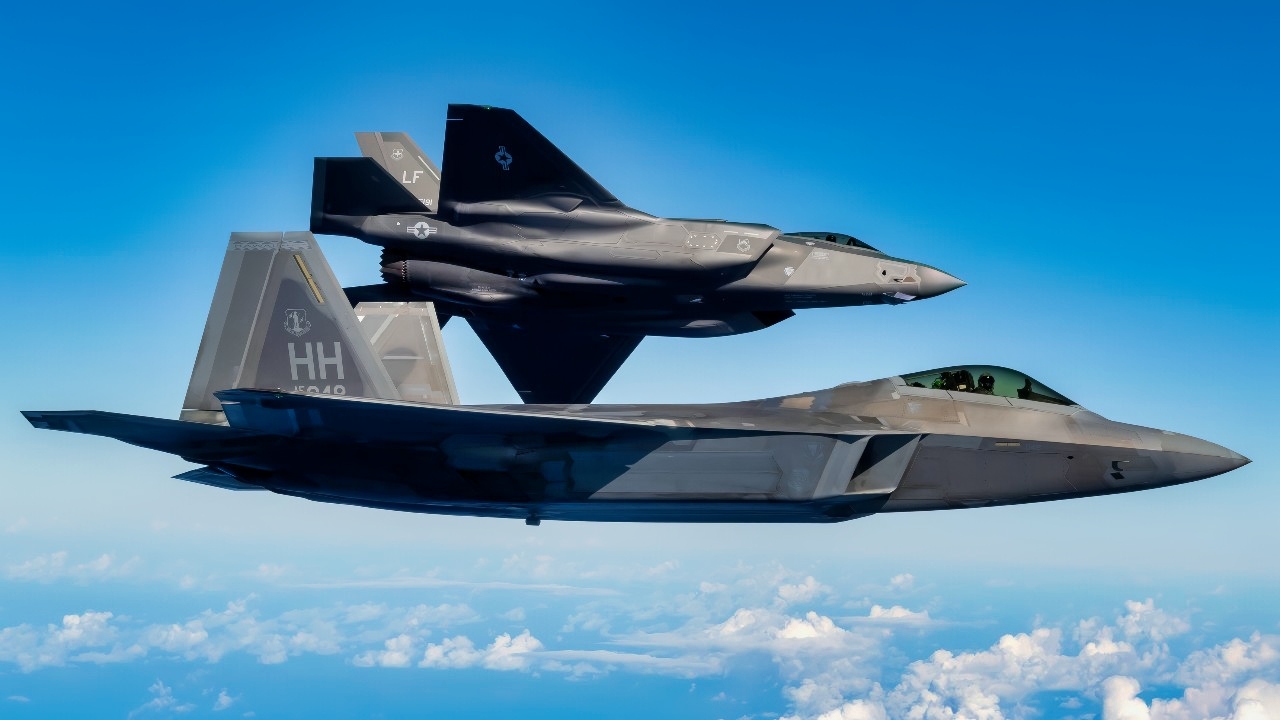
An F-35A Lightning II banks away from an F-22 Raptor Feb. 6, 2020, near the Hawaiian Islands. F-35 Airmen from Luke Air Force Base, Ariz., temporarily relocated to Joint Base Pearl Harbor-Hickam, Hawaii, to join other flying squadrons in exercise Pacific Raptor. Every training mission of the exercise was carried out by total-force teams from the Air Force’s Active, Reserve and Air National Guard components. (courtesy photo)
-The F-35B for the Marines: short takeoff/vertical landing to operate from small decks and rougher fields.
-The F-35C for the Navy: beefed-up carrier variant with larger wings and reinforced gear.
On paper, this “Joint Strike Fighter” approach promised commonality—shared parts, shared training pipelines, shared logistics. In reality, the complexity of making a single core design work across three very different operating environments added risk, weight, and cost.
Then there was concurrency.
Instead of finishing development and testing and then starting full-rate production, the United States did what it often does: it began building batches of jets while the design was still maturing, assuming software and hardware fixes could be rolled in as they went.
That decision saved time on the front end but created a hangover that we’re still paying for. Early F-35s have needed extensive retrofits. Software blocks slipped. The much-discussed TR-3 (Technology Refresh 3) and Block 4 upgrade packages, which unlock more weapons and capabilities, are arriving later and more expensively than advertised.
Every time you bolt new software and hardware onto a fleet of jets already rolling off the line, you’re paying for rework, integration, and test. That is how you inflate a lifetime bill.
The irony is that the F-35 is now finally reaching a level of maturity that critics assumed it had a decade ago. But the cost penalty from those early “build while we’re still designing it” years has already been baked into the cake.
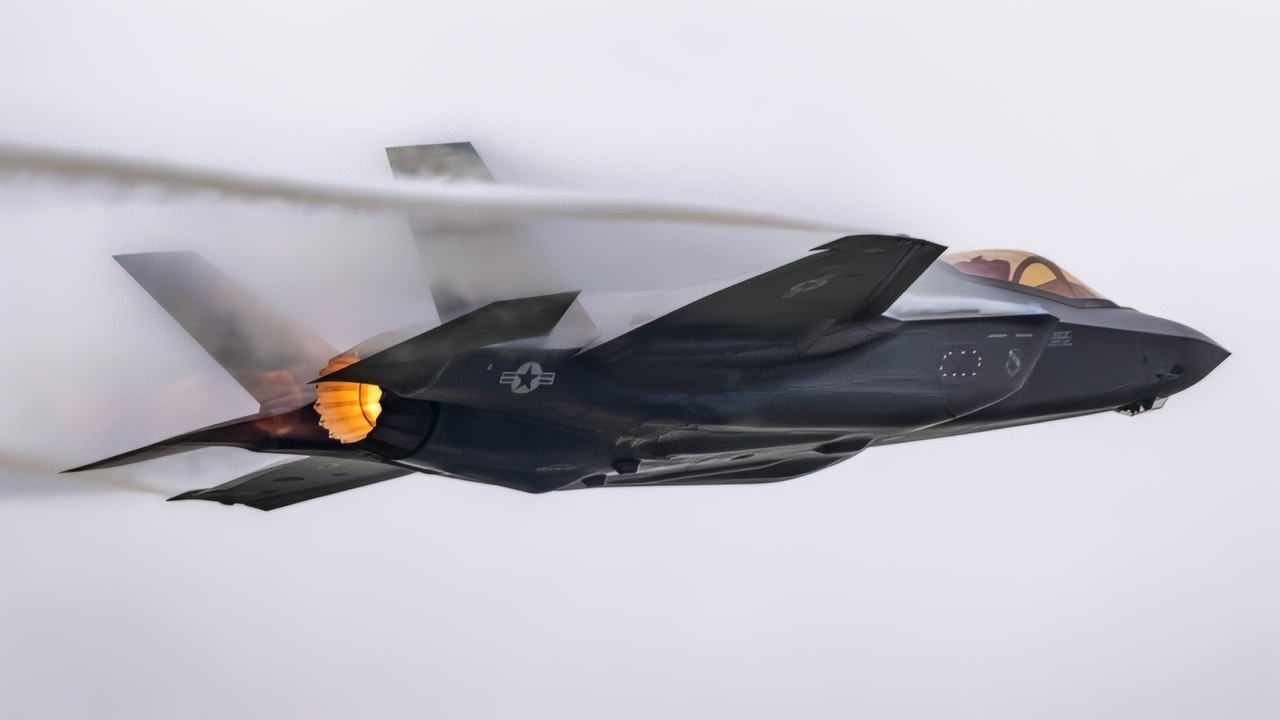
U.S. Air Force Maj. Kristin “BEO” Wolfe, F-35A Lightning II Demonstration Team pilot and commander, performs for F-135 engine maintainers assigned to the Oklahoma City Air Logistics Complex, at Tinker Air Force Base, Okla., May 25, 2021. The F-35A Demonstration Team put on the performance for the maintainers as a show of appreciation for keeping F-35s throughout the Department of Defense running and in the sky. (U.S. Air Force photo by Staff Sergeant Thomas Barley)
3. Stealth and Software Are Expensive to Own, Not Just to Buy
People love to argue about flyaway price—how much an F-35A costs “off the lot” compared to a Eurofighter or a Gripen. And yes, that sticker has come down over the years, into the $80–100 million range depending on variant and lot.
But the real money in the F-35 is not just in the jet you roll out of the hangar. It’s in the stealth and software you have to maintain for decades.
Stealth is not a one-time feature. You don’t paint a jet black and call it a day. Low-observable design means special materials, tight tolerances, sensitive coatings, and a never-ending regimen of inspections and repairs. Panels have to fit together just so. Radar-absorbent materials have to be applied, cured, and touched up under specific conditions. Any time you pop things open to fix something else, you risk degrading the signature and having to restore it.
That is not like running a 1970s F-4 out of a hardened shelter.
On top of that, the F-35 is essentially a flying server farm. Its primary advantage is not just that it’s hard to see; it’s that it hoovers up data from its own sensors and from other platforms, fuses that information into an intelligible picture, and pushes it out across the network.
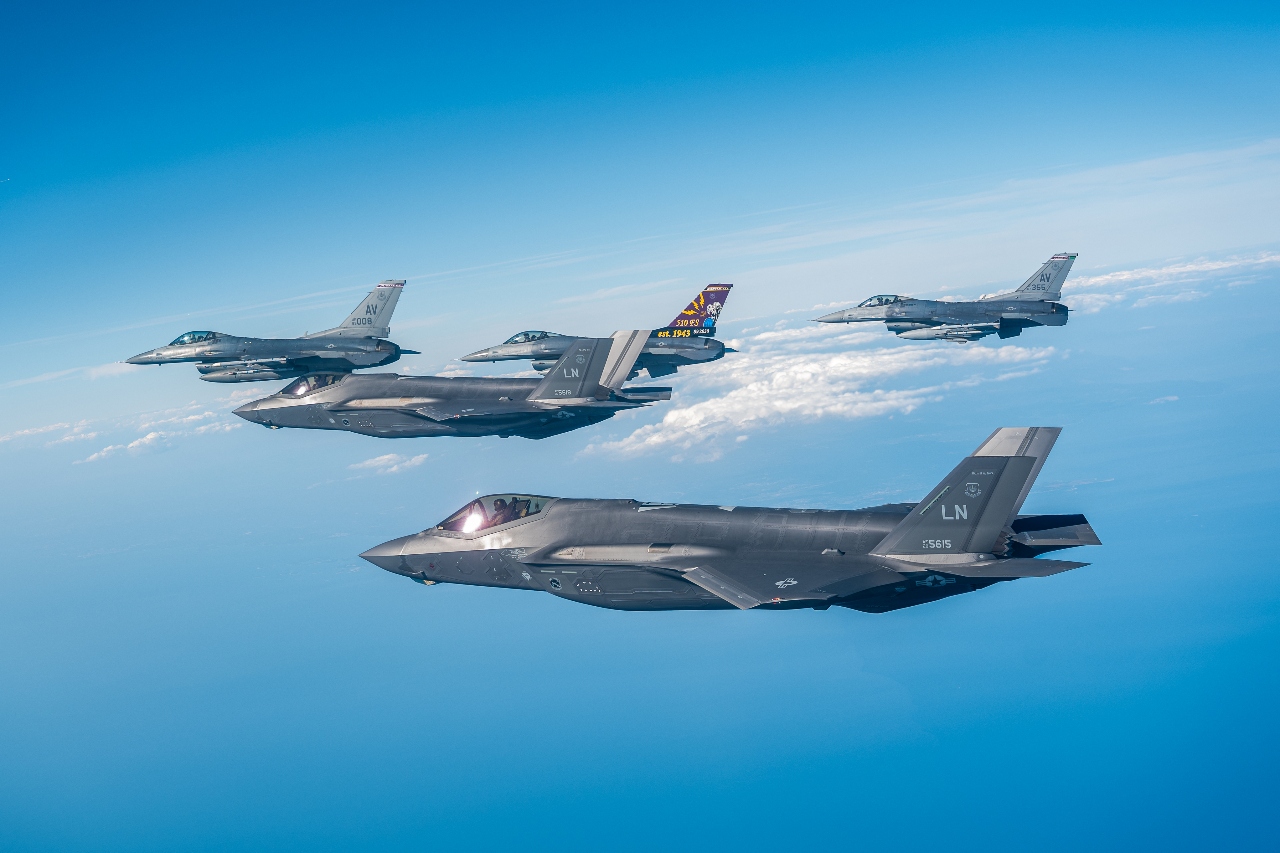
A formation of U.S. Air Force F-35 Lighting IIs and F-16 Fighting Falcons assigned to the 48th and 31st Fighter Wings respectively fly in formation as a part of Exercise Combined Strike along the coast of Italy, August 18, 2025. Exercises like Combined Strike ensure USAFE remains ready and postured to rely on one another to defend the area of responsibility. (U.S. Air Force photo by Senior Airman Zachary Jakel)
The “magic” here is software. And software is never done.
Every new threat radar, every new missile, every new targeting pod or weapon the services want to integrate means more code, more testing, more regression bugs, and more lab and flight time. Block 4 upgrades alone represent a major multi-year effort to expand weapons carriage, sensors, and electronic warfare options.
So when people ask why the F-35 costs so much, one answer is that they are buying and then constantly updating a flying software platform that can survive inside China’s and Russia’s kill zones. That doesn’t come cheap.
4. Sustainment to 2080: The Long Tail Is Where the Money Really Lives
If you look at the $2 trillion figure and break it down, you quickly see something important: the majority of that number is not procurement. It’s sustainment—keeping thousands of jets flying, combat-ready, and modernized over half a century or more.
Recent government reports put projected sustainment costs in the ballpark of $1.5–$1.6 trillion, and those figures have climbed over time as assumptions about flying hours, availability, and inflation have shifted. The acquisition slice, while large, is actually the smaller part of the pie.
Why is sustainment so heavy?

A U.S. Air Force F-22 Raptor assigned to Joint Base Langley-Eustis, Virginia, takes off during Checkered Flag 23-1 at Tyndall Air Force Base, Florida, Nov. 4, 2022. Checkered Flag is a large-force aerial exercise which fosters readiness and interoperability through the incorporation of 4th and 5th-generation aircraft during air-to-air combat training. The 23-1 iteration of the exercise was held Oct. 31 – Nov. 10, 2022. (U.S. Air Force photo by Tech. Sgt. Betty R. Chevalier)
First, the F-35 is not being treated as a short-lived bridge program. The U.S. services expect to fly these jets into the 2070s or even early 2080s. When you budget for operations and support over that kind of horizon, even seemingly modest annual costs add up.
Second, operating costs per flying hour, while improving, are still high. The F-35A’s cost per flight hour has trended down in recent years as the program works efficiencies, but it remains more expensive to fly than older fourth-generation jets in many cases. The B and C variants are even more demanding to operate, thanks to their STOVL and carrier-specific stresses.
Third, the logistics and sustainment system for the jet has had its own growing pains. The original ALIS (Autonomic Logistics Information System) was supposed to be a revolutionary digital backbone for maintenance and spares. In practice, it became infamous for glitches and reliability issues, forcing a transition to the newer ODIN system. Those kinds of resets cost real money and time.
Finally, there is the upgrade treadmill. You are not just keeping F-35s airworthy; you are continuously inserting new sensors, defensive systems, and weapons. That means repeated depot visits, software loads, test campaigns, and configuration management for an enormous fleet spread across multiple services and countries.
All of that sustainment work—the hangars, the spares, the depots, the software labs, the training and simulation infrastructure—is what fills out the trillion-plus dollar sustainment line.
It’s not glamorous, but it’s the bulk of the bill.
5. A Global Industrial Ecosystem Isn’t Cheap – But It Buys Power
The final reason is political and industrial more than technical: the F-35 is not just a jet, it is a global enterprise.
Production and sustainment touch thousands of suppliers and tens of thousands of jobs. Components are built in dozens of states and multiple partner nations. The engine is its own huge program. Every allied sale brings along training, base upgrades, weapons integration, and local industrial offsets.
That complexity adds friction. Coordinating deliveries, upgrades, and sustainment across the United States, Europe, and the Indo-Pacific is not simple. Hardening bases in Norway is different from hardening bases in Israel or Japan. Integrating a new user means tailoring training pipelines and support arrangements to their needs and politics.
But there is a strategic upside to that cost.
The F-35 has become the de facto standard for allied fifth-generation airpower. The United States, the U.K., Italy, the Netherlands, Norway, Denmark, Poland, Japan, South Korea, Australia, Israel, Finland, Canada (pending), and others are either flying it now or locked in to buy it. New customers are still joining the queue.
That does two things:
-It spreads the fixed costs of development and upgrades over a much larger fleet.
-It ties key allies more tightly into a common combat architecture that Washington leads.
When you see F-35s from multiple nations operating together in the Baltics or over the Pacific, you’re seeing more than a shared airplane. You’re seeing a shared sensor network, shared tactics, and a shared industrial commitment that has real deterrent value.
So yes, there is political pork in the program. But there is also a deliberate choice to anchor the Western world’s tactical airpower in a common, networked platform. You pay more up front for that. You get more long-term leverage in return.
So Is the F-35 Worth It?
None of this means we should shrug at a $2 trillion price tag.
There are valid criticisms: sustainment costs have risen faster than they should have. Availability rates have lagged. Concurrency created avoidable rework. The program has sometimes tried to be too many things to too many stakeholders, and paid for it in delay and complexity.
But step back and ask the strategic questions that actually matter.
Does the F-35 give the United States and its allies a level of survivability and situational awareness that older jets simply cannot match inside modern integrated air defense systems? Yes.
Does it consolidate and eventually replace a fractured mix of fourth-generation fleets with something that can actually outlast the China and Russia problem sets? Yes.
Has it become, for better or worse, the central pillar of Western tactical airpower—judging by how many serious air forces have chosen it over rival designs? Also yes.
You can see that last point in the market. Nations with real skin in the game—Israel, Japan, South Korea, the U.K., Italy, Finland, Norway, Poland, Australia, to name a few—have looked at their options and concluded that the F-35 is the best fighter they can realistically buy and integrate. They are not picking it as an act of charity. They are picking it because in a real war, they want what it brings: stealth, sensors, and the ability to plug into a larger kill web.
Is it the “best fighter on Earth”? You can argue edge cases—what about an F-22 in a pure air-to-air knife fight, or some hypothetical sixth-gen design down the road? But in terms of provable, fielded capability that combines survivability, sensing, networking, and multi-role flexibility, the F-35 has a hard claim to that title.
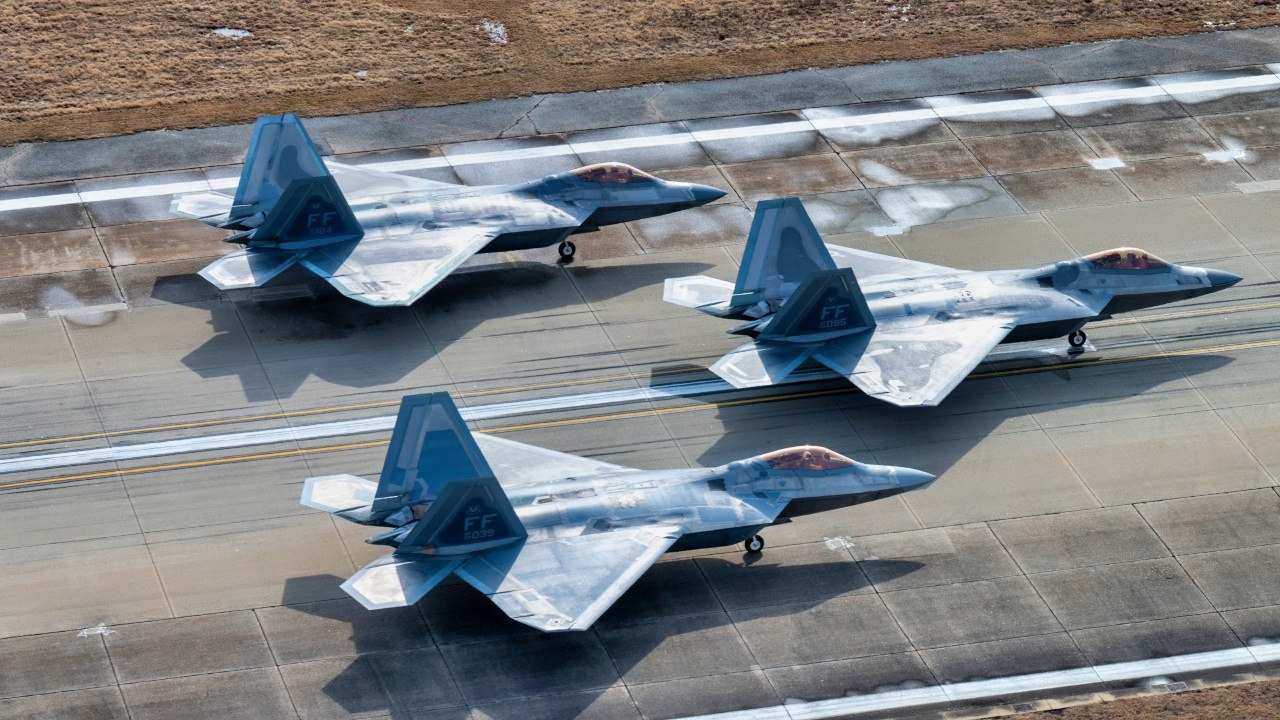
LANGLEY AIR FORCE BASE, Va. – F-22 Raptors from the 1st Fighter Wing sit in position on the runway fduring the Elephant Walk at Langley Air Force Base, Virginia, Jan. 31, 2025. The surge was designed to showcase the wing’s operational readiness and its ability to rapidly mobilize airpower. The 1st FW operates F-22 Raptors and T-38 Talons, maintaining combat capabilities that enable the U.S. Air Force to execute missions across the globe. With a focus on air superiority, the 1st FW plays a critical role in defending the nation’s interests. (U.S. Air Force photo by Tech Sgt. Matthew Coleman-Foster)

A U.S. Pennsylvania Air National Guard KC-135 Statotanker aircraft from the 171st Air Refueling Wing out of Pittsburgh provides fuel for a U.S. Air Force F-22 Raptor from Joint Base Langley–Eustis, April 2, 2025. The air refueling mission was part of routine proficiency training. (U.S. Air National Guard photo by Master Sgt. George Perkins)
The cost debate will—and should—continue. The pressure to drive down operating costs and improve availability is healthy. The Pentagon and Lockheed need to be forced to deliver on promises to cut cost per flying hour and stabilize software and sustainment.
But we should at least be honest about what that $2 trillion is buying.
It’s not just one airplane. It’s a global, long-term bet that Western airpower in the age of China and Russia will live or die on stealth, software, and networks. That is what the F-35 really is. And that, for better or worse, is why it costs so much—and why so many countries still line up to buy it.
About the Author: Harry J. Kazianis
Harry J. Kazianis (@Grecianformula) is Editor-In-Chief and President of National Security Journal. He was the former Senior Director of National Security Affairs at the Center for the National Interest (CFTNI), a foreign policy think tank founded by Richard Nixon based in Washington, DC. Harry has over a decade of experience in think tanks and national security publishing. His ideas have been published in the NY Times, The Washington Post, The Wall Street Journal, CNN, and many other outlets worldwide. He has held positions at CSIS, the Heritage Foundation, the University of Nottingham, and several other institutions related to national security research and studies. He is the former Executive Editor of the National Interest and the Diplomat. He holds a Master’s degree focusing on international affairs from Harvard University.


