

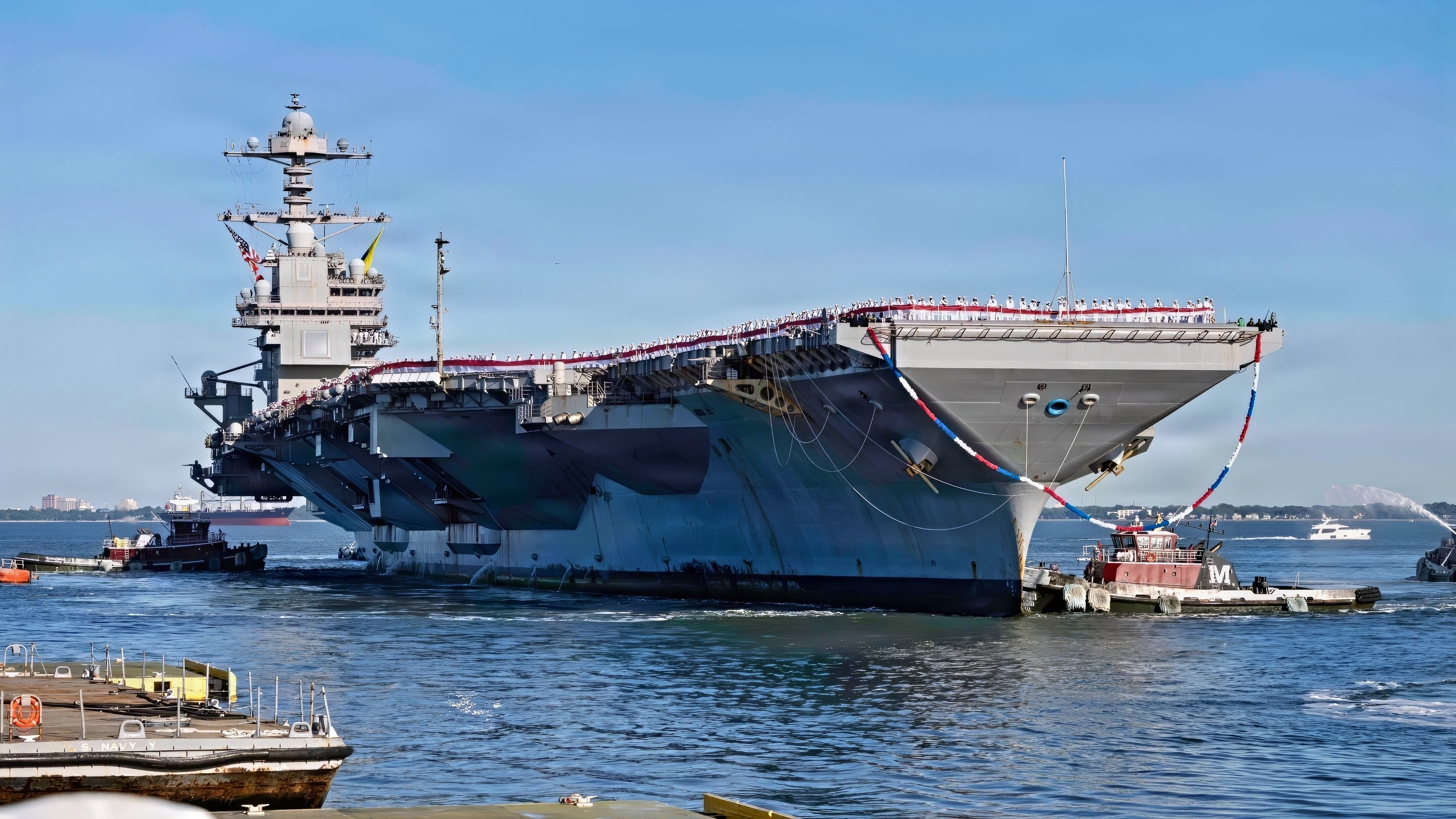
The world’s most expensive warship came home Saturday. And as one retired U.S. Navy commanding officer told me yesterday: “No one knows when she will sail again.” The USS Gerald R. Ford (CVN-78) pulled into Naval Station Norfolk on Saturday, May 16, 2026, ending the longest American carrier deployment since the Vietnam War.
The record speaks for itself: Three hundred and twenty-six days at sea. Four Atlantic crossings. Combat operations on two continents. Hundreds of strike sorties flown. Dozens of missiles were fired by her escorts. One major fire burned for 30 hours and forced 600 sailors out of their berthing compartments. Repeated breakdowns in the toilet system. A crew of 4,500 sailors held together by an extension that nobody planned for and that the chief of naval operations now says he never wants to repeat.

Ford-Class. Image Credit: Creative Commons

The Ford-class aircraft carrier USS Gerald R. Ford (CVN 78) and the Italian aircraft carrier ITS Cavour (CVH 550) transit the Atlantic Ocean March 20, 2021, marking the first time a Ford-class and Italian carrier have operated together underway. As part of the Italian Navy’s Ready for Operations (RFO) campaign for its flagship, Cavour is conducting sea trials in coordination with the F-35 Lightning II Joint Program Office’s Patuxent River Integrated Test Force to obtain official certification to safely operate the F-35B. Gerald R. Ford is conducting integrated carrier strike group operations during independent steaming event 17 as part of her post-delivery test and trials phase of operations. (U.S. Navy photo by Mass Communication Specialist 3rd Class Riley McDowell)
Clearly, the USS Gerald R. Ford has been through a lot. Now the bill comes due for all that service to the nation.
The USS Gerald R. Ford Is Home — Now The Navy Has To Figure Out What Eleven Months At Sea Did To Her
The Ford is the most technologically ambitious aircraft carrier ever built, the lead ship of the class that replaces the Nimitz fleet, and at $13.3 billion, the most expensive single warship in human history.
She is also a first-of-class platform — the prototype that every Ford-class hull behind her will learn from. Now she goes into the shipyard for an extended maintenance availability that nobody yet knows the full scope of, and the Navy goes back to a question it has been quietly asking for two years: in an era of long-range Chinese missiles, hypersonic threats, and proliferating drones, is the supercarrier still the right anchor for American power projection?
This is how the Ford got built, what she has been through, and what the next decade of carrier aviation looks like from where we sit today.
Why The Navy Needed Her
The Nimitz-class was the gold standard of American carrier aviation for nearly half a century. Ten ships were built between 1968 and 2006. The lead ship, USS Nimitz, entered service in 1975 and is currently transiting around Cape Horn on her final deployment before decommissioning. The youngest Nimitz, USS George H.W. Bush, commissioned in 2009 and will serve into the 2050s.
The problem was that the design was nearly 60 years old.
A 2005 RAND Corporation analysis cited by Naval Technology in its Ford-class assessment identified the structural limits of the Nimitz architecture. The hulls had insufficient electrical generation capacity for the next generation of combat systems. Decades of mid-life upgrades had added weight and eroded the center-of-gravity margin the original design required. Manning costs were rising as crew complement requirements stayed locked at roughly 5,000 sailors per hull, including the air wing. And the steam catapult system that had launched American carrier aircraft since the 1950s was beginning to bump against its operational ceiling — limiting aircraft weights, restricting sortie generation rates, and constraining future drone and unmanned aerial vehicle operations that the Pentagon believed were coming.
The CVN-21 program, eventually renamed the Gerald R. Ford-class, was designed to solve those problems. Per the Congressional Research Service’s most recent assessment of the program, the new design would generate more aircraft sorties per day, deliver more electrical power for future combat systems, and operate with several hundred fewer sailors than a Nimitz. Fifty-year life-cycle operating and support costs were projected to fall by roughly $4 billion per hull compared to the Nimitz design.

The world’s largest aircraft carrier USS Gerald R. Ford (CVN) 78 and the USNS Laramie (T-AO-203) conduct a refueling-at-sea in the Eastern Mediterranean Sea, Oct. 11, 2023. USS Gerald R. Ford is the Navy’s newest and most advanced aircraft carrier, representing a generational leap in the U.S. Navy’s capacity to project power on a global scale. The Gerald R. Ford Carrier Strike Group is currently operating in the Eastern Mediterranean Sea, at direction of the Secretary of Defense. The U.S. maintains forward deployed ready and postured forces to deter aggression and support security and stability around the world.(U.S. Navy photo by Mass Communication Specialist 2nd Class Jackson Adkins)
The Navy currently plans to procure at least six Ford-class carriers. CVN-78 Gerald R. Ford was followed by CVN-79 John F. Kennedy (scheduled to commission in March 2027), CVN-80 Enterprise (July 2030), CVN-81 Doris Miller (February 2032), CVN-82 William J. Clinton (2040), and CVN-83 George W. Bush (2043). The FY2026 budget requested approximately $3.4 billion in procurement and advance procurement funding for the program.
Design And The Technologies That Caused The Trouble
The Ford-class hull is based on the Nimitz hull form but is fundamentally a different ship. Approximately 100,000 tons full-load displacement. 333 meters long. 78-meter flight deck width. Two new-design A1B nuclear reactors generating more than 100 megawatts of electrical power — more than three times the 30 MW that the Nimitz reactors produced. A redesigned island, shorter and shifted further aft, designed to free flight deck space and accommodate the dual-band radar suite that was originally intended for the Zumwalt-class destroyers.
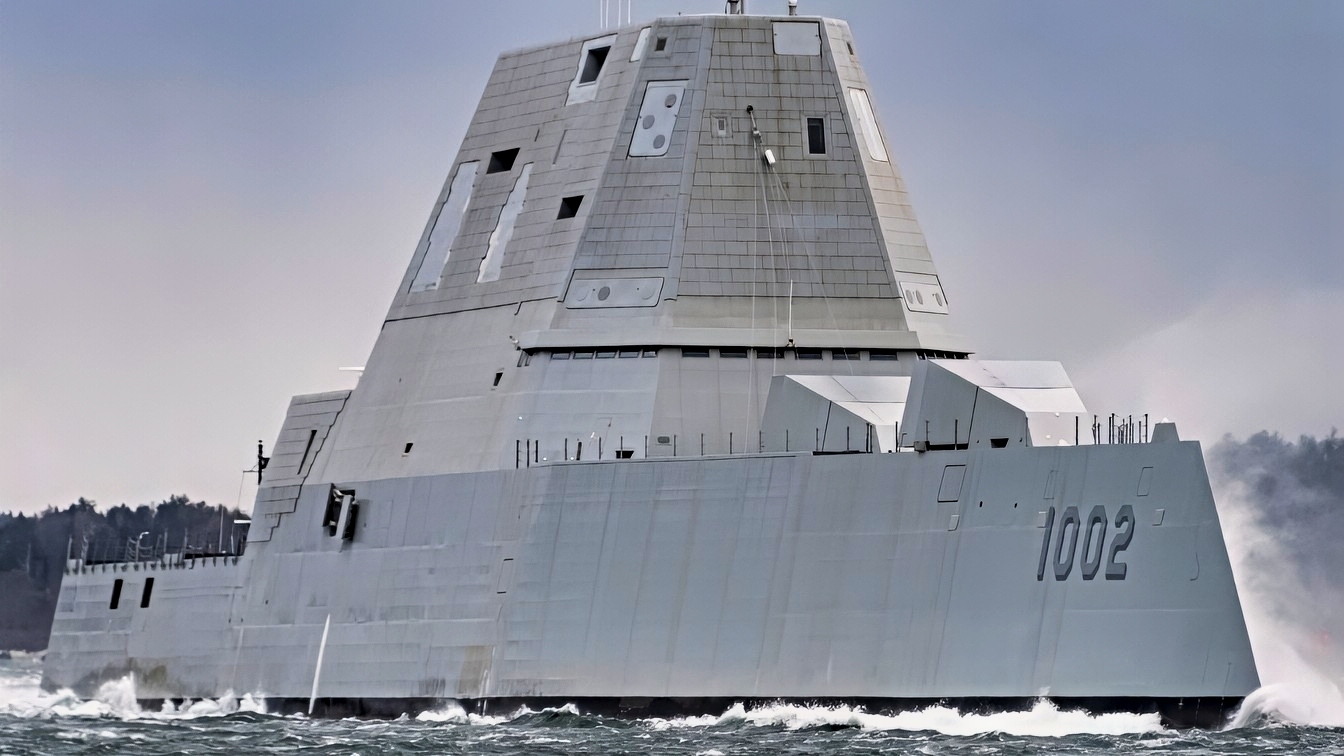
Zumwalt-Class Destroyer U.S. Navy
The Defense Aerospace Report’s detailed analysis of the Ford program identified four major new-technology systems that drove the cost and schedule problems: the Electromagnetic Aircraft Launch System (EMALS), the Advanced Arresting Gear (AAG), eleven Advanced Weapons Elevators, and the Dual-Band Radar. Defense Secretary Donald Rumsfeld ordered all four installed on the lead ship over significant Navy reservations and recommendations against doing so — a decision the Navy’s own operational testing community would spend more than a decade trying to recover from.
EMALS was the most consequential. The system uses a linear induction motor with electromagnets to accelerate aircraft for launch, replacing the steam catapult that American carriers had used since the 1950s. The advantages are real: smoother launches that reduce airframe stress, capability to launch heavier and lighter aircraft across a wider weight range, lower maintenance burden, and elimination of the freshwater steam generation infrastructure that steam catapults required. EMALS can theoretically generate 25 percent more sorties than the older system.
The reliability problem was worse than advertised. The Pentagon’s Director of Operational Test and Evaluation reported in 2017 that EMALS and AAG would not attain the minimum required reliability until more than 10 years after CVN-78 delivery. The ship’s design did not allow electrical isolation of individual EMALS motor-generators, which meant maintenance could not be performed on one launcher while flight operations continued from another. A single EMALS motor-generator takedown required 1.5 hours just to electrically isolate the equipment.
GlobalSecurity’s assessment of the program found that only 4 of CVN-78’s 17 critical technologies were fully mature as of a March 2007 GAO report. The Multi-Function Radar, the high-strength alloy steel, the new desalination system, and the nuclear propulsion plant were ready. EMALS, AAG, the Plasma Arc Waste Destruction System, the Volume Search Radar, and most of the other developmental systems were not.
The Navy was building a $13 billion warship using technologies that were not yet complete.
The Construction And What It Cost
Construction of CVN-78 began at Newport News Shipbuilding in November 2005 — the same yard that had built every previous American supercarrier. The hull was completed and launched in 2013. Commissioning was originally scheduled for 2014, then 2015, then 2016. The ship was delivered to the Navy in May 2017 and commissioned on July 22, 2017.
The cost story is its own institutional embarrassment. The original Congressional cap on construction costs was $12.9 billion. The final price tag exceeded $13 billion. Per the USS Halford Official retrospective on the program, the Ford became the most expensive warship ever built, a title she retains today. Total development and construction costs across the program — including the testing, retrofits, and post-delivery work that has continued for nearly a decade — push the real figure substantially higher, with some analysts estimating the all-in cost at $15 billion or more.
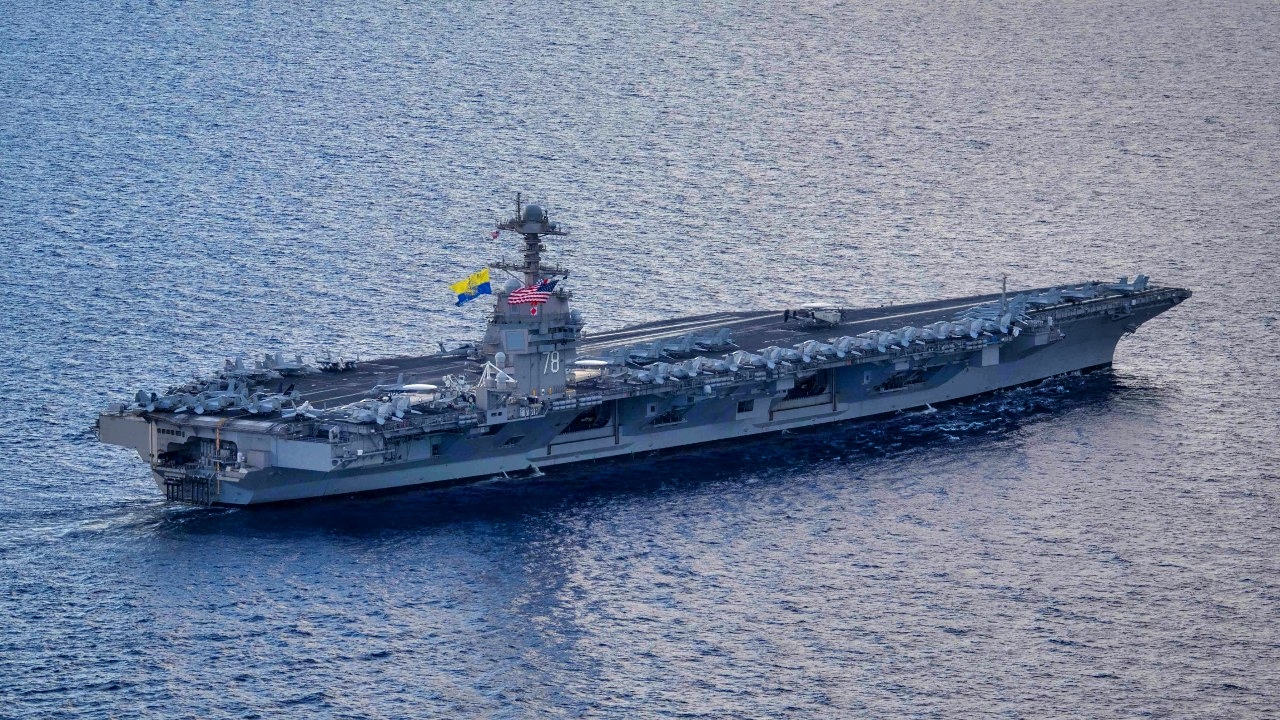
The world’s largest aircraft carrier USS Gerald R. Ford (CVN 78) sails in the Mediterranean Sea, Dec. 31, 2023. The U.S. maintains forward deployed, ready, and postured forces to deter aggression and support security and stability around the world. (U.S. Navy photo by Mass Communication Specialist 2nd Class Jacob Mattingly)
The delivery was technically on time. The ship was nowhere near ready for combat. The post-shakedown availability began in July 2018 and ran for years, working through EMALS reliability fixes, AAG modifications, weapons elevator certifications, dual-band radar testing, and the dozens of smaller problems that emerge when a first-of-class ship encounters real-world operating conditions.
The Advanced Weapons Elevators alone — designed to move ordnance from below-deck magazines to the flight deck more efficiently than the older systems — were not all certified as operational until well after commissioning.
What She Has Done
The Ford’s operational record is more impressive than its construction record suggests.
She made her first deployment in October 2022 to the Atlantic and Mediterranean — a roughly six-month cruise that demonstrated the carrier could actually launch and recover aircraft at the design sortie rates. Her air wing flew thousands of sorties without a major incident. The deployment was deliberately scheduled as a relatively low-intensity validation cruise, but it did exactly what the Navy needed: prove that the platform worked.
The October 2023 deployment was different. After the Hamas attacks on Israel on October 7, 2023, the Ford was rapidly forward-deployed to the Eastern Mediterranean to deter regional escalation. She spent more than seven months in the region, the longest single carrier deployment of the post-9/11 era at the time, providing a continuous American naval presence during the Israel-Hamas war’s most volatile phase.
The current deployment is what made the Ford a household name.
She left Norfolk on June 24, 2025, for what was supposed to be a standard seven-month rotation to U.S. European Command. By the time she returned home on May 16, 2026, the deployment had lasted 326 days — 11 months. According to Navy Times reporting on her return, the Ford broke the post-Vietnam carrier deployment record on April 15, 2026, when she surpassed USS Abraham Lincoln’s 2020 deployment of 295 days. USS Nimitz had been at sea longer during the COVID-19 era — 341 days in 2020 and 2021 —, but that figure included extended quarantine periods that kept the ship effectively in port for most of the stretch. The USS Midway still holds the all-time post-WWII record at 332 days during the Vietnam War.
The Ford’s eleven months included combat operations in two distinct theaters. She participated in U.S. Southern Command operations in the Caribbean in late 2025, including the naval buildup that culminated in the capture of former Venezuelan President Nicolás Maduro. She crossed back into the Mediterranean in early 2026. When Operation Epic Fury opened on February 28, 2026, the Ford was forward-deployed and immediately tasked with the Iran war. Her air wing, equipped with F/A-18E/F Super Hornets, E-2D Hawkeyes, and EA-18G Growlers, flew strike and electronic warfare missions across Iran. The carrier supported the suppression of Iranian air defenses and the strike campaign against Iranian nuclear and military infrastructure.
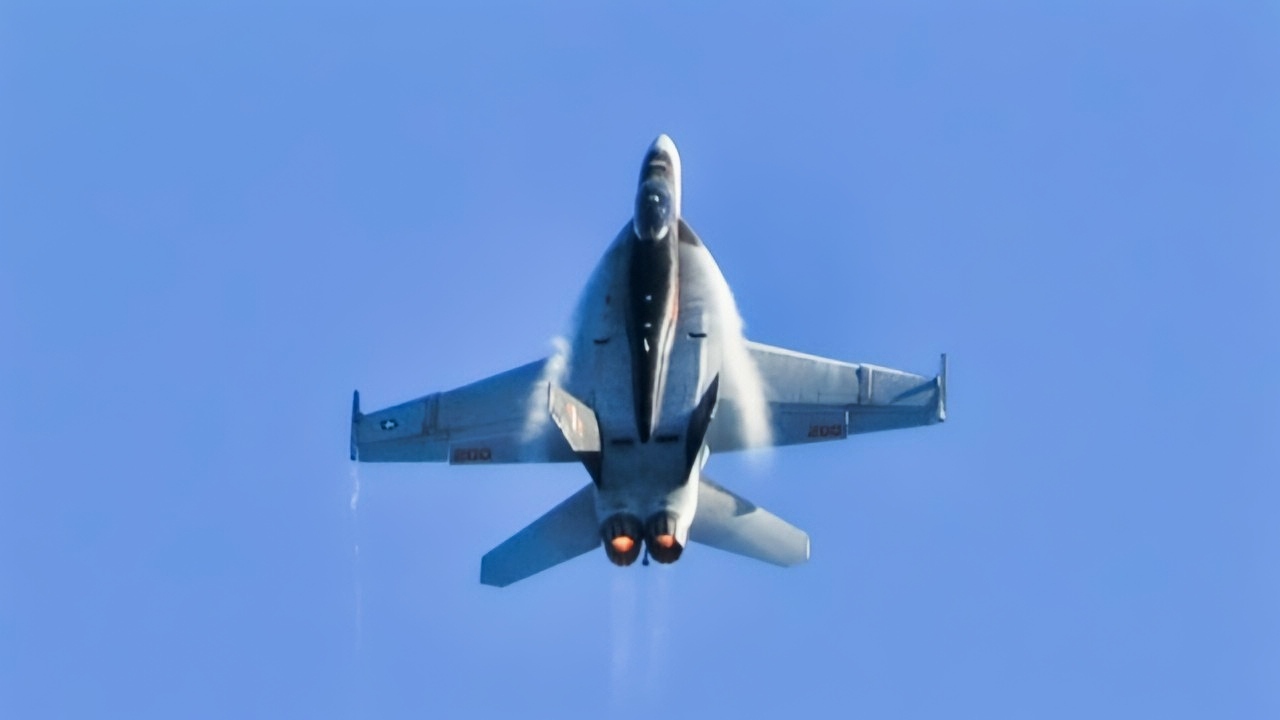
A U.S. Navy F/A-18E Super Hornet aircraft assigned to Strike Fighter Squadron (VFA) 147 performs maneuvers above the aircraft carrier USS Nimitz (CVN 68) during the departure of Carrier Air Wing (CVW) 11 Dec. 10, 2013, in the Pacific Ocean. CVW-11 fixed wing aircraft flew off the Nimitz to return home after being deployed to the U.S. 5th, 6th and 7th Fleet areas of responsibility. (U.S. Navy photo by Mass Communication Specialist Seaman Apprentice Kelly M. Agee/Released)
The mission also included one of the most consequential incidents in the carrier’s young operational life.
On March 12, 2026, a fire broke out in Ford’s laundry compartment in the Red Sea. The blaze burned for approximately 30 hours, damaged multiple berthing compartments, displaced 600 sailors from their bedroom spaces, and injured three service members. The ship broke off Red Sea operations and made an emergency port call at Souda Bay, Crete, from March 23 to March 26 for emergency repairs. From Souda Bay, she made a logistics stop at Split, Croatia, before returning to combat operations. Flight operations resumed within two days of the fire.
The deployment also produced repeated mechanical issues with the carrier’s toilet system, according to homecoming reporting from local news outlets. The toilet problem might sound minor. It was not. The vacuum-based plumbing system on the Ford requires substantial maintenance that the ship was not in port to perform. Crew quality of life took a serious hit during the extended deployment.
What The Repair Bill Looks Like
Here is the question the Navy is now living with: what did 326 days at sea actually cost the platform?
According to Stars and Stripes’ coverage of the Ford’s return, Chief of Naval Operations Adm. Daryl Caudle has stated publicly that he does not want this deployment length to become a precedent. “We really want to deploy our ships for the length of time they’re designed to,” Caudle told CNN. Aircraft carriers are designed for seven-month deployments. The Ford did eleven.
Janes defense analyst Michael Fabey, quoted in the Stars and Stripes coverage, framed the repair uncertainty bluntly: “Lord knows what problems they will find. There are a lot of unknowns. And not a lot of extra spare parts around for repairs.”
That assessment captures the structural issue. The Ford is a first-of-class ship. The spares pipeline is thinner than it is for the Nimitz-class hulls that have been in service for decades. Specialized parts for EMALS, AAG, the Advanced Weapons Elevators, the Dual-Band Radar, and the dozens of other developmental systems aboard are not on shelves at every Navy supply depot. When a Ford-class system breaks in ways the engineering community has not seen before, the fix must be engineered and manufactured before it can be installed.
The known damage list is substantial. Repair of the laundry compartment and the surrounding berthing spaces from the March 12 fire. Restoration of the ventilation ducting and electrical wiring that had taken heat. Comprehensive teardown and component replacement of EMALS and AAG components that ran at combat tempo for months. Reactor maintenance windows that would normally have been worked into shorter deployment cycles. Hull, paint, and anti-fouling work that requires dry dock time. Weapons elevators, plumbing, refrigeration, and habitability systems have been running on workarounds throughout the deployment.
The realistic timeline runs anywhere from six to twelve months of intensive availability work. The Navy has not publicly disclosed the planned scope or duration of Ford’s post-deployment maintenance period. Per Stars and Stripes, Navy officials in Norfolk on Saturday focused on the homecoming and deflected questions about what comes next.
The Aircraft Carrier Future Debate
The Ford’s deployment has reopened the carrier debate inside the U.S. Navy.
The supercarrier was the indispensable platform for American power projection throughout the post-World War II era. No other nation came close to fielding a comparable capability. The carriers won the Pacific, anchored Cold War deterrence in the Mediterranean and the Western Pacific, and projected American airpower into every major regional conflict from Korea through the global war on terror.
The 2020s have introduced threats that the previous carrier generation never had to contend with. Chinese DF-21D and DF-26 anti-ship ballistic missiles can hold carriers at risk at ranges of more than 1,500 kilometers from the Chinese coast. Hypersonic glide vehicles compress the engagement timeline below what the carrier’s defensive screen can effectively manage. Long-range Russian and Chinese submarines threaten carrier strike groups in waters where they previously operated with relative impunity. Cheap drone swarms, demonstrated in the Red Sea and the Strait of Hormuz, can saturate the air defense umbrella around a carrier with mass and persistence that the previous generation of anti-air systems was never designed to handle.

DF-17 Missile from China. Image Credit: PLA.
The Ford-class is being built around the assumption that the carrier remains the right platform for the next generation of warfare. Improved sortie rates, better defensive systems, more electrical power for future directed-energy weapons and high-bandwidth networking, and reduced manning requirements all assume the basic platform concept is sound. The longer-range F/A-XX sixth-generation fighter, scheduled for Navy contract award in August 2026, is designed specifically to extend the carrier’s reach beyond the Chinese A2/AD engagement envelope.
The critics — including a growing number within the Navy itself — argue that the asymmetry between a $13 billion carrier and a $200 million anti-ship missile has crossed the threshold at which the cost-exchange ratio no longer favors the carrier. The Ford is an extraordinary engineering achievement. She may also be the last generation of carriers that makes operational sense in the threat environment her successors will face.
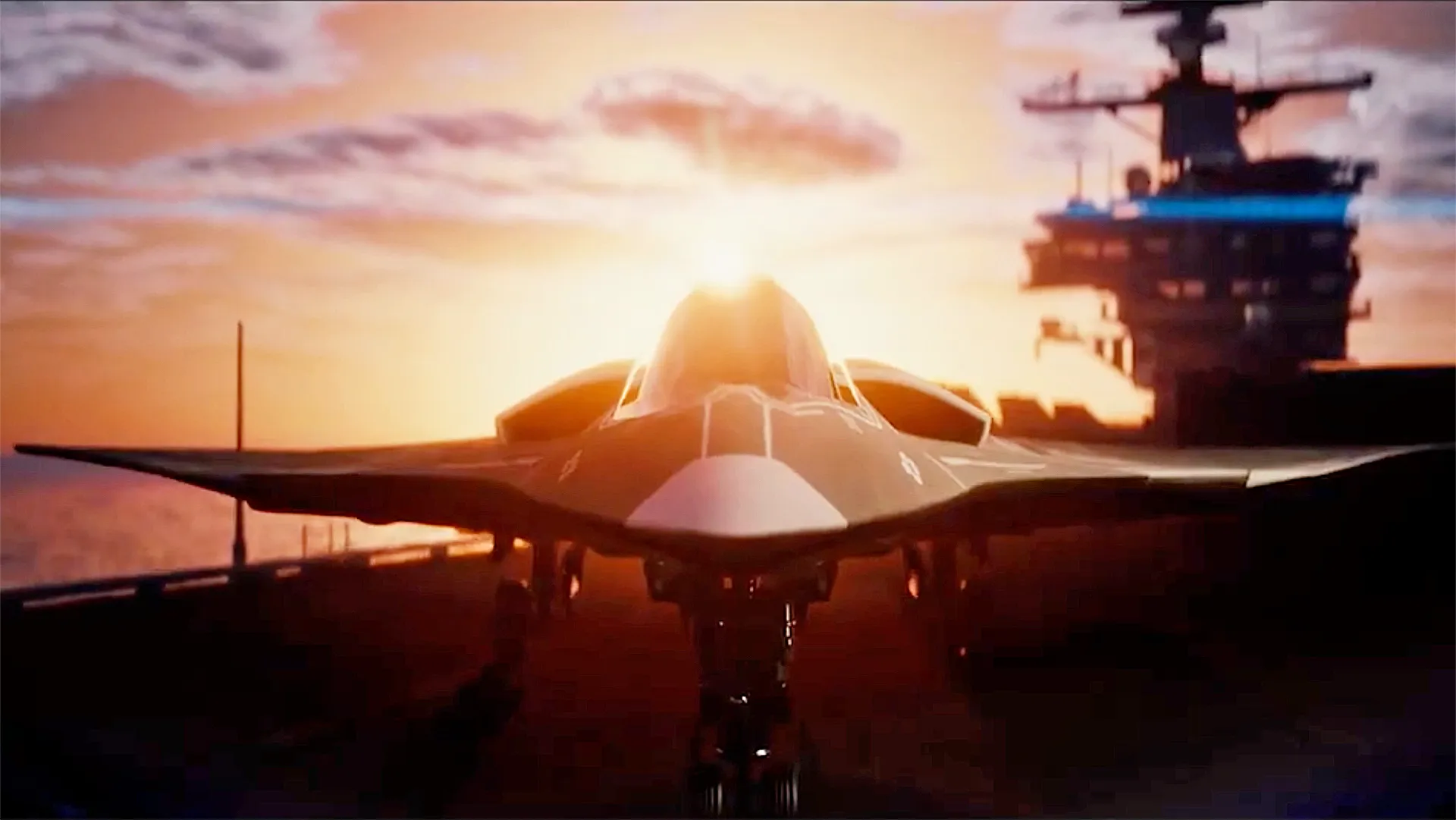
FA-XX. Northrop video screenshot.
That debate won’t be resolved by Ford’s repair availability. But the availability is when the Navy gets its first real look at what eleven months of continuous combat operations did to the platform — and that data will shape every decision about the rest of the Ford-class procurement plan, including whether CVNs 82 and 83 (Clinton and Bush) get built at all on the current schedule.
The carrier era is not over. But the U.S. Navy has some big calls to make in the immediate future. Watch this space.
About the Author: Harry J. Kazianis
Harry J. Kazianis (@Grecianformula) was the former Senior Director of National Security Affairs at the Center for the National Interest (CFTNI), a foreign policy think tank founded by Richard Nixon based in Washington, DC. Harry has over a decade of experience in think tanks and national security publishing. His ideas have been published in the NY Times, The Washington Post, The Wall Street Journal, CNN, and many other outlets worldwide. He has held positions at CSIS, the Heritage Foundation, the University of Nottingham, and several other institutions related to national security research and studies. He is the former Executive Editor of the National Interest and the Diplomat. He holds a Master’s degree focusing on international affairs from Harvard University. Kazianis is Editor-In-Chief of 19FortyFive.


